We Are Not Alone

Bill Diamond
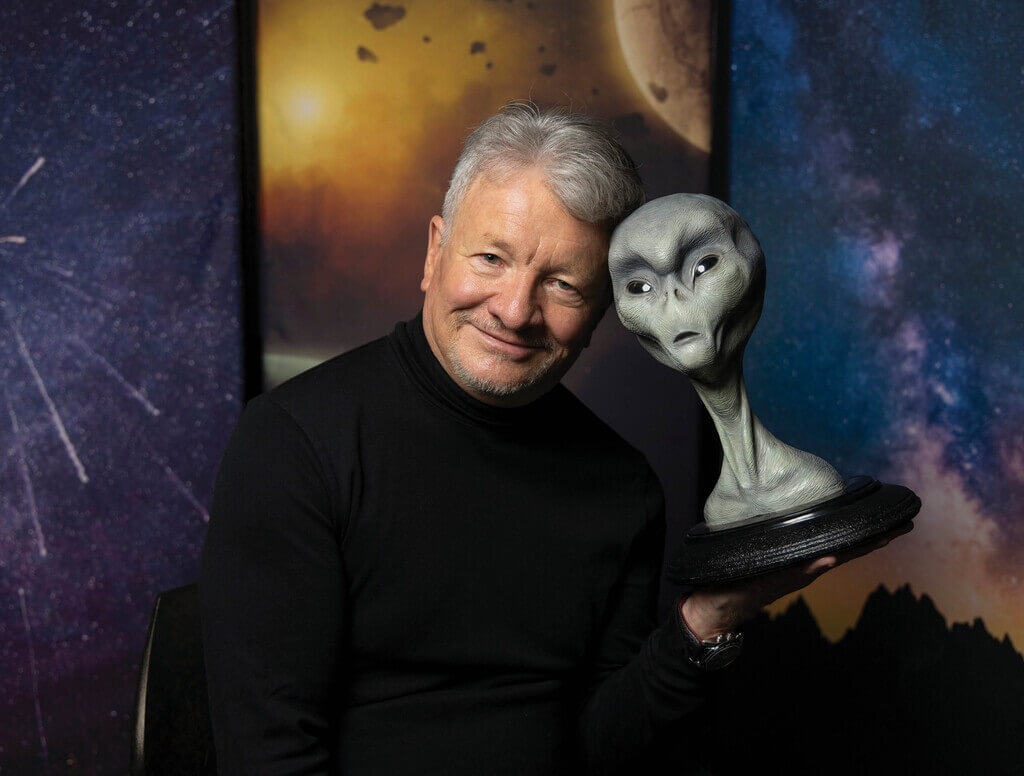
William H. “Bill” Diamond Jr. ’78, president and CEO, photographed at the SETI Institute in Mountain View, California.

William H. “Bill” Diamond Jr. ’78, president and CEO of the SETI Institute, says the truth is out there, but it’s likely not what you think.

We are not alone in the universe. 

It’s a conversation-stopper of a statement and one that William H. “Bill” Diamond Jr. ’78, president and CEO of the SETI Institute, is confident in making. 

SETI is the acronym for the Search for Extraterrestrial Intelligence, and the SETI Institute has been looking for proof of whether we’re alone in the universe since 1984. Among its many research activities, the organization uses radio telescopes to scan for engineered signals transmitted from elsewhere in the universe as a proxy for life and intelligence. Diamond has been president, CEO and chief cheerleader for the nonprofit since 2015, which means on occasion he’s referred to as the “world’s chief alien hunter” (The Telegraph, 2026).

Now, Diamond’s not saying that we should expect extraterrestrial contact of the “Close Encounters” kind; rather, that, statistically speaking, the probability of life existing elsewhere in the universe is very high. 

“What I tell people is that the reality of the scientific search for life beyond Earth is far more fascinating and more compelling than the nonscientific notion of aliens in our airspace,” Diamond says. “Get to know what’s really going on and where this question of life in the universe really stands, and you’ll be both amazed and excited.” 

A businessman and CEO several times over, Diamond’s tenure at SETI has brought financial stability and increased visibility to the institute, which, in turn, has allowed it to grow from some 70 scientist-explorers to 120 working in the following research areas:

  • Astrobiology
  • Astronomy & astrophysics
  • Climate & geoscience
  • Advanced data analytics
  • Heliophysics (the physics of the sun and its impact on the solar system)
  • Exoplanets (planets outside our solar system)
  • Planetary exploration
  • Radio & optical SETI (the search for the aforementioned engineered technology as a proxy for intelligent life elsewhere in the universe)

NASA funds much of the work of SETI’s scientist-explorers, though the particular science of looking for extraterrestrial technology is privately funded.

You won’t hear colleagues and friends using words like “visionary” or “pioneer” to describe Diamond. Praise is plainspoken: He’s great with people and numbers. He’s spontaneous — and responsible. He’s the kind of guy who looks you in the eye. He does what he says he’s going to do. He loves science and speculation. He can laugh at being called the world’s chief alien hunter. He’s the kind of friend and colleague you keep for 50 years. 

He’s comfortable with not having all the answers, which, in Diamond’s line of work, is kind of a nonnegotiable, anyway. 

“Science is about asking questions — and most importantly, asking the right questions,” Diamond is fond of saying. “You know you’re doing good science when every time you get an answer, you raise 10 or 100 new questions.”

‘I WAS THE WEIRD ONE, THE BLACK SHEEP IN THE FAMILY’ 

Over his career, Diamond has served as CEO and/or president of several technology companies, mostly in the telecommunications sector. He does not have one of those hostage-to-the-pull-of-space origin stories you expect of a person running one of the world’s best-known space research endeavors, though he did have a space helmet as a kid, admired Spock and Captain Kirk, and watched the Mercury, Gemini and Apollo missions with the appropriate amount of appreciation and awe for his generation.

Diamond grew up in a family of scholars and creatives outside of Boston in Reading, Massachusetts. His was a middle-class upbringing: modest house, big neighborhood, lots of kids, lots of activity. His father, William H. Diamond Sr. ’43, was a town lawyer who worked mainly on civil cases. 

Mom, Marie, was a Wellesley College-educated art historian who worked at the Boston Museum of Fine Arts and taught at Boston College and Berklee College of Music. The three other Diamond children are classic humanities types, scholars and artists: One sister is the chair of directing at Yale University’s David Geffen School of Drama; another is a retired head of the English department at the Boston Latin School. Diamond’s younger brother, a former journalist, recently retired from a communications role at the World Bank.
Image
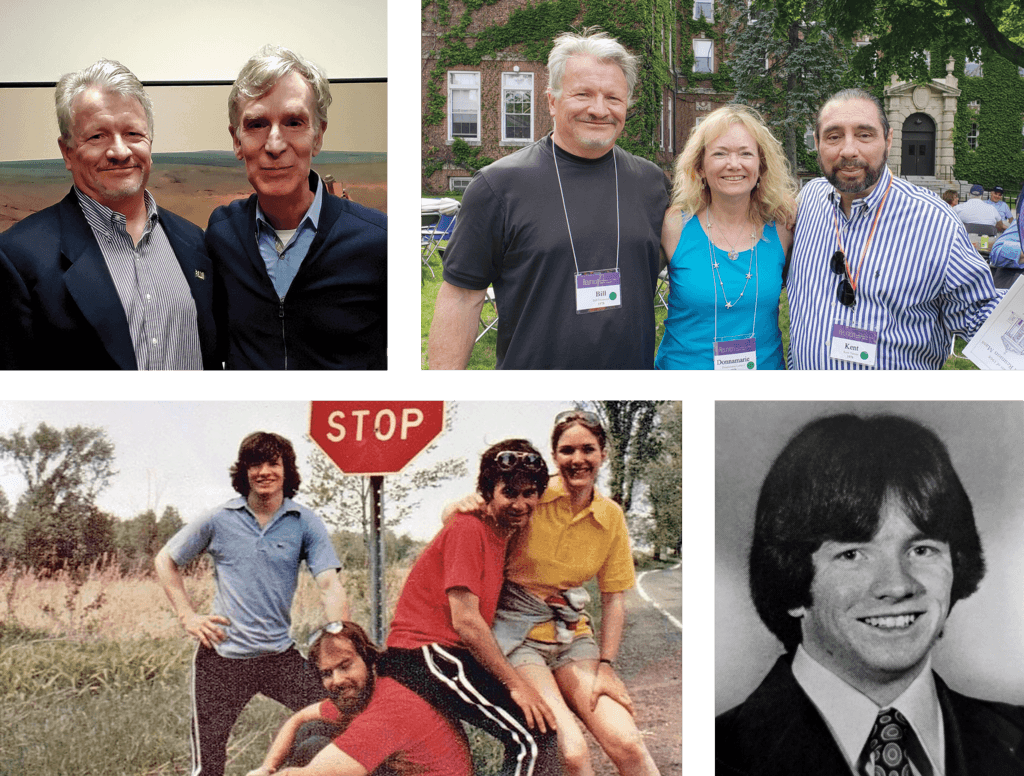
Collage of Bill Diamond and friends
(clockwise from left) With William Sanford Nye — aka, Bill Nye the Science Guy; with classmates Donnamarie Larievy and the late Kent Ozman at their 40th reunion; Diamond’s Purple Patcher photo; on a bike trip with Ralph Megna ’77 (bottom) in May 1977.

“I was the weird one, the black sheep in the family,” he says. “Our family gatherings always involved enthusiastically delivered and wonderfully appreciated updates of our latest exploits and achievements. But my updates about lasers, fiber optics, photonics and optical communications were generally met with confused looks.”

Diamond loved science from junior high school on. He thought he wanted to be a geneticist, but became passionate about physics in high school. He entered Holy Cross as a physics major on the premed track, but left pre-med after being introduced to lasers and photonics, the science and technology of generating and using light to transmit information. In the summer of his junior year, Diamond was working on a National Science Foundation-funded research project led by beloved physics professor Harry Gunther. Diamond was one of six students studying particulate air pollution.

“My physics colleagues and I were using lasers to make measurements of particulate air pollution across highways around Worcester,” he says. “The chemists on the team sucked air through filter paper and analyzed the composition of what was captured.”

A chance phone call made to Laser Analytics in Lexington, Massachusetts — Diamond had questions about laser spectroscopy and thought someone there might have answers — landed the then-rising senior a job offer. After graduation, he accepted and worked in the company’s laser spectroscopy lab, a job that took him all over the world: to the engine research lab at Mercedes-Benz in Stuttgart, Germany, as well as to Switzerland and Asia.

‘HIS JOB IS TO KEEP HOPE ALIVE’ 

Laser Analytics’ owner, Ken Nill, an MIT-educated Ph.D. and electrical engineer, was one of Diamond’s first bosses. The pair have been friends for more than half a century, in part because Nill thought of Diamond whenever he founded a new company. And there have been several over the years. Nill’s voice registers an almost paternal fondness for Diamond. 

“Bill ended up in my first, second and third companies, and then Bell Laboratories, and then he headed off in another direction,” Nill says. He laughs, “The next thing I know, he’s working for SETI.”

It could be said that Nill was instrumental in priming Diamond for SETI success. Early on, Diamond expressed his intention to pursue a physics Ph.D., but Nill steered him toward an MBA. Get a Ph.D. in physics and you’ll be an administrator, either a department head or the head of R&D somewhere, Nill told Diamond. Get your MBA, and you’ll be the guy with the business background who understands the science. 

“All these companies around Boston are either run by technologists or scientists who don’t understand business, or they’re run by business people who don’t understand science,” Diamond recalls Nill saying. “You’ve got the science; go get the business.” 

Diamond applied to Georgetown’s business school in its inaugural year. He got in. 

“I watched his coming of age in the business world. He’s a very bright and capable guy and willing to do anything,” Nill says. “I think Bill is in a good place. He’s such an extrovert. He can read and relate to people.”

This gregariousness and connectivity make Diamond an excellent emissary for the work in which the SETI Institute is engaged, Nill says. And it should be said that this 86-year-old is a staunch skeptic when it comes to the likelihood of humankind connecting with a technologically savvy alien civilization. 

Though he’d like to be proven wrong. 

“Hope springs eternal; I’d love to be surprised,” Nill says. “Bill’s enthusiasm, I’m sure, is what holds that place together. His job is to keep hope alive.”
Image
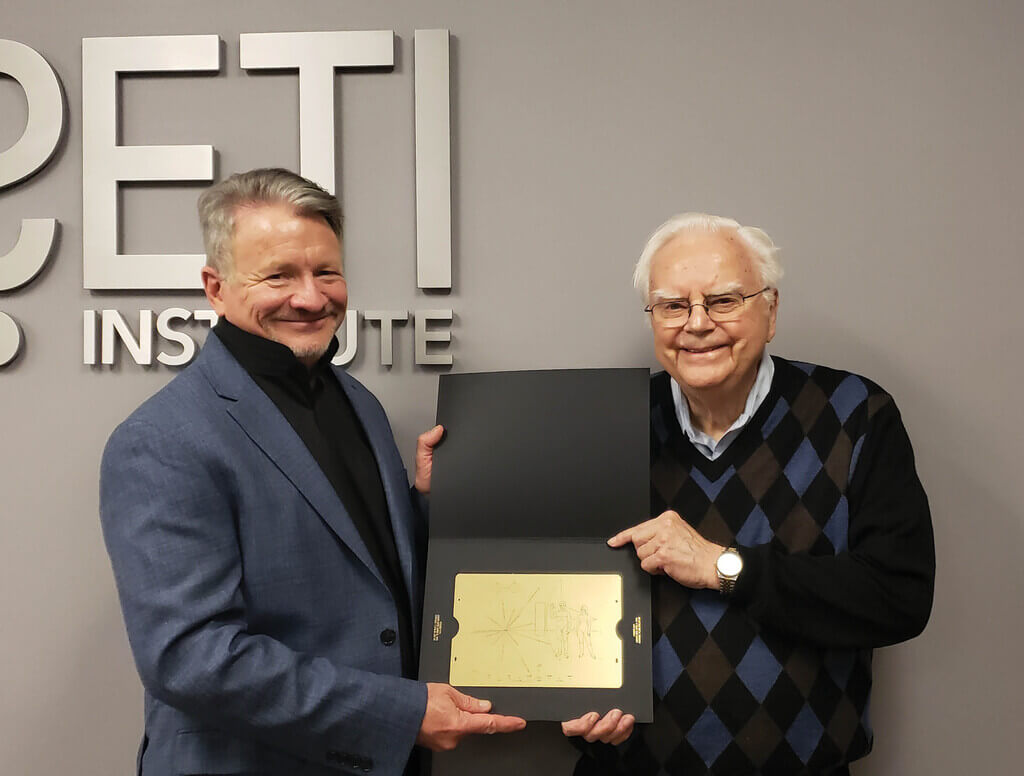
Bill Diamond and Frank Drake
With famed astronomer Frank Drake, holding a replica of the plaque from the Voyager spacecraft that Drake designed with Carl Sagan. Drake served as the first chairman of the SETI Institute during the first decade of its existence.

‘WE’LL MAKE A DISCOVERY OF LIFE ELSEWHERE’ 

Spring 2026 was a banner season for those who want to believe. In February, former President Barack Obama caused the internet to erupt after his “They’re real” statement on a podcast, in response to a question about extraterrestrial life. He subsequently clarified his answer, saying extraterrestrial life is a statistical probability.

In the same month, President Donald J. Trump announced on Truth Social that the U.S. government would be declassifying and releasing hundreds of Unidentified Anomalous Phenomena (UAP) files. That happened in May and June, through the Presidential Unsealing and Reporting System for UAP Encounters (PURSUE), a website of the U.S. Department of War (with a dark, all-caps design straight out of the popular 1990s Fox sci-fi series “The X-Files”). Also, in June and in advance of his highly anticipated sci-fi movie “Disclosure Day,” Oscar-winning director Steven Spielberg said on “CBS Sunday Morning” that he “absolutely thinks that [extraterrestrials] have been here and they are here and, who knows, maybe they’ve always been here.”

He’s not alone in his belief. In June, Adam Kirsch, a senior editor at The Atlantic, wrote, “aliens have become respectable” in a piece, “The Truth is Still Out There,” a nod to “The X-Files.” Kirsch presents tax dollars and surveys as evidence. He cites a 2017 New York Times story, “Glowing Auras and ‘Black Money’: The Pentagon’s Mysterious U.F.O. Program,” which reported that the U.S. government spent $22 million on a secret task force dedicated to investigating reports of flying objects. Kirsch follows that with multiple sources collectively indicating that belief in extraterrestrials is growing. “In 1996,” Kirsch writes, “69% of Americans thought that humanity would not contact aliens in the next half century; by 2022, only 39% did.”

That’s a lot of believers. If belief were measured on a spectrum, though, Diamond sits closer to Obama than Spielberg. 

“The statistics suggest we’re certainly not alone in the universe, and life, probably the simplest of life forms, microbial life, will turn out to be all over the place,” he says. Life that can build and operate interstellar spacecraft and zippy hovercrafts, however, is an entirely different matter. 

“I think the most extraordinary recent discovery for the human race is the fact that planets are ubiquitous,” Diamond continues. “The first planet beyond our solar system wasn’t discovered until 1995. And then NASA’s Kepler space mission, which the institute supported significantly through data management and analysis, taught us that statistically every star in the sky is, in fact, a solar system and has one or more planets.

“In our own galaxy, we now know there are hundreds of billions of planets, and 30% of those are estimated to be in what we call the habitable zone of their host stars. So, they’re at the right distance where liquid water could potentially be maintained,” he continues. “That translates to tens of billions of potentially habitable worlds just in our galaxy alone, which is one of hundreds of billions of galaxies in our known universe.”
The statistics suggest we’re certainly not alone in the universe, and life, probably the simplest of life forms, microbial life, will turn out to be all over the place.

Bill Diamond '78

This delights Diamond. He is a science geek of the first order and an inveterate optimist. 

“We’ll make a discovery of life elsewhere,” he says. “It may not start with a discovery of advanced aliens, but it could well start with the discovery of basic life, even in our own solar system. Thanks to the James Webb Space Telescope, we’re able to study atmospheres of exoplanets — planets around other suns — and characterize the composition of those atmospheres. 

“There could be what we call biosignatures in those atmospheres,” he says. “The composition of the atmosphere suggests the presence of life on the surface. Those kinds of discoveries are just around the corner.”

‘SETI IS THE PIRATE SHIP OF SCIENCE’ 

Diamond is seated in his SETI office, which looks nothing like the interior of the Starship Enterprise or even George Jetson’s home. Behind him are bookcases made of blonde wood and the vibe is understated Scandinavian elegance. The conversation ranges from talk about Diamond’s admiration for Jill Tarter, co-founder of the SETI Institute and the real-life radio astronomer played by Jodie Foster in the 1997 movie “Contact,” to a debate about who was the best “Star Trek” captain: James T. Kirk or Jean-Luc Picard. Diamond doesn’t take a side, per se, but does register admiration for Kirk, comparing him to a pirate captain.

“SETI is the pirate ship of science,” Diamond notes and smiles broadly. Eleven years into the job, he is still like a kid on Christmas who got everything he wished for. And how did he get the job, exactly? 

Diamond had been consulting for the institute, helping with business and financial matters related to revenue and expenses. The board was impressed and asked Diamond to consider coming on full time as president and CEO when the position opened in 2015. 

“I said, ‘Yes, absolutely. You don’t even have to pay me,’” Diamond says and grins.

Funny story: Months before Diamond became CEO, he was supposed to go sailing with his predecessor. A mutual friend had arranged the outing, but it was twice derailed by foul weather and engine trouble. By the time the sailing excursion finally happened, Diamond’s predecessor had departed the institute. Diamond was CEO. 

“I’m finally getting to sail with the CEO of the SETI Institute,” Diamond recalls saying to his friend. “Frankly, I’m not nearly as impressed as I thought I would be.”

Just months after accepting the position, Diamond approached Nathalie A. Cabrol about becoming the director of the Carl Sagan Center for Research at SETI. She was involved in the institute’s work, but at the time, she was working on a large grant at NASA Ames, one of NASA’s 10 field centers. She planned to stay there. Diamond was determined to change her mind.

A little context: Cabrol is a worldrenowned French-American explorer, astrobiologist and author. She’s written more than 600 peer-reviewed publications and four books on planetary science, most recently 2024’s “The Secret Life of the Universe: An Astrobiologist’s Search for the Origins and Frontiers of Life.” Cabrol also holds the women’s world record for free and scuba diving at altitude (she had to climb a 20,000-foot volcano to get to the lake that got her the record). Express admiration at such a feat, and Cabrol shrugs. The world record is incidental.

“I had to gather samples,” she notes. Cabrol researches other planets’ habitability; that is, how likely they are to support the conditions necessary for the onset and evolution of life. “Astrobiology is a mirror for humanity,” she says. “It answers a question about us.”

Cabrol is no-nonsense — and no pushover. She wasn’t looking to become director of SETI’s Carl Sagan Center when she agreed to meet Diamond for lunch at an Asian fusion restaurant in Mountain View, California. 

“The first thing I noted, which, to me, is extremely important, is that Bill looked me straight in the eye,” Cabrol says. “The other thing I appreciated is that he never tried to oversell himself. He was not overly humble, but he was just saying, ‘This is who I am; this is what I know. This is what I’ve been doing. This is what I’m trying to bring to the institute.’”

Image
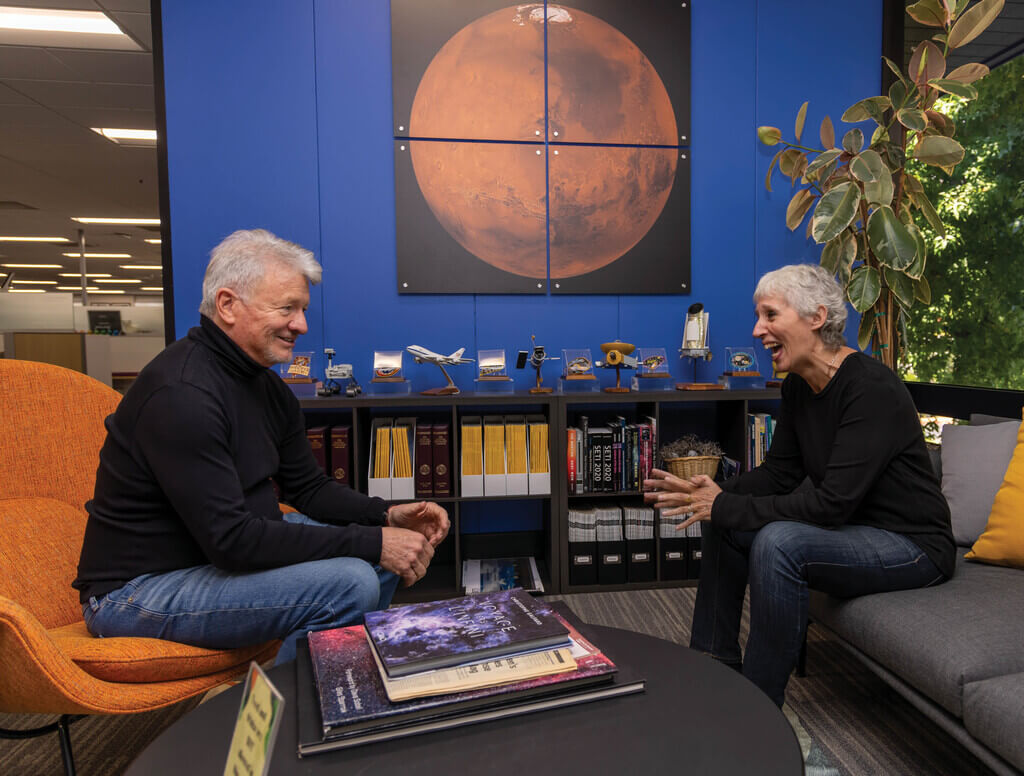
Bill Diamond and Nathalie Cabrol sitting down and talking
Diamond and Nathalie A. Cabrol, SETI Institute Science Director, Carl Sagan Center for Research Astrobiologist, Explorer, Author, Speaker.

Still, Cabrol wasn’t changing her mind that day, but something about Diamond made her do something she hadn’t planned. 

“I stood up and grabbed my bag and opened it and said, ‘Here are two documents I’ve been working on.’ I very quickly told him what they were about.” 

They were a parting gift. Cabrol had been working with SETI’s previous CEO on the documents. Having them would ease Diamond’s transition. 

“He told me, ‘I’m going to read them tonight. Would you mind stopping by my office tomorrow afternoon, and we can talk about them?’” Cabrol recalls.

She did. At the end of the second meeting, Diamond asked if she would return the next day to talk some more. She did. That continued for about three months. Occasionally, Diamond asked her again to lead the Carl Sagan Center. She said no. Again and again. 

“I said, ‘I’m a scientist; I’m not pushing paper anytime soon. I’m too young for that,’” Cabrol says and grins. “There was no way someone was going to put a leash on me. So, fine. We continued, and in the next few weeks, he asked the question a few more times. And he always had the same answer from me.”

Until one Friday afternoon, when Diamond pressed the issue again. 

“That was the first time I said, ‘I need more time,’” Cabrol says. “And he looked me straight in the eye and said, ‘OK, you have until Monday.’” 

Cabrol has worked with Diamond for 11 years. She calls him a strategic, tactical thinker, a man whose ethics are impeccable and apparent in all their dealings. He is someone who brings a tech industry perspective and fundraising expertise, she says. Turns out, such attributes pair well with Cabrol’s scientific vision. 

“We’re always the last two people to leave,” she says. “He has a sense of wonder about him; what he does touches his heart. He has the passion of a 5-year-old kid who still can’t believe he’s there.” 

Former Vatican astronomer, Brother Guy Consolmagno, S.J., agrees.

‘HE KIND OF REMINDS ME OF POPE FRANCIS’ 

Diamond and Br. Consolmagno met about a decade ago. Diamond was developing SETI’s Science Advisory Board and had put together a wish list of scientists from diverse backgrounds. Br. Consolmagno was on that list. 

The goal of the board is to make sure that the science SETI researchers conduct is good science, Br. Consolmagno says, “regardless of what they find or don’t find, because it’s legitimate science either way.” 

Br. Consolmagno thought it a very worthwhile thing to do, plus the board comprised colleagues and friends of his from the 50 years he’d been in the field. It was a coup for Diamond, though. Appointed director of the Vatican Observatory by Pope Francis in 2015, Br. Consolmagno acquired a nickname during his tenure: “The Pope’s Astronomer.” Now retired, he holds a Ph.D. in planetary science and is the author of multiple books, including 2014’s “Would You Baptize an Extraterrestrial?: … and Other Questions from the Astronomers’ In-box at the Vatican Observatory,” co-written with the Rev. Paul Mueller, S.J. (Spoiler: Only if they ask.)

Br. Consolmagno also has an asteroid named for him: 4597 Consolmagno, referred to by some in the community as “Little Guy.” Br. Consolmagno downplays the honor: “It’s so common among us. I’d be surprised if Nathalie doesn’t have one.”

Image
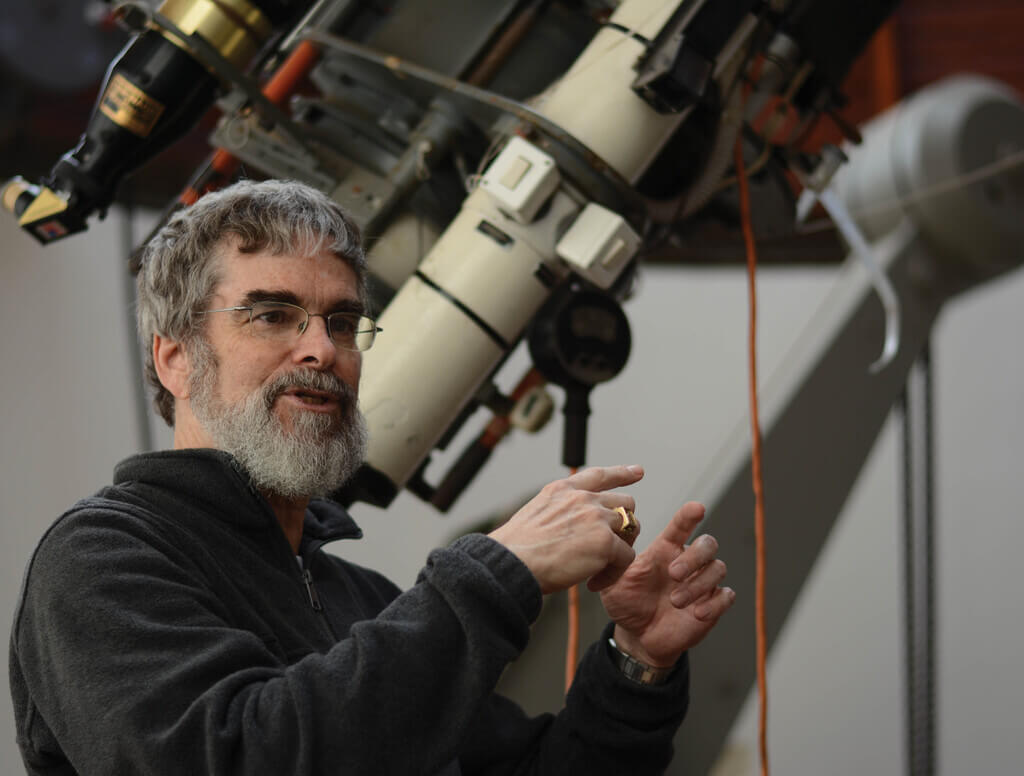
Brother Guy Consolmagno in front of a telescope
Brother Guy Consolmagno, “The Pope’s Astronomer,” Diamond’s colleague and friend.

Anyway, a few years later, Diamond visited Br. Consolmagno in Castel Gandolfo, Italy, a small lakeside town about 15 miles southeast of Rome and home to the pope’s summer palace, the Vatican Gardens and the Vatican Observatory. The two spent several days together and became fast friends. Ask him why Diamond is good for SETI and Br. Consolmagno gives you three reasons: “The first thing about Bill, and this sounds weird, is that he’s not a visionary.” 

This is a compliment. SETI is all set on visionaries, Br. Consolmagno notes. 

“He’s not like SETI’s founders, Frank Drake or Jill Tarter, who have this dream that they’re trying to push. What you need is someone who understands the vision but won’t get in the way of it by trying to force his own vision on things,” Br. Consolmagno says.

This is one of Diamond’s great strengths, he explains: “The phenomenal thing that he’s good at is assembling a team that’s very diverse and giving all of them voices and making sure that they have the resources they need, each of them, to follow their own dreams.” 

In this way, Diamond is like Pope Francis — something only Br. Consolmagno could say, having known both men personally: “Everybody remembers Francis as the wonderful, warm Jesuit with this love of the poor and the world — all of which is true. You don’t notice what a really good politician he was to actually get a lot of the stuff he got done. 

“And, likewise, everybody sees Bill as a warm and wonderful person,” he continues. “You know the old cliché of herding cats? Bill knows how to herd cats. So, that’s the first thing: He’s really capable, and he has a good, clear idea of what the job is.”

Reason #2: Diamond is a servant leader with a humanistic vision and a conscience. 

“I’ll pretend that this comes from his Jesuit background,” Br. Consolmagno says, then grins. “Bill’s talent as a leader is that he gets all of these different people to talk to each other, learn from each other and work together. He also has the deep understanding that you need artists, that you need poets, that you need people who can do all of the above with some of the above.

“And that’s quite remarkable,” he continues. “We’re talking about people from different countries, different ethnic backgrounds, different socioeconomic backgrounds. And he welcomes them, and he gives all of them a place to be heard because he recognizes that not only is this good for the institute, but it’s the moral thing to do.” 

And the final reason? 

“He’s just likable,” Br. Consolmagno says. “People enjoy being in his company. SETI’s profile has certainly been raised, but without anybody in the field necessarily knowing who Bill is.”

Image
Bill Diamond and family
Diamond and family on the 86th birthday of his father, Bill Diamond Sr. ’43. Front row, from left: Diamond’s brother, John; Diamond Sr.; back row from left: Diamond’s wife, Petra; Diamond; sisters, Liz and Susie; and mother, Marie.

‘WHERE IS THE MOTHERSHIP?’ 

So, just for fun, what would happen if SETI discovered extraterrestrials attempting to communicate with us? Turns out, there’s a lab for that. The Discovery and Futures Lab, established by the institute in 2026, is dedicated to exploring the implications (and consequences) of the discovery of life beyond Earth from religious, philosophical, civic, scientific and technological perspectives, Diamond says. And unlike what we see in the movies, that discovery, once verified, would be made public. SETI’s mission is to lead humanity’s quest to understand the nature and prevalence of life and intelligence in the universe and share that work with the world. 

“We are fundamentally about research, education and outreach,” Diamond says.

So, it’s sort of comforting and yet deflating to hear that SETI’s position on the U.S. government’s declassification of UAPs is that they’re not evidence of visits from an extraterrestrial civilization. So much for a real-life “Disclosure Day.”

“UFO and UAP observations have one thing in common, which is quite interesting,” Diamond says. “One hundred percent of them are all the result of accidental observation. They’ve never been the result of purposeful investigation. Never. Not once. Not ever. Nowhere. And it’s puzzling that there isn’t a government that’s actually interested in doing that.” 

No government has an agency for UFO or UAP observation, Diamond says. 

And this tells you two things: 

  1. There’s probably no compelling evidence for taxpayer money to be spent scanning the skies for flying saucers or motherships. 
  2. Governments don’t want people scrutinizing our airspace. 

Wait, what?

“The government probably doesn’t want the public taking a close look at our airspace and experimental aircraft or technology,” Diamond says. “They’d rather keep that under wraps.” 

This is again veering into “The X-Files” territory, but hear him out. What’s “classified,” Diamond says, is not the fuzzy images of discs or the mysterious radar blips captured over the years; rather, it’s the technology that recorded them that government officials are trying to keep secret. 

“It’s a classified image because it was taken with a camera system or a technology we’d really rather not talk about,” he says. 

Again, comforting, but disappointing. But also plausible.

Image
Bill Diamond holding an alien statue
Science with a sense of humor: Diamond and the classic little green man of lore and cinema.

Diamond drops more facts: NASA’s New Horizons spacecraft is the fastestmoving, man-made, physical object moving in a straight line. It flew past Pluto in 2015, traveling at 56,000 kilometers per hour. Alpha Centauri, our closest neighboring star, is the nearest possible star in our galaxy where there could be other planets. If you directed New Horizons to head to Alpha Centauri, it would take 80,000 years to get there. 

Think about that for a minute, Diamond says: “Any civilization that has the technology to travel interstellar distances has technology that we can’t yet comprehend. Technology so far advanced from anything we can imagine that, you know, the notion that they’d be buzzing around our airspace in little probes is kind of a stretch. And where is the mothership?”

Well, when you put it that way. But Diamond’s not done: “And if a civilization has the technology to travel interstellar distances, you would hope that they would do something more interesting than draw symbols in cornfields.” 

Point taken. The likelihood of an alien civilization with the technological capabilities to reach Earth is diminishing at what feels like the speed of sound, anyway. 

But, as his mentor Ken Nill notes, Diamond is an optimist. And that optimism extends to SETI. Check out its website. The first thing you’ll read is: “Are we alone? Let’s find out.”

“We’re in pursuit of that one basic question,” Diamond says. “To that end, SETI is interested not only in evidence of alien life, in the sense of biological evidence, but also in technological evidence.”

Bill’s enthusiasm, I’m sure, is what holds that place together. His job is to keep hope alive.

Ken Nill, engineer, friend and former boss of Bill Diamond

Ironically, to discover the secrets of the heavens, you look down more often than up. Discoveries are to be found in the fine print: data, events or anomalies recorded but not yet discovered. 

“Step one is to verify,” Diamond says. 

All of this is to say that none of this dampens Diamond’s enthusiasm. The unknown enthralls him. He notes that the “S” in SETI’s logo is a stylized question mark. Fans of “The X-Files” might call Diamond a cross between the show’s two main characters: FBI agents Dana Scully and Fox Mulder.

Diamond is a man of science who believes the truth is out there. 

“I think we’ll ultimately find that life at its most basic level is all over the universe, because it’s composed of the most abundant and simplest elements on the periodic table, which are everywhere, spread throughout the cosmos,” he says. “I think we’ll ultimately find that the most remarkable thing about life is that it’s not remarkable at all.”