‘The porch light went on June 7, 1976, and never went off’

Porch light on a building at night
The original location of Abby’s House, 23 Crown St. “Those first students, they were brave,” founder Annette Rafferty says of the mid-’70s Holy Cross women volunteers. “And they were overwhelmed at the beginning, but they kept coming back.”

The 50-year history of Worcester’s first women and children’s shelter, Abby’s House, is more than a feel-good story about a little nonprofit that could; it’s a story of what happens when women move heaven and earth. Together.

Student volunteers at Abby’s House had a name for the jigsaw puzzle on the coffee table: “that-damn-puzzle,” run together as one word and said with equal parts annoyance and fondness. 

The first issue with the puzzle was that its form was a circle, so no helpful corner pieces to get you started. Then there was the pattern: an abstract design of concentric circles encased in cubes. The third maddening thing: the puzzle’s colors, black and white.

Shelter guests and volunteers would put the puzzle together then take it apart, again and again, much in the manner of Buddhist monks creating their sand mandalas and destroying them after completion. For the monks, the mandalas’ destruction serves as a meditation on impermanence. For the volunteers at Abby’s House, “that-damn-puzzle” was a leveler. Differences in education, socioeconomic status, age and cultural capital disappeared in the pursuit of solving “that-damn-puzzle,” says the Rev. Meredyth Wessman Ward ’81. 

“We discovered that if we were working together on something, conversations happened in a different way than if we were sitting, staring at each other or watching television together,” she says. “And, so, in that act of being in a circle working on a circle, we understood what it meant to be in solidarity with other women.”

The history of Abby’s House is a medley of such moments, powered, as it was, largely by volunteers — women with no formal training in running a shelter for women and children. This year, the shelter marked a major milestone for any nonprofit, celebrating its 50th anniversary in June. Its founder, Annette Rafferty Hon. ’07, is 96. She’s liberal with her praise for Rev. Ward and the many Holy Cross students and employees who’ve volunteered there over the past half century. 

“The fact that Abby’s House still exists is a testament to the willingness of a group of young women in 1976 to come down off that hill and enter some dark places,” Rafferty says. “Those Holy Cross students were essential in establishing Abby’s House.” 

So, how was it that young women new to a college in the first years of coeducation became integral in running a nascent nonprofit? 

Let’s begin in 1976.

‘I NEVER LOOKED BACK’ 

In 1976, Eileen Dooley, then-director of student activities, asked Paula Sasso ’78 to attend a meeting about establishing an emergency shelter for homeless women and children in Worcester. 

Sasso said no. 

She had her reasons. She was only 19. She was a stressed-out sophomore on scholarship. She was struggling with a demanding major, economics and accounting. She was a volunteer in SPUD (Student Programs for Urban Development). She had a work-study job in the student activities office. 

There just wasn’t time for another thing. 

Or so she thought. 

“And Eileen, she literally quoted the Bible to me,” Sasso recalls. Matthew 25:37-40: “Lord, when do we see you hungry and not feed you, naked and not clothe you?” 

“Alright, alright, I’ll go,” Sasso recalls saying. She grins. “I never looked back.”

Today, Sasso serves as board chair of Abby Kelley Foster House Inc., as the shelter is formally known. Her tenure with the organization places her among its most ardent and visible supporters; she’s also emblematic of the long-standing commitment by Holy Cross women — staff, faculty and students — to Abby’s House and the women and children it serves. 

That a women’s shelter could be a radical experiment in women’s leadership seems hyperbolic by 2026 standards, but casting it as anything less would be a misrepresentation of events. In the mid-1970s, Rafferty encountered skepticism, if not disbelief, that women could advocate, fundraise and run a women’s shelter without a powerful backer.

“Men are the planners and designers of such projects and women are hired into whatever positions the planners determine are necessary,” Rafferty wrote in her 2001 memoir, “Wearing Smooth the Path: 25 Years at Abby’s House.” 

But the collective influence of a series of fortunate events — Vatican II (1962-1965), the advent of coeducation at Holy Cross (1972) and the arrival of second-wave feminism — set in motion a particularly Catholic, particularly feminine, activism. And it was unstoppable. As was Rafferty. 

“The truth is this: The decision came from a stubbornness of soul so powerful it frightened me, but it managed to push me forward with a strong sense of purpose,” Rafferty says. “We women would create the model. We would get the money, find a place and staff it all in good time.”
Image
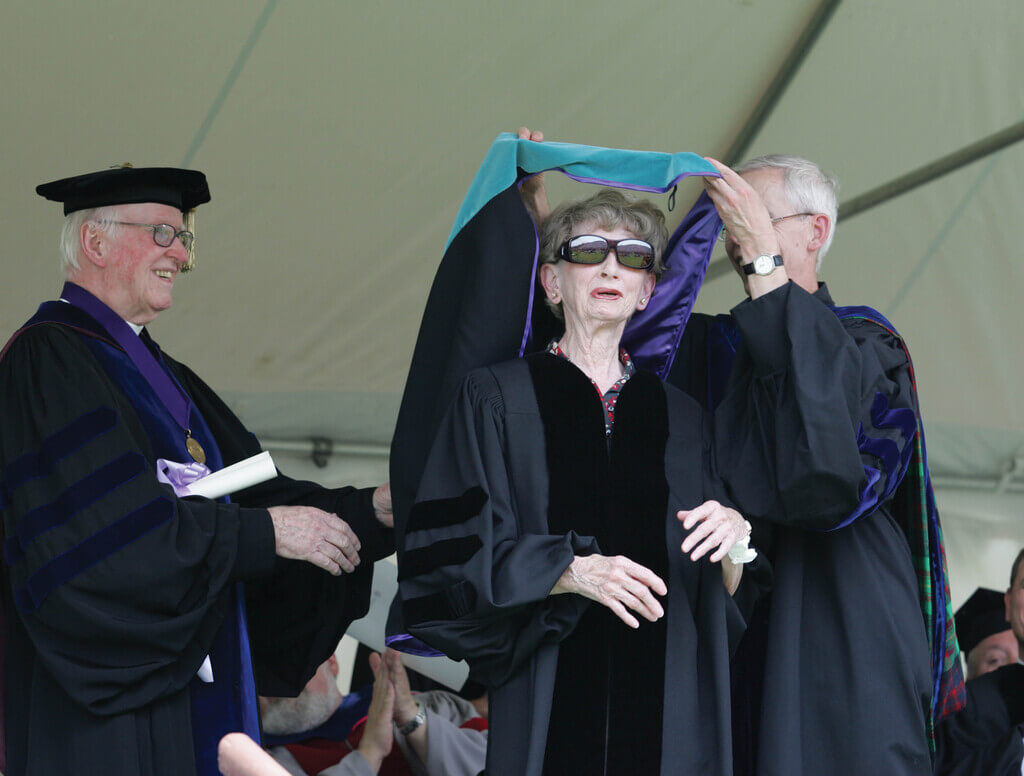
Annette Rafferty being hooded at commencement
Rafferty was honored at Holy Cross’ 2007 commencement ceremony, receiving an honorary degree. “We were a sisterhood,” she says of the original Holy Cross student volunteers. “We all grew together.”

If spirit is propulsion, sisterhood fueled Abby’s House in those early years, says Dooley, who regularly volunteered for overnight shifts during her six-year tenure at Holy Cross. 

“It was heartbreaking and shocking to see these women come in so tired; they just wanted to eat and go to bed,” she says. “The women in their 40s and 50s seemed especially hardened, as if they had no one to turn to. They’d worn out their welcome with family and friends. 

“And here we were doing this without a plan,” she continues. “But from the beginning, we all had responsibilities, and we were all going to fulfill them. And those first [Holy Cross] classes of women were just so extraordinary. They jumped at the chance to get involved. We were all working and learning together.”

‘BY NO FAULT OF HER OWN, THIS WOMAN WAS HOMELESS’ 

To understand the marvel that is Abby’s House, here is a brief history lesson: The first women students arrived at Holy Cross in 1972, during what was the most productive decade in U.S. history for advancing women’s rights. These young women came of age smack in the middle of secondwave feminism, which spanned from 1963 to the late ’80s. They’d grown up with the examples of Betty Friedan, Gloria Steinem, Bella Abzug and bell hooks. They’d read “The Feminine Mystique,” Ms. Magazine and “The Women’s Room.” They’d seen Shirley Chisholm elected to Congress and Ruth Bader Ginsburg winning cases before the Supreme Court. On campus, they encountered dynamic women in leadership roles: professors, administrators and chaplains, modeling what was achievable for a woman with drive and intellect. A decade after Vatican II and its renewed commitment to social justice, these young women were primed for the kind of hands-on activism that volunteering at Abby’s House offered and required.

Holy Cross’ women students were also the early beneficiaries of several legislative milestones from that era that opened up new opportunities. Title IX was established in 1972, making sex-based discrimination in education illegal. In 1974, the Equal Credit Opportunity Act made it possible for women to apply for a credit card without a husband’s written permission. And in 1976, Nebraska became the first state to criminalize marital rape. 

Public acknowledgement of the rights of women took material form; rape crisis centers, health clinics and women’s shelters opened up across the country. In 1973, Rafferty, Dooley and Sister Leona Donahue, RSM were members of the Diocese of Worcester’s Urban Ministry Commission, charged with developing a plan to address the issue of the “new homeless” of Worcester: women and children.

Commission members agreed to establish a fund for homeless women, the Abby Kelley Foster Fund, named for the 19th-century Worcester resident, abolitionist and women’s rights advocate. The first donation to the fund was an anonymous gift of $1,000. The second came from the Holy Cross Women’s Organization, led by Eve Gilmore ’76.

The whole effort nearly derailed; in June 1975, the commission decided not to move forward with the plan for a shelter. Rafferty promptly resigned from the group and refused to abandon the idea. Six months later, she and other local activists established the Women’s Collective. Its mission was simple and simply stated: “a shelter for women done by women,” Rafferty wrote in her memoir. The Women’s Collective met every two weeks in Room 307 at the College’s Hogan Campus Center. In addition to Gilmore and Dooley, the late Sister Anna Marie Kane, SSJ ’74, the College’s first woman associate chaplain, and Theresa McBride, professor emerita and deputy Title IX coordinator, were among the effort’s early supporters.
There were times when it was just two Holy Cross women there and nobody else.

Paula Sasso '78, Board Chair, Abby's House

Marybeth Kearns-Barrett ’84, today director of the Office of College Chaplains and former Abby’s House board chair, recalls that early fundraising was a truly grassroots effort. Several of the College’s female employees would contribute to the fund directly from their paychecks each payday, she says. 

“These were some of the lowest-paid workers at Holy Cross, and they were giving regularly from their modest salaries,” Kearns-Barrett recalls.

In April 1976, Rafferty signed a lease for a building at 23 Crown St. “The porch light went on June 7, 1976, and never went off,” she says. It’s become her tagline. 

Next came the challenge of furnishing the shelter. Rafferty appealed to her growing network, seeking furniture donations and volunteers to work in the shelter. The community delivered on both fronts. Rafferty credits Holy Cross, and especially the efforts of Kane, Dooley and Daniel G. Dewey, associate professor emeritus, mathematics, with the donation of “fancy furniture” — retired College furnishings and student castoffs. Local women volunteered to take and launder items in the absence of an on-site washer and dryer. And Holy Cross students became some of the emergency shelter’s first volunteers. 

“There were times when it was just two Holy Cross women there and nobody else,” Sasso recalls. “You were in a secret location, and if the doorbell rang, you had no idea what you were going to be opening the door to. And there we were, 19 years old.”

Sasso and her fellow students couldn’t have known that generations of Holy Cross students would follow suit, but so it went. 

“Abby’s House is not a one-person story,” Kearns-Barrett says. “For 50 years, Holy Cross students have staffed the shelter. I think most people will be kind of shocked by that.”

‘A LOT OF THE MINISTRY I DID BACK THEN WAS JUST LISTENING’ 

One-time student volunteer Suzanne Geaney ’76 resists an interview request at first, characterizing her contribution to Abby’s House as “paltry.” It is something of a leitmotif among the volunteers. After demurring about the role she played, each woman brings another woman’s name into the discussion. “Really,” they say, “you should be talking to so-and-so.”

“I operated a very simple monthly envelope system to collect funds that Eileen then got to Annette Rafferty to give to the YWCA to help pay for the lodging of homeless women,” Geaney writes in an email. “After graduation, before the start of orientation for the Jesuit Volunteer Corps East, I was on the volunteer staff at the first residence on Crown Street, being there to welcome women and sleeping there overnight.” 

Some would take issue with Geaney’s characterization. Fifty years later, Rafferty namechecks Geaney, Sasso and Rev. Ward, calling them “brave” and “courageous.” 

“I remember the first night we had a woman with a couple of kids, and I remember spending time talking with her, and the children, too, but mostly with her about her situation,” Geaney says. “I remember being a little concerned because she had left her husband, and I was wondering, What if there’s some kind of violence?” 

Still, she set her worries aside. 

“A lot of the ministry I did back then was just listening,” Geaney says.

In those early years, even the women in charge didn’t have the formal training required today for running a women’s shelter. Rafferty, a former teacher, took the lead, but that was more a matter of bearing responsibility than being the boss. 

“We were treated as equals by the other women; we weren’t treated as students,” Sasso recalls. “We felt fully empowered to do what we needed to do, what the house needed to do.”

In Sasso’s case, this was to extend hospitality. Clients were invited to take a shower (after being checked for lice), then offered a meal and a bed. If there were children, volunteers would play with them. Sasso took to the work naturally. She was the product of an extended Italian-American working-class family. Caring for one another was second nature. Dad was a mason, mom, a bookkeeper. Sasso and her brother, Joseph Sasso Jr. ’75, lived next door to their grandparents. 

“I grew up with the principle that to whom much is given, much is expected,” she says. 

Her early experience at Abby’s House (she’s never stopped volunteering) taught her that advantages weren’t insurance against misfortune.

“I remember this woman talking over breakfast, telling me her story, and I had the realization that this could be my mother talking, and that, by no fault of her own, this woman was homeless,” Sasso says. 

She reads aloud a recent text from Rafferty sent when the latter learned that Sasso had been named board chair in January 2026. 

“All those nights of staffing will make you understand firsthand the struggle of women trying to rebuild a shattered life,” she reads. “Please give my best wishes to all the dedicated members of the board as they carry on the treasured work of helping women rebuild their lives and together move heaven and earth on their behalf.”

‘HEALING IS ALMOST NEVER A LINEAR JOURNEY’ 

As of February 2026, 323 women await word on their applications for Abby’s House affordable housing units. Another 752 women and 513 families, mothers with at least one child, are on the list for emergency shelter.

These statistics are never far from Julie Orozco’s mind. When the executive director of Abby’s House arrived three years ago, the organization was still almost entirely volunteer-run. Now Abby’s House has a paid staff of 48 and 50 long-term volunteers. Aside from some city funding for affordable housing, Abby’s House operates without state and federal tax dollars. Its $3.5 million budget comprises donations and proceeds from a thrift store it operates.

Image
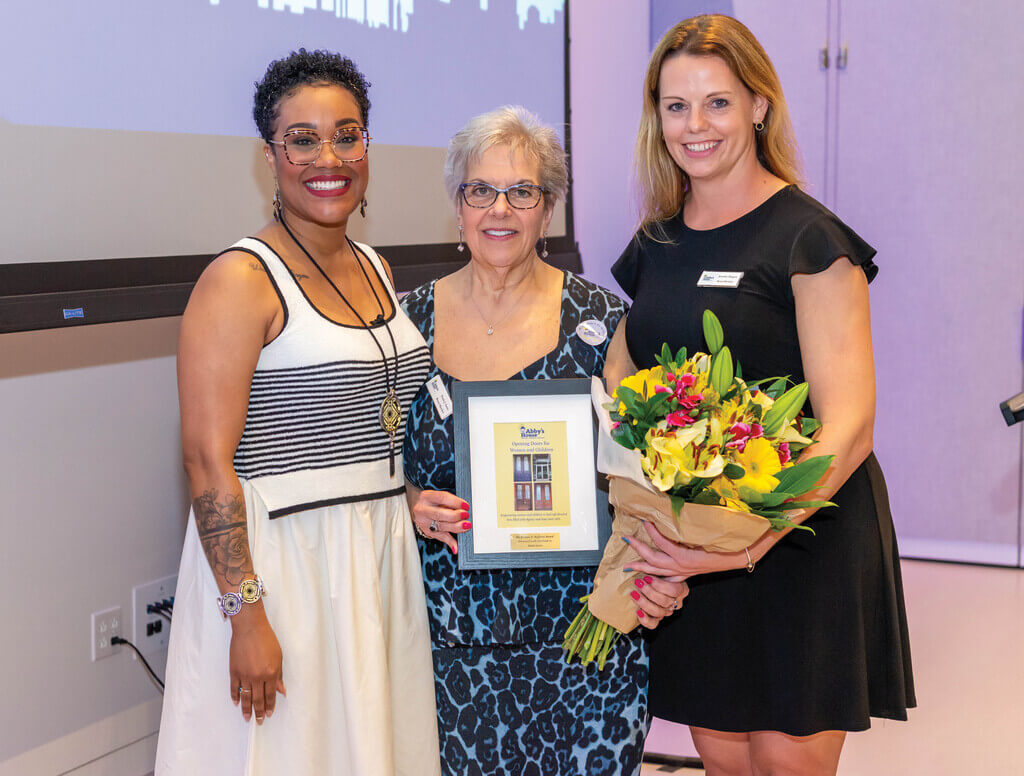
Julie Orozco, Paula Sasso, and Jennifer Dragon
(left to right) Abby’s House Executive Director Julie Orozco, board chair Paula Sasso and board member Jennifer Dragon in 2025, when Sasso received the organization’s Annette A. Rafferty Award.

Orozco smiles at the idea that civic leaders in the mid-’70s once called women and children the “new homeless.” Homelessness is indiscriminate, but there is something gendered about it. 

“Women who are homeless are not street-dwelling women, but they are still either completely unhoused — in a car — or unstably housed, moving every couple of nights from one location to another,” she says.

Ideally, Abby’s House would provide a lot more than shelter for its guests. Stability, dignity and longevity for starters. Some of the women in residential housing have lived there for 15 or 20 years. The goal here is a fulfilling life for every guest, Orozco says.

“You get to live the life you want to live. You are self-directed. And what’s meaningful to you is such a high value for us,” she says.

Over the years, Abby’s House has expanded its services, providing computer training, financial literacy courses, cooking classes, and health and wellness programs to guests. Still, need outpaces the ability to provide. Abby’s House accepts all types of donations and would welcome even more student volunteers. Helping people overcome homelessness requires sustained community effort, she says.

“Our mission is rooted in actual help, actual healing — not just throughput,” Orozco says. “And healing is almost never a linear journey.”

And coming back from homelessness is harder than ever. It might surprise you to know that most Abby’s House guests are employed, many in full-time jobs. 

But sometimes full-time employment isn’t enough. The average annual salary of a Worcester resident is between $50,000 and $60,000, according to ZipRecruiter, and Zillow puts the average monthly cost of a two-bedroom rental at about $2,000. That’s $24,000 in rent before any other expenses are addressed. 

“Having a full-time job is no longer tied to whether or not you will also have stable housing,” Orozco says. “These rents are only affordable for two-income families or individuals who are making six figures. Just for rent.”

The fact that Abby's House still exists is a testament to the willingness of a group of young women in 1976 to come down off that hill and enter some dark places.

Annette Rafferty Hon. '07, Founder, Abby's House

‘LIFE IN ALL ITS UGLINESS AND BEAUTY’ 

On a Tuesday morning in March, Rafferty calls. She is encyclopedic in her recall of a half-century’s worth of history regarding Abby’s House. She answers every question asked in depth and with alacrity. 

Rafferty also tells great stories like this one: She once ate in Kimball Dining Hall with some student volunteers who had formed a small group, Friends of Abby’s House. During the meal, Rafferty told her dinner companions a story of a homeless woman who came to the shelter at 6:45 p.m., hauling all her belongings in a shopping cart, which she left on the porch. Rafferty is certain about the time the woman arrived because several women at the shelter, Holy Cross student volunteers among them, were chatting about watching “Wheel of Fortune” at 7 p.m. 

The new arrival was aghast. 

“We’re going to turn on Channel 2, and we’ve got to watch ‘Washington Week in Review’ to find out what’s going on in our government,” the woman told the little assembly.

Rafferty laughs in delight. She calls such exchanges “little surprises.” There were a lot of them over the years, she says. 

“What the Holy Cross students saw was that a woman, homeless and on the street, was no different than they were,” she says. “They had the same dreams, the same desires: to get a good job, to be free, to have opportunities. The Holy Cross students realized they just had more fortunate circumstances, more breaks that the other woman never had.

“Those Holy Cross women received an education about what was going on in the world,” Rafferty says. “In the world” is delivered slowly and with force, in the manner of a preacher at a pulpit. 

“These women were the same,” she says. “Abby’s House was the best education I could ever have. It touched life in all its ugliness and beauty. Those first students, they were brave. And they were overwhelmed at the beginning, but they kept coming back. We were a sisterhood. We all grew together.”

Rev. Ward experienced her calling to ministry while still in high school, but her experiences at Abby’s House gave it form. In the summer of 1980, the summer before her senior year, she lived at Abby’s. When school resumed, she volunteered a couple of nights a week, walking to and from the shelter in all kinds of weather, showing up for morning classes tired, but also joyful. Hard as the work could be, Rev. Ward says she also felt delight and passion.

Image
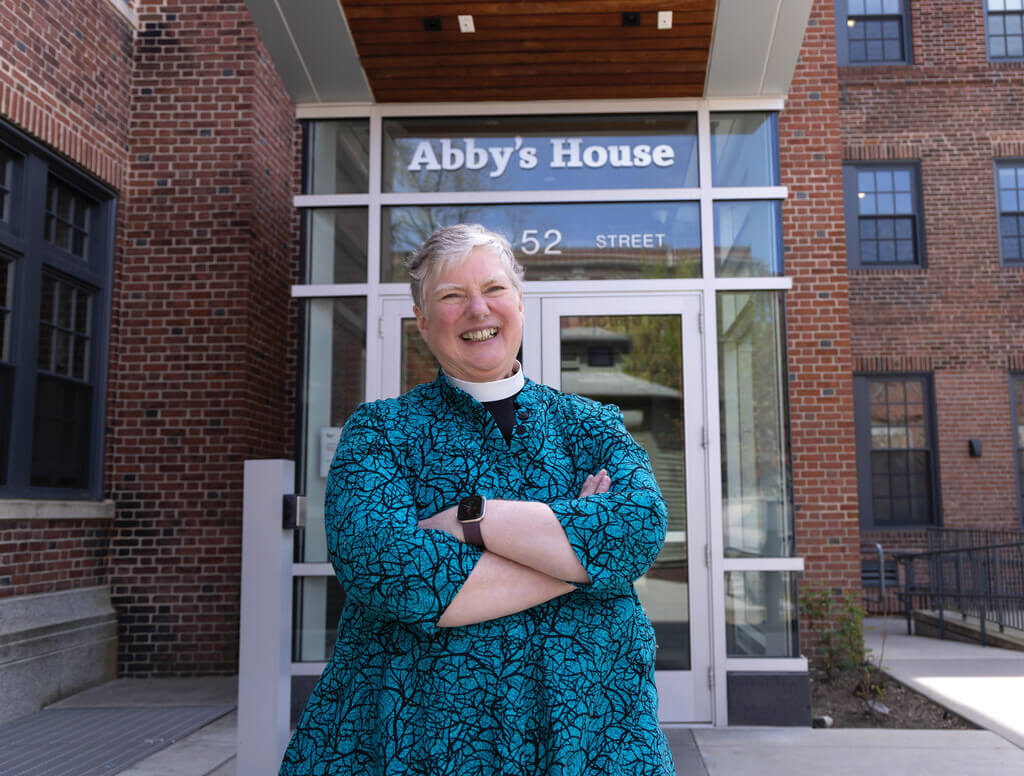
The Rev. Meredyth Wessman Ward
The Rev. Meredyth Wessman Ward ’77 first felt called to ministry when still in high school. She became one of the first student volunteers at Abby’s House.

“I realized this was something I could give myself to,” she says. “I’m not sure that I articulated it at that time as a ministry, but that was the sentiment. This was service informed by my understanding of faith, formed by faith. This was loving other people deeply and fully — and without asking for something in return.” 

Rev. Ward shares that she was the one to train Sasso. She grins broadly.

“I mean, there was no training, but I understand why there was no training because everything at that time was about keeping Abby’s House open, keeping it going,” Rev. Ward says. “Then, we were thinking about what would happen tomorrow: Do we have enough food? Do we have the rent this month? [Abby’s House] is a miracle, really, when you think about it.”