Understanding Venice Beyond Its Postcard Image

View of Venice from the Campanile
Students brought their sketchbooks everywhere, like the Campanile at Piazza San Marco (pictured). “We had to draw the whole city of Venice in our style," Amelia Ciarleglio '27 explained. "It was an experience that none of us really expected to have.”

Holy Cross professors, students lived in the floating city for a month to create art, study architecture and grasp its real-world problems and contradictions.

Most students who signed up for Professors David Karmon and Cristi Rinklin’s inaugural Maymester in Venice had the same desire: “I want to see it before it sinks.”

This is a popular tourist narrative, along with visions of glittering blown glass, festival revelers in masquerade, canals haunted by ghosts and mythical sea creatures. The city has a romantic, fantastical aura about it, one that the two visual arts professors wanted to inhabit – and investigate. 

“Although the romantic stereotype tends to dominate the popular imagination, it’s just one way of understanding Venice,” Karmon explained. “We wanted to challenge our students to think more critically about the city, and to explore how this extraordinary place can make us think differently about the world we live in today.”

Karmon, professor of architectural and urban studies, and Rinklin, professor of studio art, had been looking for a way to promote collaboration among faculty in the visual arts department, as well as combine their mutual interest in environmental studies. They selected Venice as the perfect environment due to prior experiences working in Italy and the nature of the city itself, and from there, the Maymester course was born. 

“Venice is a really interesting case study, because it's not only this ancient city that has all of this history, but it's also where the contemporary art world coalesces every year” with architectural, art and film festivals, Rinklin said. “It's just kind of this place where all these things collide, but it's also full of all of these interesting problems and contradictions. … It gives opportunities to center ideas of art and architecture in really exciting ways.”

Art on the go

Understanding Venice started with getting students out of the studio and into the city. For four weeks beginning in late May 2025, almost every morning began with site visits to architectural and historical landmarks, museums, churches and various spots around the city. They started in Piazza San Marco, the traditional arrival point to Venice, and worked outwards until they had covered the entire city – to the point where students became regulars at cafes, found a gym and knew their way around without a map. It was different from how most experience Venice, which Karmon explained is usually just a pit stop on the way to other destinations throughout Italy, one that lasts no more than a few days.

The students also got to know the city on a deeper level – by creating art everywhere they went. They carried a field journal and portable art supplies at all times, to work on projects and to be ready whenever inspiration struck. 
Image
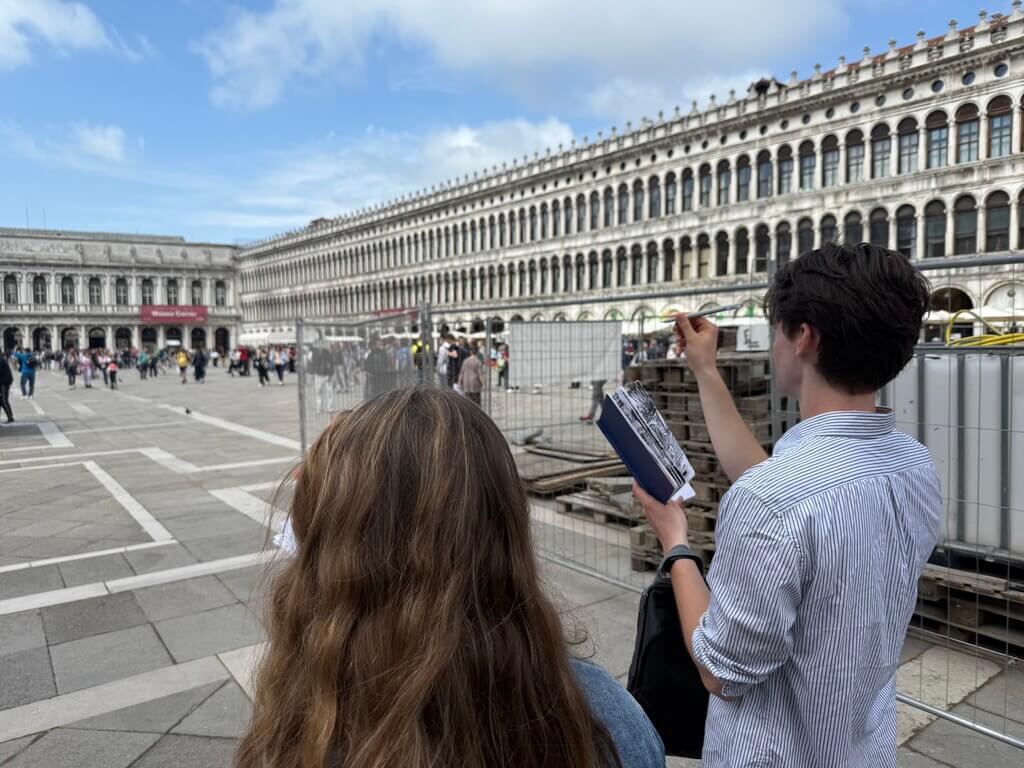
Students in the Piazza San Marco
Sketching in the Piazza San Marco, the traditional arrival point to Venice.

This approach to art was a change for Maeve Foley ’26, a studio art and psychology double major, but one she welcomed. “I'm so used to doing all of my art in the studio, but I was sort of surprised at how easy it is to kind of do art everywhere,” she said. “I think it'll make me now think to bring my art supplies with me everywhere I go and want to create art out of everything.”
Image
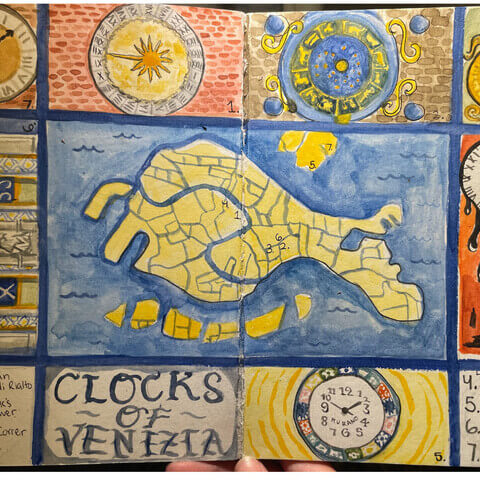
Illustration of clocks in Venice
One assignment was to create a map of Venice of your own interpretation. Ciarleglio based her map on the city's clocks: “I just really have a strong affinity for clocks. I don't know why. But we only had a month in Venice, and so every minute counts.”

Ben Roe ’27, a double major in English and studio art, saw his work evolve through this approach as well: “Before going on this trip, my art was very fast-paced, cartoony, abstract kind of stuff. This made me really sit down and focus on drawing architecture and figures from life. Our assignments would be, like: Go out and draw a building, or sketch this tower. So it really helped boost what you would call my traditional art skills.”

Though about half the participants had prior art experience, it was not a course requisite. Rinklin and Karmon emphasized growth and engagement with the material more than mastering technical skills, which paid off for the art majors and non-majors alike.

“They were really encouraging, and there was no great pressure to be perfect,” explained Amelia Ciarleglio ’27, a political science major and writing minor who’s been painting since middle school, but hadn’t been able to focus on her art amongst her other courses. “And we all kind of helped each other learn techniques.”

The imagined city

The program also helped students tap into not only the imagination required to create the art and architecture Venice is known for, but the imagined state of the city itself.

Image
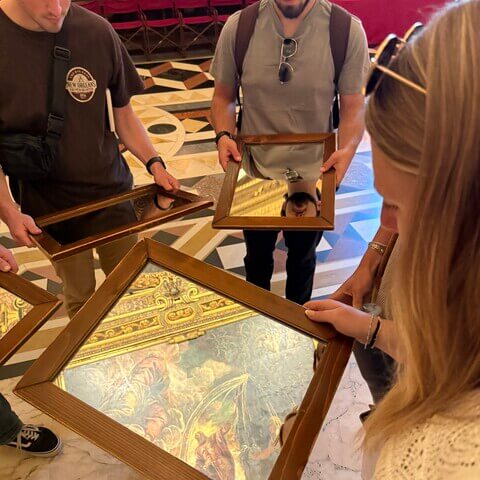
Students looking at art through a mirror
Studying Tintoretto at the Scuola Grande di San Rocco.

“Venice has this long history of really captivating the creative imagination,” Rinklin said. It’s inspired countless novels, plays and other works of art that have contributed to a romanticized view of the city. The course aimed to investigate that popular narrative as well as its present reality. “It’s really this idea of thinking through Venice, going deep into specifics about Venice that are far beyond the sort of checklist of tourist destinations,” she noted. “The projects became ways for the students to think about these ideas and to learn to express and inhabit them.”

The fantasy of Venice is another reason why some students signed up for the Maymester in the first place. “To me, it's this magical, fairy tale-esque city. Like, it's floating on water,” Roe said. And in many aspects, it is indeed a magical place: the abundance of historic and contemporary art, festivals like Carnevale and Biennale, the alleys that lead you to unexpected spots. But other aspects, it is just that: a fantasy. There are few true Venetians left living in the city. Its main economy is tourism, which it needs to survive and also threatens its infrastructure. And while the romanticized vision of Venice helps to preserve many of the city’s most treasured features, such as its architecture and car-free streets, it also may be keeping the city trapped in time – to a fault.

“It was really impactful to realize Venetians don't really live there anymore,” Ciarleglio said. “It was really cool to have the experience to live here for a month and build relationships with the shop owners who don’t see that as a regular thing. Having the privilege to be in Venice before it sinks was huge.”

Image
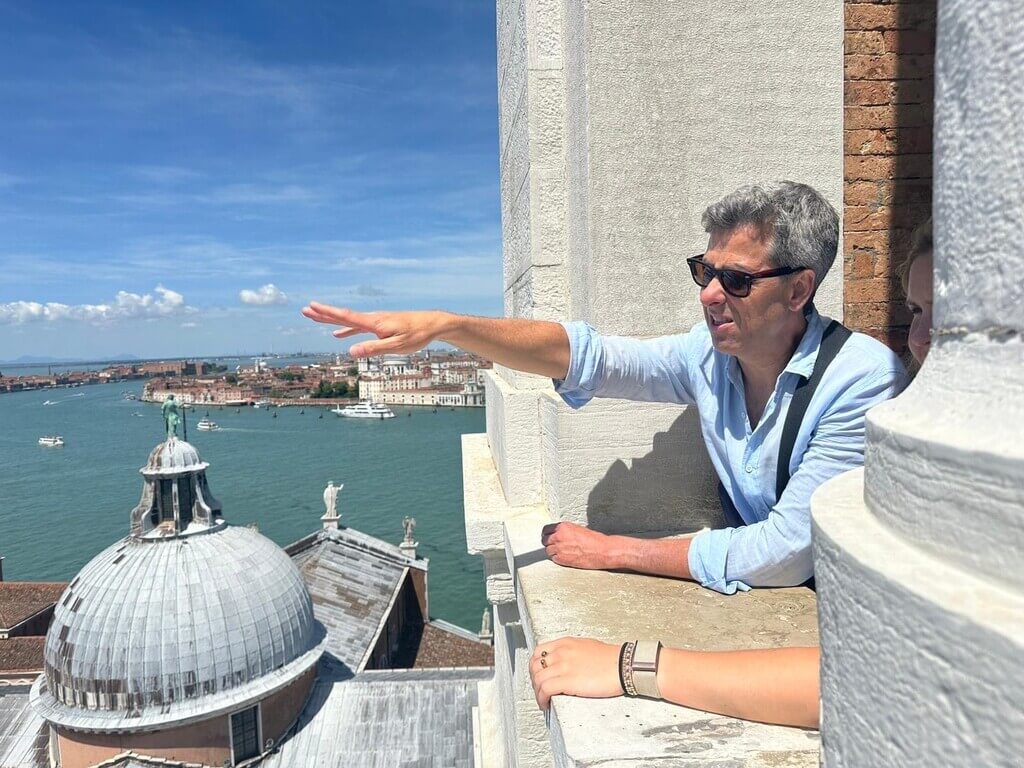
Professor David Karmon
“Venice changes the way you think,” explained Karmon, pictured here at the Campanile.

The sinking city

Venice is indeed at a precarious point in time, facing more extreme flooding and other environmental challenges than ever before. It’s a place Karmon calls impossible and, yet, it’s still standing.

“People have been able to live in this improbable place, under these improbable conditions, for centuries,” he said. “There's lots to learn from the ways Venetians coexist with their environment. They were able to flourish in the lagoon by becoming very attuned to the natural ecosystem in which they are immersed.”

The ways the city has found to adapt and survive found their way into the students’ art. They participated in tours of the lagoon and learned about the city’s bridges and flood defense systems. One week of the program was spent in residency at Scuola Grafica, an art and design center, where they learned printmaking from a Venetian dedicated to environmentally friendly practices. Some of the students pulled elements from these lessons into their projects.

“While you're in Venice, you can't escape the water,” said Roe, who created a map of Venice by drawing pipes to illustrate how crucial water is to the city. “You're constantly thinking about how the water is being used. Even, ‘How can I use the water? What vaporetto should I take, or what bridge should I cross to get to my destination?’”

Image
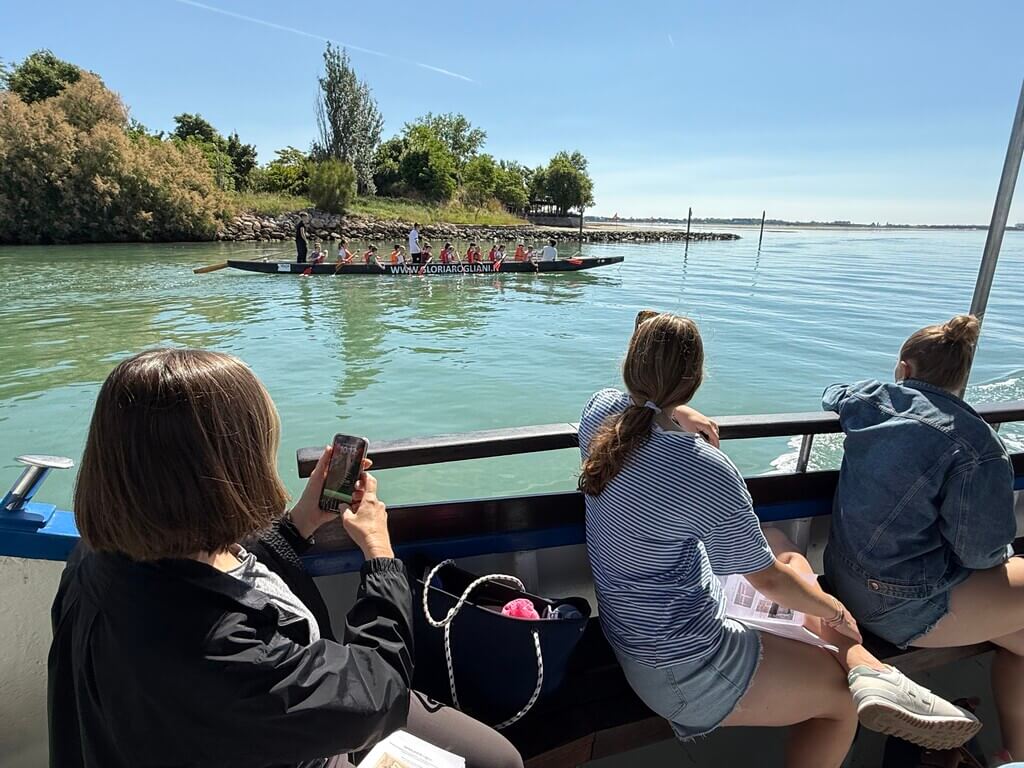
Students on a boat in the lagoon
Students toured the lagoon to learn more about how integral water is to the city and its inhabitants. Here, they watch children learn to row at Sant’Erasmo in the lagoon.

“Venice changes the way you think,” Karmon explained. “Things are changing constantly. The tide comes in and out three times a day. The rhythm of change and movement in Venice is visceral, and the experience is challenging and provocative for the creative process.”

Capturing the magic

Just like the tides, Rinklin’s and Karmon’s plans for the course changed unexpectedly and frequently over the course of the month. The city itself made sure it had its say, offering a little of that Venice magic to the students who were studying it.

“While we were there, there were all of these unplanned, serendipitous connections that were made that were gifts dropped in our lap, like people we were introduced to that became central to the course,” Rinklin said. “This is basically the story of this course. These magical connections just kept happening.”

Image
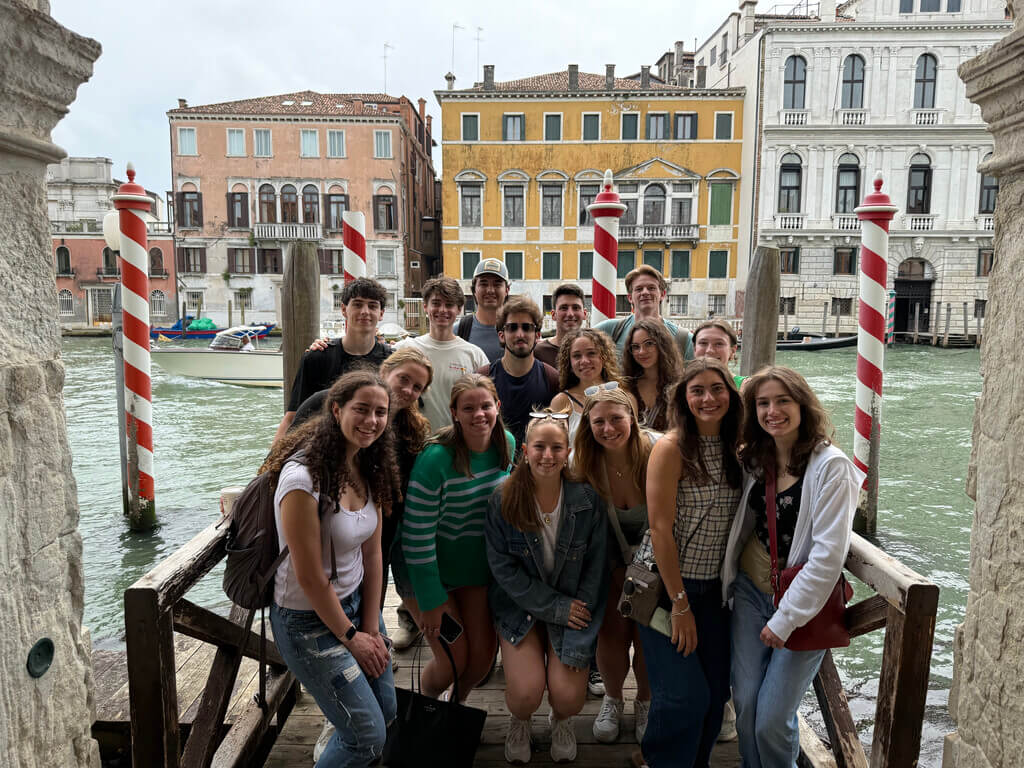
Group of students on the Grand Canal
The class along the Grand Canal.

Karmon plans to run the Maymester course again for 2026, this time in partnership with Leslie Schomp, assistant professor of studio art. That will, he explained, inevitably change the experience of the course. But just like the magic of walking down an alley in Venice and stumbling upon something unexpected, those changes are part of what makes the experience special.

“You wonder if it's the place that helps that to happen,” Karmon mused. “There is something magical about Venice that way. So many people come there from all over the world. You can never tell – you might just turn the corner and bump into someone you know.”