Sophie Sundaram ’26 Spent Her Senior Year Thinking About Home

Sophie Sundaram working on a black and white drawing at an easel
Fenwick Scholar Sophie Sundaram '26 in her studio in Millard Art Center.

As part of Holy Cross’ premiere academic scholarly experience, the Fenwick Scholar turned people’s description of “home” into works of art.

Sophie Sundaram ’26 had one goal for her senior year: Go out into Worcester and listen to people.

She asked them about their families, their cultural traditions, the places they grew up. She learned about the foods they loved, the plants they tended, the scents and sounds that evoked specific memories. She wondered, “What does ‘home’ mean to you?” 

A studio art major, she then took everything she learned in these conversations and turned them into portraits. 

For her Fenwick Scholar project, “Landscapes of the Heart and Home,” Sundaram built relationships with several people in the Worcester area with histories of migration, and over the past academic year, created 15 works of art that depicted their interpretations and feelings around the idea of “home.” Sundaram is one of three seniors named a Fenwick Scholar for the 2025-26 academic year. One of the highest academic honors the College bestows, these scholars complete a program of independent research or a project over their senior year in place of the traditional two semesters of courses.

Image
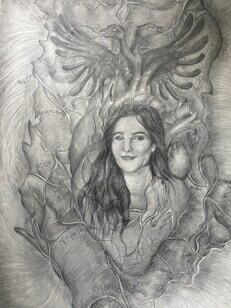
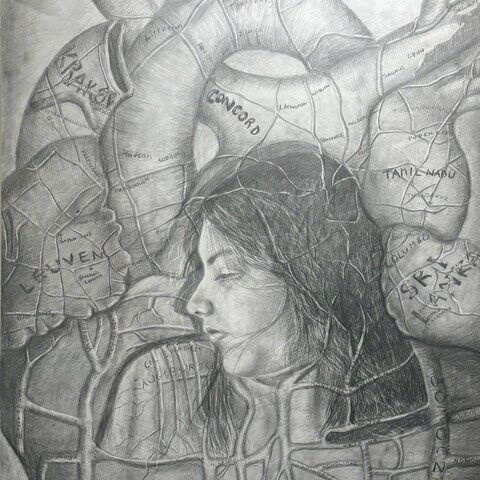
Black and white drawing of Sophie Sundaram
Sundaram's self-portrait that inspired her Fenwick project, created during her first year at Holy Cross.

Sundaram’s project was initially inspired by her own complex definition of home and a self-portrait she created during her first year at Holy Cross. 

“I was really thinking about home, and the fact that my family's from different places, and the sense of home was never just one thing for me,” said Sundaram, who grew up in Concord, Massachusetts. Her mother is from Poland; her father’s family is Indian and he spent his early childhood in Sri Lanka. Aside from her parents, all of her family lives outside the U.S. “It always felt really layered and multifaceted,” she said. “I love Concord. But then, at the same time, home to me is speaking Polish with my mother and sister, and the silk saris my grandma would bring from India, and stuff like that. And so, you know, it's complicated.”

Sundaram’s project also grew from a desire to connect more closely with the Worcester community: “I wanted to do something where I felt like the people I was talking to, I wasn't in a role of helping them. I was in a role of actually learning from them.”

To make connections with people willing to share their stories and have their portraits created, Sundaram attended cultural events throughout the city, made contacts through an artist circle and Holy Cross faculty and students, and extensively cold-emailed people. She got involved with community organizations like the Worcester Senior Center and Refugees and Immigrants Cultural Empowerment Massachusetts (RICEMA), attending their events, book clubs, English language lessons and tai chi classes, even when she needed a translator.

“I think it was important to me to feel like if I'm going to try to get into the community, I need to also live like I'm in the community,” she said.

“It struck me that she was really authentically and genuinely out in the community and learning about Worcester from diverse voices. This is the way we should learn,” said Leslie Schomp, assistant professor of visual arts and one of Sundaram’s advisers on the project. “And [she was] thinking about what home meant – particularly Worcester as a home, not just home in general.”

By immersing herself in these community spaces, Sundaram built what she calls a web of connections and interactions that led her to each of her subjects. Then, it was time to get to work. 

Image
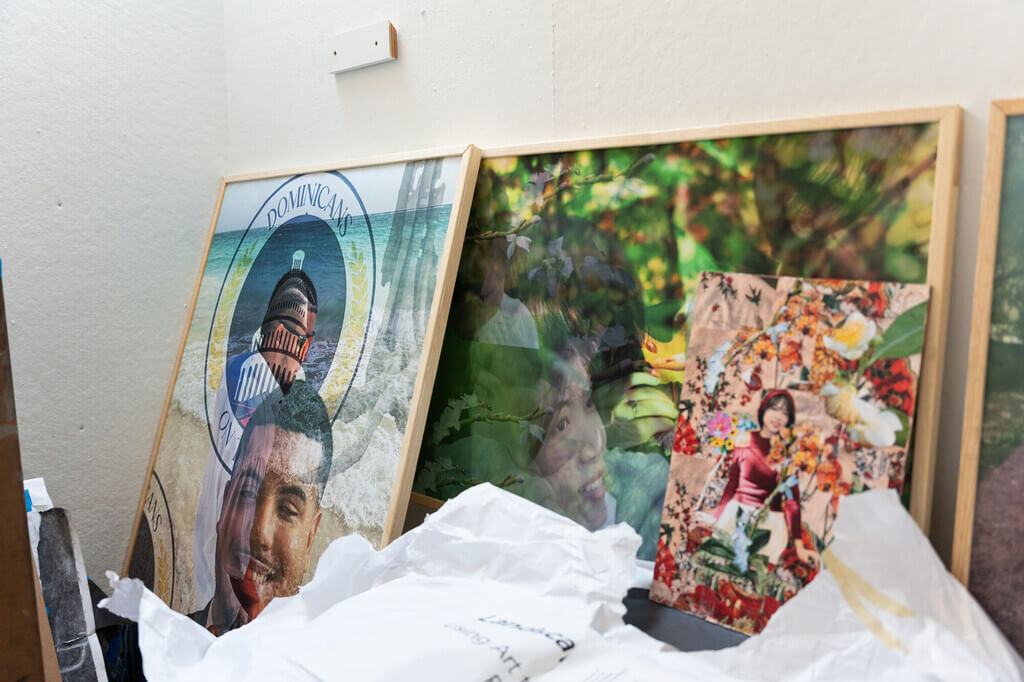
Three works of art leaning against a wall
Though each portrait was deeply unique to its subject, several themes connected them all: food, flowers, loved ones, landscapes, memories and more.

“I came into the process with a very rigid idea of how the process was going to go. I wanted to have three to four interviews, I wanted them to all be in person, and I wanted to be at people’s houses. It didn’t really end up working out. People have messy, complex lives,” she explained.

Sundaram adapted her interview process to include emailing, virtual meetings and even lengthy text message conversations. “I was learning so much more about people the more flexible I was. In my initial work, I was so subsumed by this idea of the perfect conversation that I was kind of treating my subjects as the means to the perfect conversation. And then when I loosened up my approach, I had a lot more fun.”

She also adapted her art style in response to the conversations. Sundaram’s primary medium is black and white pencil drawing, and she anticipated that all the portraits would follow suit. But, as her interviews progressed, she found that many of her subjects would pull out photographs to show what they associated with home. It inspired her to move into digital photo collage.

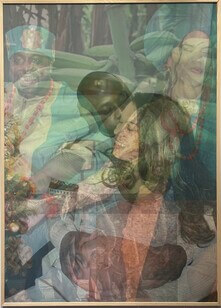
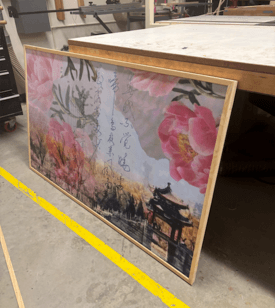
“This idea of home – it's kind of a layered thing. It's like a palimpsest that people had, especially when they moved to different places, and through time they've had many different experiences of home. Some of the people I interviewed were in their 80s, you know, [and they’ve] had so many different experiences and different ways of thinking about it. Through digital collage, I could put these things together and layer them and create transparencies and opacities and physically reflect a multifaceted, layered sense of home.”

Except digital art was an entirely new medium to Sundaram. She reached out to Rachelle Beaudoin, professor of practice in digital media, and worked one-on-one with her to learn Photoshop and other layering techniques.

“She really picked it up pretty quickly and started to do some different experiments. She was very curious. It speaks to her willingness to experiment and try things where, here's the biggest project that she's ever done, and then she's like, ‘I think that this is the best way to express what I'm trying to express, even though I'm not 100% sure how to do it,’” Beaudoin said. “She was letting the project lead the work.”

This idea of home – it's kind of a layered thing. It's like a palimpsest that people had, especially when they moved to different places, and through time they've had many different experiences of home.

Sophie Sundaram '26

While each portrait is deeply unique and personal to its subject, Sundaram found several common themes recurring through her conversations: family members, food, landscapes, flowers, physical homes and childhood memories. 

Many of these are joyful topics, and as a result, many of Sundaram’s finished works exude that joy. But she acknowledges that that “positivity bias” is a limitation of her project: Most of the participants were middle class, college-educated adults, willing and able to engage in a public project without putting their immigration status at-risk. This makes her project both political, because of current immigration policies, and apolitical, because home is something to which  everyone can relate, she said

“When they talked about home, they talked about the everyday, they talked about their families, they talked about their children, they talked about the gardens and flowers and all of these things,” Sundaram said. “It's showing people who have histories of migration as not just political entities at a time when they're often seen in terms of policy and migration laws. But the people I interviewed are so much more than that. It acknowledges the migration histories. But it's not about policy. It's not about politics. It's not about, well, you know, all of these immigration laws and things like that. It's about a sense of home, which is something that I think can bring a lot of people together.”

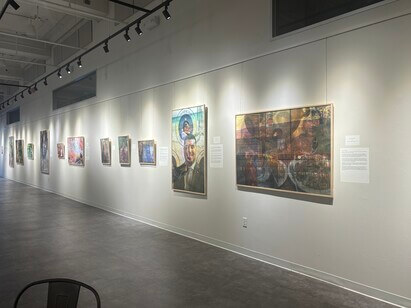
Sundaram’s completed portraits were displayed at an exhibit at the Jean McDonough Arts Center in Worcester in April 2026. For some of her subjects, it was the first time they saw their finished portrait.

“It was such a great feeling, just seeing how happy people were when they saw their portrait,” she said. “One person told me that when she read the wall label that I had made, and saw the portrait I made of her, that she felt like I knew her better than she knew herself.”

“Because it was art that was going to be a gift, and art that came from people's information, not just hers, that was a very different way of making art,” Schomp said. “When I stepped into that opening and saw how excited everyone was who were participants, it was like, you don't actually get to see that as a teacher. And that was just lovely.”

Each subject was gifted their portrait, and some have already installed them in places of honor in their homes or businesses. These works of art are becoming family heirlooms, connections to family heritage and loved ones near and far. One participant even wanted to try this project for herself with her daughters, family members and friends.

“I love the idea that this might continue past me,” said Sundaram, who will be completing a Fulbright in Vienna, Austria for the 2026-27 academic year, then pursuing a Master of Arts at the Yale Institute of Sacred Music and Yale Divinity School. “It's sparking conversations that maybe they wouldn't have otherwise. People will pick up the phone and be like, ‘What do you think about home?’ Maybe people are learning more about themselves and their emotions and their families and friends, and it's sparking some of those deeper questions that are so important. That is just the biggest gift I could have asked for.”