
Let’s begin on the losing side of an epic battle.
Or what seems to be.
Shieldmaiden Éowyn, noblewoman of Rohan, faces off against the Witch-King of Angmar, Lord of the Nazgûl, at the Battle of the Pelennor Fields. She kills his horse. He breaks her arm. Looming over the girl, who is disguised as a young man, the Witch-King gloats, saying, no man can kill him.
Éowyn removes her helmet, revealing her woman’s face and saying, “No living man am I!"
And suddenly the battle turns. One blow by a Hobbit with a magic sword and another by Éowyn and the Witch-King is dust.
Éowyn’s story thrills “Lord of the Rings” fans but none, perhaps, so much as Éowyn Bailey’s father — if her first name is any indication. She is, indeed, named after the Tolkien character.
Some might worry that such a name sets a level of expectation for a child that others like “Lisa, “Melanie” or “Carrie” do not.
Or, maybe such a name sets something in motion, suggests a purpose. Perhaps naming is a calling.
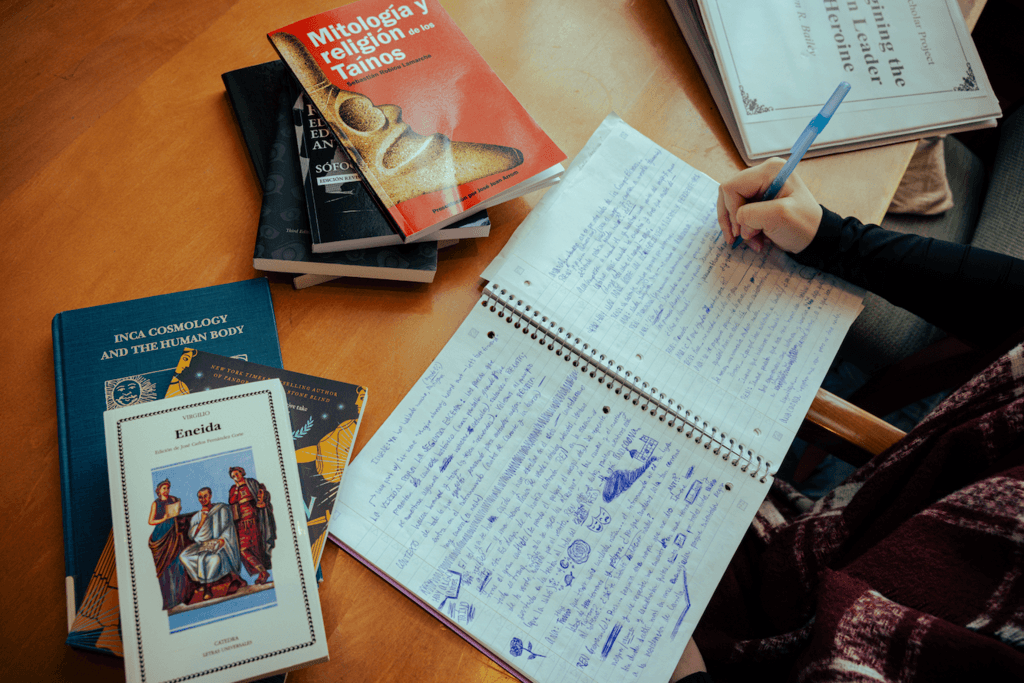
Bailey is one of three of the College’s 2026 Fenwick Scholars. The Fenwick Scholar Program, one of the College’s most prestigious academic awards, supports students conducting an independent research project in their senior year. Bailey’s project, “Reimagining the Woman Leader and Heroísma,” examines the concept of the woman leaders in Classical and Indigenous literature.
Bailey’s project draws on coursework and experiences from her two majors, Classics and Spanish, as well as a concentration in Latin American, Latinx, and Caribbean Studies. Through these disciplines, Bailey encountered women, historical and mythical, who, together, enhance and expand the concept of the traditional heroic figure.
“This connection will challenge the depiction of heroism as an act or trait traditionally characterized by masculinity,” Bailey says. “In the process of reimagining these women, I have learned how distinct their voices are and how recognizing these distinct voices has helped me realize how many stories there are to be told that are both different and similar.
“I’ve also gotten the opportunity to study the variety of ways we can consider ourselves heroines.”
To ‘look fully at the good and the bad’
Bailey’s project, a play and a critical paper, examines the stories of four female heroines, two mythic and two historical, encountered by the protagonist, Renata: Ismene, sister of Antigone, Volsci warrior Camilla, 15th-Century Taíno chieftess and rebel, Anacaona, and Micaela Bastidas Puyucahua, an 18th-Century Peruvian rebel. Leaders, all, but varied in their approaches and tactics, Bailey says.
“Ismene is a patient, pragmatic guide; Anacaona, a creative, fierce chieftess focused on unification,” Bailey says. “Camilla is a skilled, unrelenting warrior and Micaela Bastidas, a strategic, resolute and caring revolutionary.”
Common to all is a kind of scholastic underappreciation of varying degrees. And popular culture hasn’t been quick to right wrongs. Camilla, favorite of the goddess Diana and skilled in weaponry, was said to be able to run across water without getting her feet wet and dash across corn fields without disturbing the ears, but how many blockbuster movies about ancient civilizations feature her as the headliner?
“They are women who often go overlooked or are silenced,” Bailey says. “Even having their names mentioned or some portion of their stories preserved is a powerful thing.
“I want to give an authentic voice to the figures I’ve selected and look fully at the good and the bad,” Bailey says. “Predominant narratives have had the tendency to represent these women as against the status quo and, ultimately, to die as a result.”
In discussing her project, Bailey mentions more than half a dozen courses and experiences — and as many faculty members — having directly influenced her project.
As a Weiss Summer Research scholar, she worked on databases created and maintained by Bridget Franco, professor and director of the Montserrat Program, a year-long living and learning experience for all first-year students. Bailey says her Montserrat seminar with Franco opened her eyes to the possibilities that Latin American, Latinx, and Caribbean Studies might enhance and extend her scholarly interests.
Latin 301: “Nation and Individual: Vergil” provided her the opportunity to create artwork depicting Camilla leading troops and cavalrymen into battle. In Modern Spanish and Spanish American Poetry, Bailey was introduced to Bastidas, who led a rebellion against Spanish conquerors, through the poetry of Magda Portal.
Professor Daniel Frost calls Bailey a “woman of many voices” and worked with her to develop each of her play’s characters.
“As a budding scholar, Éowyn has always seen language as a window into the past, but I have also loved seeing her working so hard to develop the expressive side of her Spanish, whether in theater or poetry,” says Frost. “She often drops by my office just to talk, and I have come to look forward to that moment when she cracks open her little notebook to scribble something new among all the other verses and snippets already there.”
In choosing to explore women heroes in myth and culture, Bailey enters an arena of her own, engaging, as she is, in the ongoing and sometimes heated debate about what exactly is a Classics education and who deserves to be taught in Classics programs. She joins international scholars such as Emily Wilson, the first woman scholar to translate "The Odyssey" and "The Aeneid," and Maria Tatar, the John L. Loeb fellow at Harvard's Society of Fellows, whose 2021 book "The Heroine with a Thousand Faces" foregrounds women heroines' stories and challenges the quest narrative as the only path to heroism. More broadly, Bailey's scholarship highlights how Classics departments nationwide have been wrestling with how to include more ancient cultures and voices in their respective disciplines. In response, Holy Cross's Classics Department has expanded its scope, adding courses in ancient Egypt and Mesopotamia and Biblical Hebrew.
Professor Timothy Joseph of the Vergil course praised her work on this front:
“She did a wonderful final project on the mythical character Camilla in Virgil's ‘Aeneid.’ Camilla is an Italian queen who leads an army to ward off the invading Trojans. She's an unforgettable character who—as Éowyn has emphasized—is too often forgotten!”
Creative scholarship in Classics Education
Bailey is not the first Classics major and Fenwick scholar to choose a project with a creative bent. Maia Lee-Chin ’21, also a Classics major, landed a book deal after her Fenwick Scholar presentation went viral. “Et Cetera: An Illustrated Guide to Latin Phrases” was included in NPR’s 2024 article “20 new books hitting shelves this summer that our critics can't wait to read,” and in September 2025, it made USA Today’s bestseller list.
Bailey, whose creative bailiwick is poetry, took first prize in the 2024 Ramero Lagos poetry competition sponsored by the Department of World Languages of Worcester State University. A poet since high school, she wrote 71 poems during a junior year abroad in León, Spain.
While abroad, Bailey experienced what it is to be, at once, oriented and disoriented in the best sense. Living and learning abroad developed in her an appreciation for the “intricacies and intimacies of cultural exchange from the perspective of both a learner and a teacher,” she says.
That may factor into why Bailey chose to make her play multilingual, an act of homage to the language and culture of each character. Bailey believes her audience will not see the languages spoken in her multilingual play as a barrier.
“I believe people do not need to have a perfect knowledge to explore, listen to and appreciate others’ languages, cultures and perspectives,” she says.
What Bailey hopes to achieve is to challenge her audience to consider not only their definitions of heroism but also to discover their own heroísma.
“For me, the most important thing is finding your place and knowing your direction,” Bailey says. “I believe Renata is a little bit of all of us because it is her story of discovering what she wants and needs to do to be a leader, [which is to listen] to others’ stories.”


