‘Knowing Your Community Matters’

Two women walking in the Worcester Common
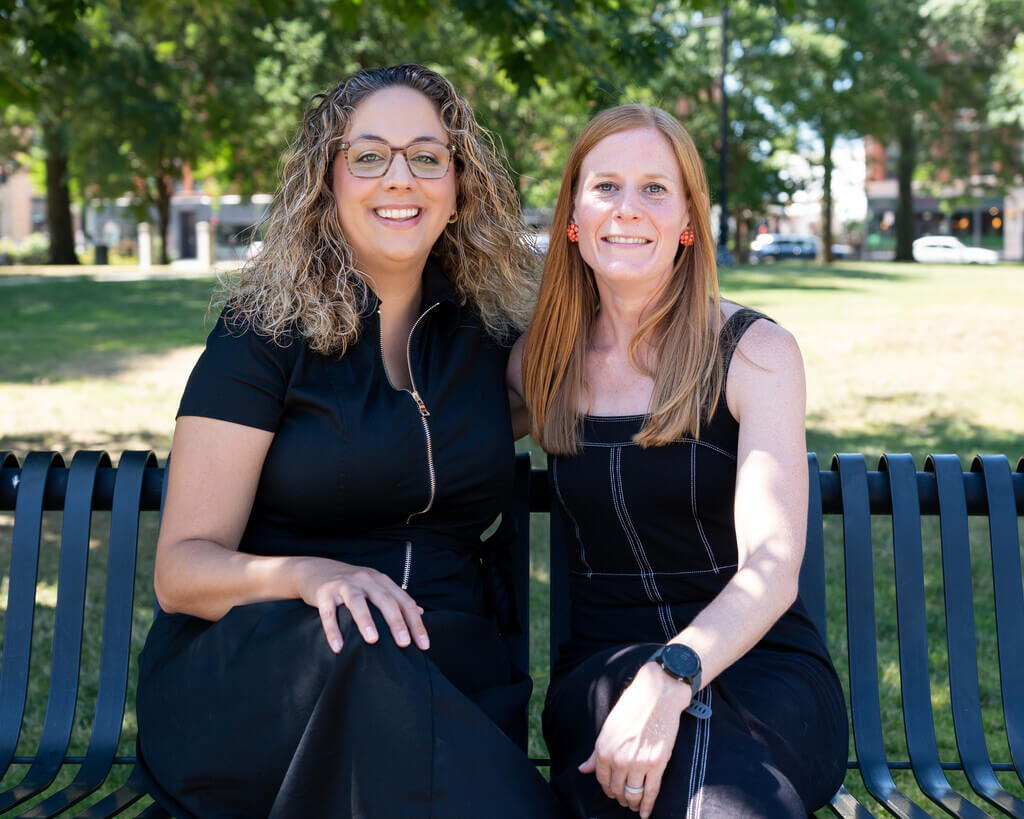
Two alumnae, one job: Megan Moran '11 (left) and Isabelle Jenkins '10 are both committed to connecting their institutions with the Worcester community.

Isabelle Jenkins ’10 works at Holy Cross. Megan Moran ’11 works at Worcester State University. Yet both have the same goal: Building relationships between students, faculty and city organizations, businesses and nonprofits to deliver life-changing opportunities.

Isabelle Jenkins ’10 and Megan Moran ’11 didn’t know each other during their time on The Hill. 

Just a year apart, they say they were like ships passing in the night, certain they must have overlapped at an event, Kimball dinner or program. If they did, neither can remember.

But now, more than 15 years later, something is finally bringing them together: the same job.

As director of the College’s Donelan Office of Community-Based Learning, Teaching and Engaged Scholarship, Jenkins supports community-based learning (CBL) courses, through which students work with Worcester-based organizations, nonprofits and groups as part of a class. The office also assists with joint research between faculty and community partners, offers a learning certificate program in social action and civic leadership, and more. 

Just three miles away, Moran recently joined Worcester State University as director of the John J. Binienda Center for Civic Engagement, in which she supports student volunteering, internships, experiential learning, civic engagement research and developing community engagement opportunities in courses.

Separately and together, the two are dedicated to connecting students and faculty with organizations, businesses and residents of the city through academics and service opportunities. They sat down with Holy Cross Magazine to talk about their Holy Cross roots, working with the city and more.

How did you first get involved with community engagement work? Was it at Holy Cross? 

Isabelle Jenkins: I took Intro to Women's and Gender Studies – it’s called something different now – and we did CBL projects on women's and gender issues in Worcester. My group was doing some fundraising and work with some organizations in Worcester about breast cancer awareness, and it was just a great way to get to know the city and also to help me understand how I learn best, which is applied learning.

Megan Moran: I don't think I ever took a CBL course at Holy Cross. After leaving Holy Cross, I pursued a Ph.D. in musicology at the University of North Carolina Chapel Hill. I met with different faculty, and one would bring all these different hip-hop artists into his classes to co-teach. I was like, ‘What is going on?’ I didn't realize that we could have faculty and artists teaching classes together. So I became really enthusiastic and eager to learn more about what community engagement in the college classroom looks like. My career has been kind of all over the place, but I always find that the guiding light has been community. 

Jenkins: For me, the most captivating part of experiential learning is the pedagogical side. I'm really interested in ‘What is the type of education we're providing?’ and ‘How is that education serving a larger purpose?’ I like working with people and having them think about, ‘What are your learning goals and how can you connect these to the wider world? How can we bring that world into the course experience to make your course serve a larger purpose and be a better course for students?’

What are some similarities and differences in your roles?

Jenkins: The biggest difference is what type of institution we are, because that dictates some of the types of community engagement we're able to do. Holy Cross is a small, Jesuit liberal arts institution. We have students who are strictly undergraduates, and we have faculty in the humanities, social sciences and the sciences. So courses and faculty research interests sometimes are the drivers of community engagement. But if a community partner needs someone who's a nurse, they can't actually partner with Holy Cross. I think it's great that we have all these different types of institutions in Worcester because each institution can provide a different type of community engagement, at a different time of year.

Moran: I agree 100%. I'm grateful to be in a place where there are so many different types of institutions that can leverage each other’s specializations and resources to make Worcester a better place. What's exciting to me about Worcester State students is so many of them are from Worcester and stay in Worcester. It's interesting to work with students who are already entrenched in the Worcester community in ways that I'm learning from them, and to be working with students who want to see their impact outlive their time at Worcester State.
This type of work – the people-to-people, relationship building, community-driven work – really expands, invigorates and inspires students in ways they might not have known were possible.

Megan Moran '11, director of the John J. Binienda Center for Civic Engagement

How do you collaborate with each other and with other institutions?

Jenkins: There’s been ebbs and flows of formal collaborations between community engagement centers over the years, and now we are building that network ourselves. Those of us who work in community engagement understand the absolute importance of working across institutions. Having those relationships really helps. And then being courageous to reach out to folks I don't know and saying, ‘We do this same work, we should get together.’

How do you connect students, faculty and staff at your institutions with community members and partners in Worcester? 

Jenkins: For CBL courses, the whole point of the community engagement piece is to serve the community and the goals of our community partners in Worcester, and also to fulfill the learning goals of the course. So we need to have a particular understanding of the type of learning that the faculty member wants their students to have, and then work with our community partners to say, ‘Through the volunteer work that you have, will they achieve that goal?’ The logistical piece is so much relationship building. I have a beautiful staff, I have a great assistant and associate director, and they're out in community partner meetings all the time, understanding and listening to the community so that when we have a faculty member approach us, we know exactly who to partner them with. 

Moran: I'm going to answer this question in a slightly different way. I'm going to share one program which I think demonstrates the type of partnership work we want to be doing at the center. It's called the Worcester Civic Leaders Program. We have an inaugural cohort of five students from Worcester State, and we are matching them with local nonprofits to serve on their boards. I love this program because the students have all successfully matched with local organizations that are so excited to have youthful, diverse perspectives on their board. And it really gets to the point of wanting to make that positive social change and empower our students in that work. 

Why is it important for students to participate in community work?

Jenkins: Oh my, so many reasons. First and foremost, experiential learning is an excellent way for many students to learn. It helps concepts make sense and it makes the work more meaningful. I've had students say if they have a CBL project, ‘I worked harder on this than any paper ever,’ because somebody else is receiving the product or volunteering. 

Also, most of our students are 18 to 22 years old. They’re young adults. They're going to be participating in the world. And you don't wait for college to be over to do that. There’s also so many people in Worcester who have so much great knowledge and lived experience, and it enriches, I think, students’ understanding of the major or the minor that they're in, but also themselves.

Moran: I don't know how to top that answer. The only thing I'll add is what I love about experiential learning is that students get to explore other aspects of their own identity and their own selves. For a student who might not care too much about music or the arts, for a student who might not really know too much about biology, to be able to do a CBL project or to be engaged in a community organization, that opens up a whole new world and creates new pathways for students to explore their own identities and different career paths that they might not have otherwise known about, or people they might not have ever met that could change and influence their life forever. This type of work – the people-to-people, relationship building, community-driven work – really expands, invigorates and inspires students in ways they might not have known were possible. And that's the real power of education. 

Jenkins: Can I add one more thing? We have assessments of our courses every year and students will submit feedback. One of the questions we ask is, ‘Why was CBL meaningful for you?’ So many students say it was so impactful to be working alongside others and seeing people care about other people. That's also really important for students. If you're in a social media bubble or a news bubble, you're often actually not seeing day-to-day caretaking, and that can be really demoralizing. But when you're out in the community working with organizations, you're seeing people work hard and care about other people and care about social justice issues. And I think it provides a lot of hope for students in a time where it's hard to find that.

Image
Megan Moran and Isabelle Jenkins
Moran (left) and Jenkins.

At Worcester State, a lot of students are from Worcester. At Holy Cross, while we have local students, we also have people coming from all over the country or the world. Whether they have a long-standing relationship with the city or are only here for four years, why is it important for them to connect to Worcester?

Jenkins: For four years, they’re residents of Worcester. That matters. Knowing your community matters. We want people to love Worcester and stay in Worcester. The more you engage, the more it feels like home. And then a lot of the volunteering our students do is in elementary schools or with little kids. The kids in Worcester love meeting the basketball player from the West Coast or the international student from across the globe. I think that's fun for them to bring their knowledge of another place or their home or their own lived experience to the community. That's a great exchange.

Moran: What we want for our students is these life-changing opportunities which really shape their own journeys. Whether they come back to us or not, they are now civic leaders. They're serving on their boards in their home communities. They're bringing all of that knowledge, that expertise, those skills and that empathy with them along the way, whether it's going to be in Worcester County or it's going to be in California.

Jenkins: And I'll steal a quote from our most recent valedictorian, Peter Stamoulis ’26. He's from Worcester, and he took nine CBL courses. He had the most beautiful commencement address where he talked so much about Worcester and how, as alums, we’re all stewards of Worcester now. And you can't be a steward of Worcester if you don't engage with Worcester.

Moran: I love that. Can we get t-shirts? "Stewards of Worcester." 

How does this work benefit the community partners? 

Jenkins: In lots of ways. So many partners appreciate having youthful voices and ideas, and that shows up in all sorts of ways, if they're on a non-profit board or in a classroom or doing a research project. Also, a big part of how nonprofits operate and serve the community is with volunteers, and we fill the spots they need. And then encouraging community partners to think differently or more deeply about the work that they're doing, helping creatively address the issues nonprofits are working on. 

Moran: If a partnership is successful, it should be collaborative. It should be reciprocal, with us as university partners really meeting our community partners where they're at, and meeting their priorities through the educational experiences that we're providing for our students. 

For four years, [students are] residents of Worcester. That matters. Knowing your community matters.

Isabelle Jenkins '10, director of the Donelan Office of Community-Based Learning, Teaching and Engaged Scholarship

Building on that, one of the things we talk about Holy Cross is being part of the community, not “saviors coming down from The Hill.” How do you navigate that?

Jenkins: By asking, ‘What are we adding on to?’ rather than ‘What gap are we filling?’ By helping students and faculty confront their own biases about service and volunteering. And in collaboration, everyone’s giving and receiving. For example, as a math tutor, I might have the math knowledge. But the student I'm working with in Worcester Public Schools has knowledge about Worcester or lived experiences we can exchange. I bring the math. You bring something else. 

Moran: “Reflection” is the word that comes to mind. Teaching our students good reflective practices before, during and after their community engagement experience is really important. Whether it's in a class, whether it's volunteer based, whether it's co-curricular or curricular, I think centers like ours can really empower faculty and students to make sure that they're embracing and integrating reflective practice into that work, and making sure that students can see themselves as members of the community, as well.

Are there any other challenges or misconceptions you come across in your work? How do you navigate those?

Jenkins: Historically, community engagement and experiential learning have been viewed as less rigorous, so not everybody's on board. As the professorship is becoming more diverse, that's changing, but it's always a challenge to advocate for. Another challenge is, as a higher-ed institution, we have a particular operating structure. We have two semesters. We don't really have many students in the summer. And community partners work all year long. That's where collaboration is so important, making sure we're working together to not just be here for eight months of the year, but all 12.

Moran: There's so many different people involved in this work. It is hard when the student wants one thing, the faculty wants one thing and the partner wants one thing. Having a really strong mission and values be the driving force [helps you say] no sometimes or prioritize one relationship over the other. And I think the way to navigate that is through having really strong relationships. 

So much of the Donelan Office’s work is tied to Holy Cross’ Jesuit mission. Worcester State, meanwhile, is a public university. What drives your work from the institutional level? What drives you personally? 

Moran: At Worcester State, the mission involves creating engaged citizens. It certainly drives the work we're doing at the center to foster engaged citizens. Students are craving and looking for these real-world experiences. Our partners are also very invested in having youthful, diverse perspectives in their communities and working with their institutions and fueling that economic development in our city as future employees or interns. 

Personally, as a mother of two, I want to have my kids grow up in an amazing community where they can have their voices heard, and to be in community spaces where they can drive positive social change. I see this work as not only a professor or an administrator, but also as a mother and as a Crusader, trying to bring out the best in our communities. 

Jenkins: First and foremost, Holy Cross formed me as a person. To be able to participate in the formation of others at the place that formed me – what a gift. And then specifically for the work of community engagement, I really believe that the purpose of higher education is both to educate students and to serve the world. Through the programs that we have in the Donelan Office, we're engaging with the world, we're listening to the world, we're trying to figure out how the resources we have can partner with the amazing organizations in Worcester that are doing the work to address social injustices. Higher education has a huge role in that, especially a place like Holy Cross that has a ton of resources and a wonderful alumni network. We're a part of this city, and we're not just the college on The Hill.