Don’t Speak Portuguese? Dance Instead

People learning to dance
Students learn to dance xaxado from the Grupo de Xaxado Cabras de Lampião in Serra Talhada, Pernambuco.

How one Maymester turned to the beaches, the streets, and the experts — from ages 6 to 80 — to learn what music and dance mean to Brazil.

When a group of students arrived in Recife, Brazil to spend a month studying music, dance, culture and history, most of them were unfamiliar with Brazilian music. A couple were music majors. Some had instrument experience; others had taken a course about Brazil. Only two spoke any Portuguese.

It didn’t matter. As they would soon find out, music and dance have a language of their own, and it’s one that transcends translation.

The course, “Brazil: Music, Culture, Environment,” was the inaugural Maymester for Schuyler Whelden, assistant professor of music, and Clarissa Carvalho, visiting assistant professor of sociology and anthropology. Set to be offered again in June 2027, the course was also the first Maymester run in conjunction with Holy Cross’ music department. Over the course of four weeks, the group explored musical traditions across various locations and climates in northeastern Brazil, from the urban spaces of Recife and Olinda and coastal villages like Ilha de Itamaracá, to the forest zones and arid interior of Arcoverde. 

“We were able to look at musical, archaeological and other kinds of human cultures in two different states in four or five different locales, including a very large city, some small cities and some very rural places, in order to think about ideas of Brazilian-ness, northeastern Brazilian-ness and other identity categories, as well as how people make meaning in their lives,” Whelden explained.
Image
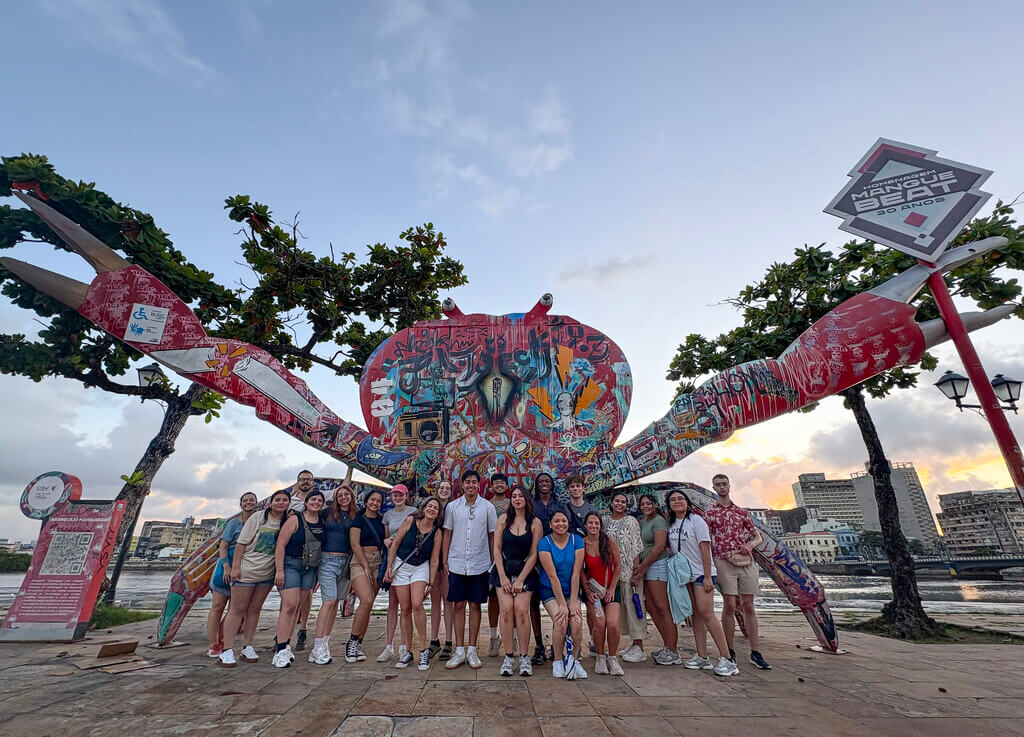
Group of people in front of a crab statue
The class in front of the famous Mangue Beat Crab Statue in Recife, Pernambuco.

The two professors chose music and dance as the lens through which to explore Brazil because of how intertwined the two art forms are with the culture and history of each region. Because music and dance vary throughout the country’s different climates, based upon the environment and materials available, it's one way to understand the geographical landscape of the world’s fifth-largest country. It’s also a way that, throughout history, Brazilians have exercised resistance against slavery and colonization, as well as expressed their religion. 

“Thinking music through anthropological lenses is understanding the social context in which music and dance interconnect, and the context in which certain types of music started. For example, during slavery time, a certain type of dance music – martial arts – started,” Carvalho said. “It gives context to the music that is not only about the rhythm, the melody, but what it meant for the people when they started that and the people who still carry it on.”

“The Afro-Brazilians showed this strong source of resistance through music and art culture,” said Curtis Goines ’27, a history major and education minor. “They weren’t separate from each other. They worked hand-in-hand because they showed their strength through their music, through their art, and through everything that they did. Their resistance, the music and the religion, those all intersect with each other. And it was cool to see how everybody had their own way of expressing it.”
Image
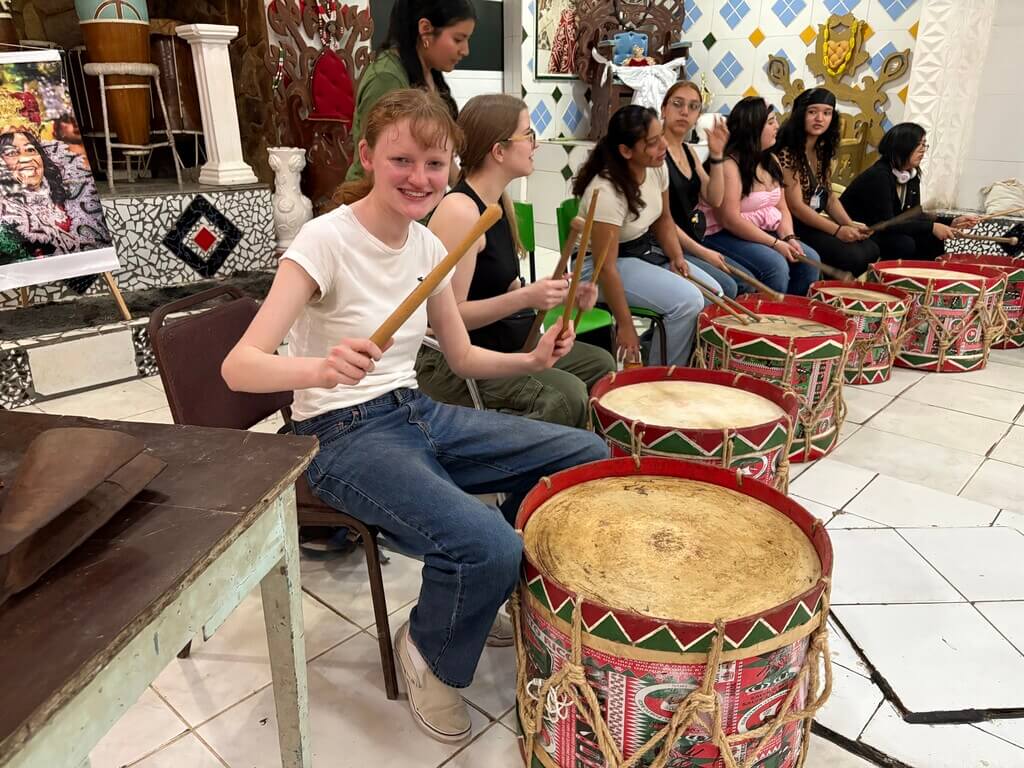
Simone Cooke with drum sticks
Simone Cooke '27 learning to play Maracatu de Baque Virado from Ogã Ivan Silva at Nação do Maracatu Porto Rico in Recife.

The class spent the first two weeks of the Maymester in the state of Pernambuco, taking Portuguese classes in the morning, followed by activities, workshops and site visits in the afternoons. The second half of the course was spent traveling throughout the northeast region, including a week in Carvalho’s native state of Piauí, to explore archeological sites and learn more about the country’s history. But no matter where in Brazil the class was located, the highlight was always the same: live music and dance.

“I teach a lot of Brazilian music in the classroom at Holy Cross, but there’s nothing like experiencing a musical culture in person,” Whelden said. “You might have seen a clip of a religious ceremony involving music and dance and that’s interesting, but being there and seeing it, seeing how long it actually takes, smelling what it smells like, and being able to talk to people involved – those kinds of things are the reason to go into the field.”

“The idea of going and seeing the stuff we learned about in person and meeting people who have dedicated so much of their lives to this kind of music was crazy,” said Simone Cooke ’27, a double major in music and political science. “Going from learning on the fourth floor of the Brooks Music Hall about these styles to being in the middle of a street in the city of Recife at this massive parade-type thing where everyone's dancing this kind of music everywhere – it was really cool to see these things in person.”
Image
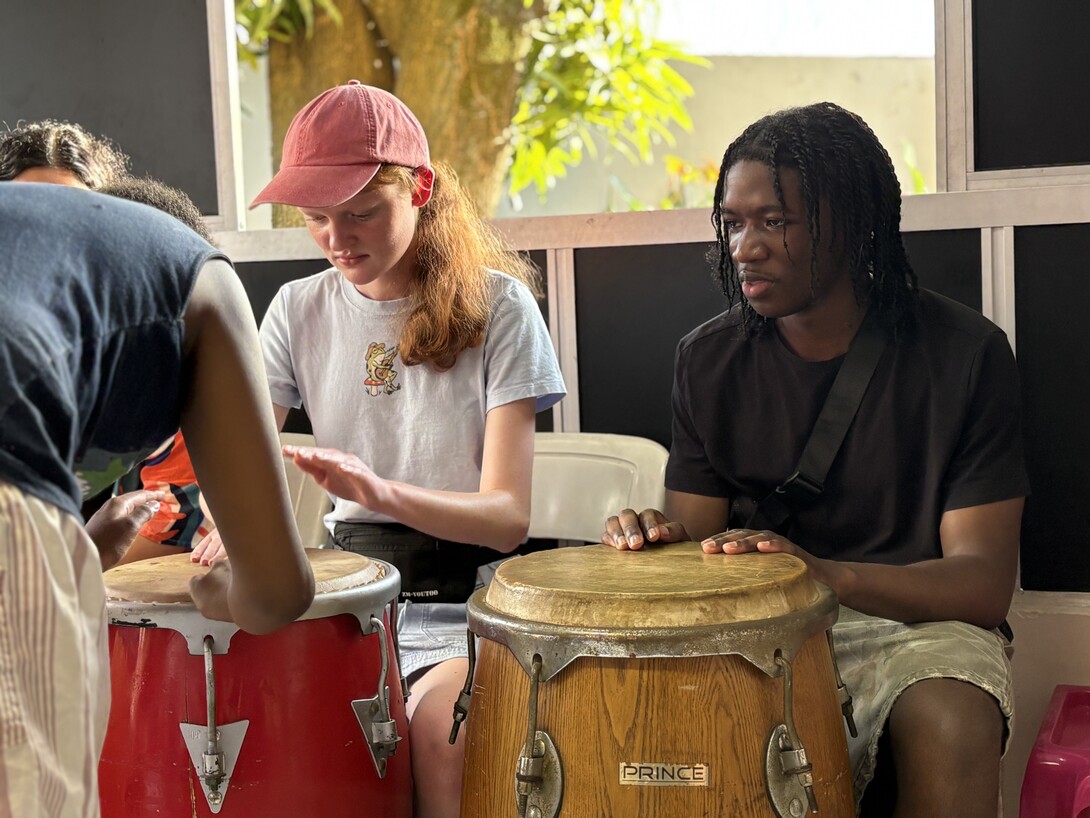
Two students playing drums
Simone Cooke '27 and Curtis Goines '27 learning to play coco at the Nação Xambá Cultural Center in Recife.
Image
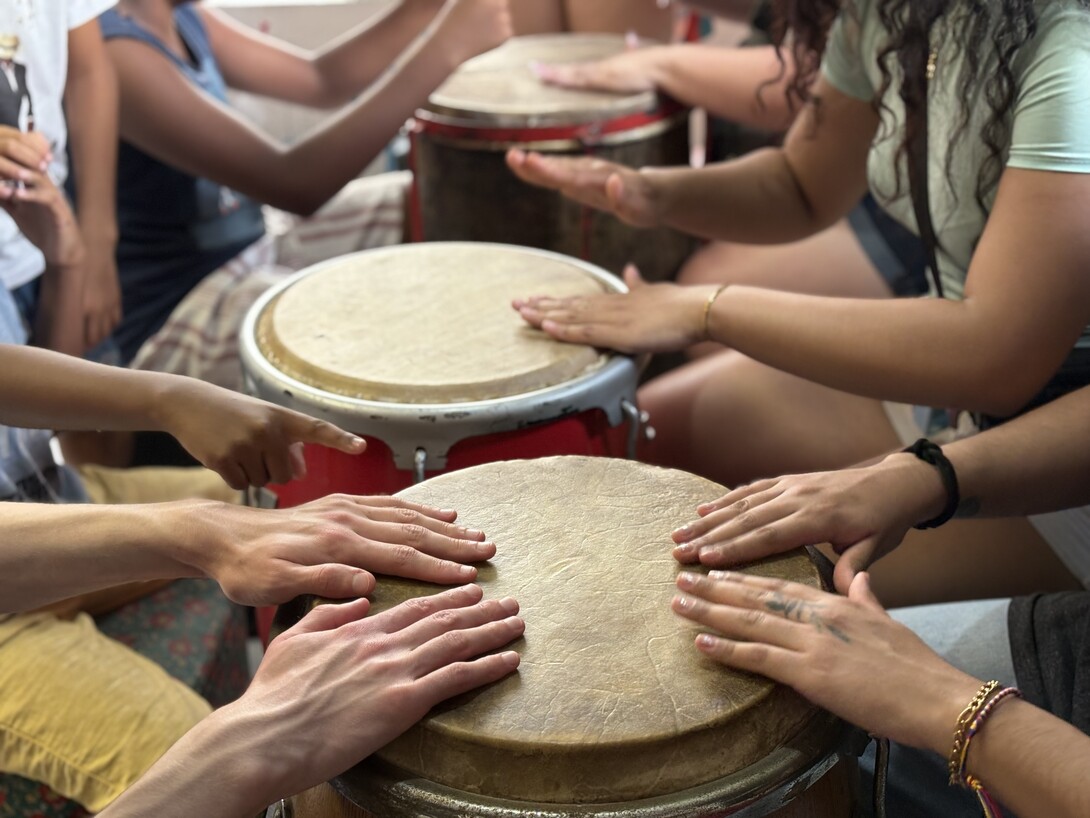
Hands on drums

One afternoon was spent at a center for Candomblé, a Brazilian religion, where they watched people ages 6 to 70 perform a coco, a common percussive rhythm for that area. The young children taught Whelden and the students how to play the drums.

“All of our students were taking drumming lessons from 6-year-olds. It was beautiful, and it was remarkable,” Whelden said. “You wouldn't ever have this happen. You wouldn't bring a 6-year-old to do a guest lecture in a university setting, but the reality is, the music is not transmitted in a university setting in most cases. This is a community experience that you learn by doing at a very young age.”

“They didn't know any English at all, and I didn't know any Portuguese, but they connected with us through music teaching us how to play the drums. If we got it, they got excited,” Goines said. “It was cool, learning from kids who are also immersed in that culture. It just shows how [the tradition] trickles down and how they want it to carry down to the next generation.”

“To be able to communicate musically, to interact through the medium of percussion, was really cool,” said Cooke, who is a classically trained trumpeter. “A lot of my music education was formal lessons; you have this allotted time with your teacher and you sit down and learn it. In Brazil, you learned a lot more by ear.  It was very common for people to play something, and then you listen to it and internalize it and try to replicate it. It was very immersive.”

I often forget this as a music major, but music is supposed to be fun.

Simone Cooke '27

Another day was spent learning the ciranda, a traditional communal circle style of music and dance, from Lia de Itamaracá, a living cultural heritage of Pernambuco. That night, coincidentally, a Ciranda da Resistência was taking place on the beach. The event happens once a month, and Lia and others play ciranda, and people from all over the village come to dance.

After the workshop, the students headed down to the beach ahead of Whelden and Carvalho.

“When we got there, there's all these people from the town dancing, and our students were there, dancing with them, holding hands and dancing,” Carvalho recalled. “We were literally tearing up. That was the most impactful thing that happened there. That was beautiful. They didn't want to leave. They wanted to stay there forever. And so did we.”

“We're out there dancing, and it's raining on us, and it doesn't matter. Because you are learning directly from someone who is a living repository of a particular cultural memory. You're getting to be in the presence of this person who has been practicing this art for more than 80 years. And our students realized that it was a rare, maybe a unique opportunity, and they threw themselves into it,” Whelden added. “It wasn't just that they got to learn a certain rhythm, or a certain dance step. They got to feel what it was like to be part of that community, if just for a moment.”

“And although they had two weeks of Portuguese classes, it's not like they had learned all this Portuguese in just two weeks,” Carvalho continued. “So they were doing all that, dancing with people who didn't speak their language, holding their hands. To us, it was just incredible how music and dance allowed them to do that.”

That joy – of sharing music, dance and unique experiences across language barriers and different cultures – was the heart and soul of the Maymester for the professors and students.

“What made the biggest impact on me was the people were so incredibly kind and excited about sharing their culture and music,” Cooke said. “I often forget this as a music major, but music is supposed to be fun. Witnessing the relationship to music that people have there and their enthusiasm about music and the kindness of everybody there to share it was really impactful.”