College Tradition Lives on in an Unexpected Place

Rev. Keith Maczkiewicz, S.J.
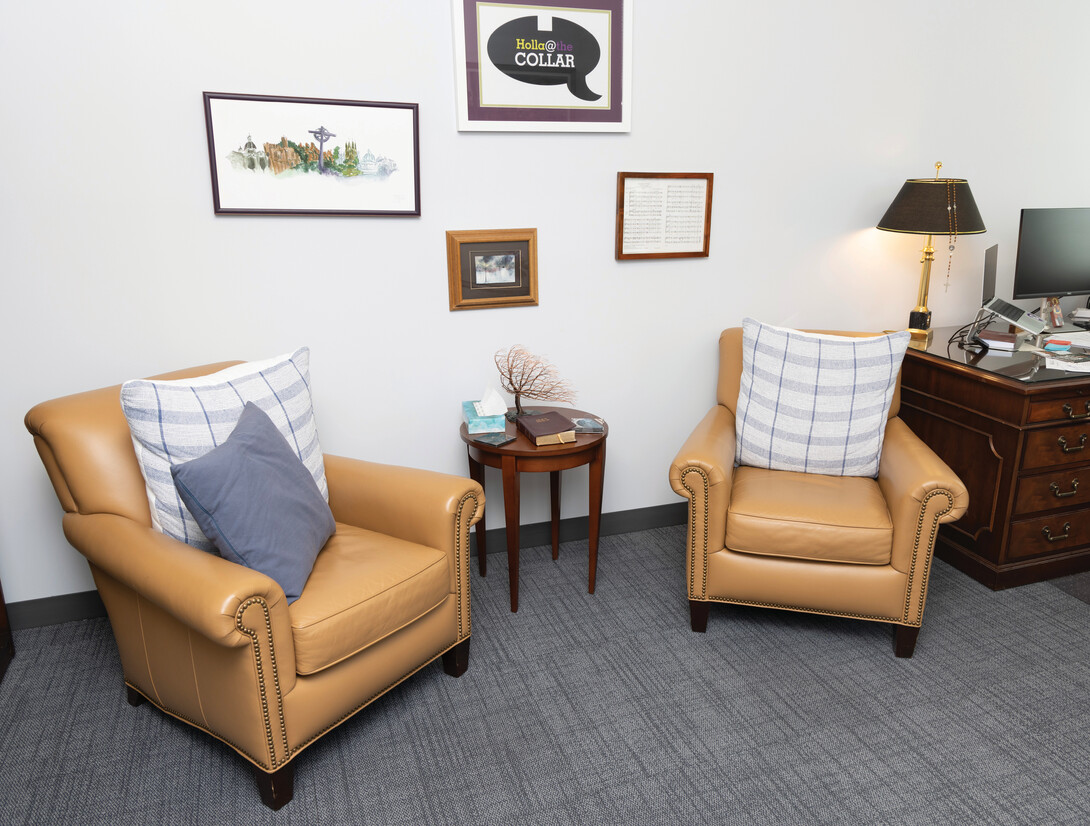
Rev. Keith Maczkiewicz, S.J., associate vice president for mission and ministry, in his new Smith Hall office.

How necessity, sustainability, happenstance and Jesuit identity converge in the office of Rev. Keith Maczkiewicz, S.J.

Walk into the Smith 303A office of Rev. Keith Maczkiewicz, S.J., and it looks like many others on campus. There’s a desk tucked in the corner, a table with a few chairs pulled up for meetings, a bookshelf stuffed with books and memorabilia. Look a little closer, and you’ll see touches of personalization: a hat from his alma mater, Fairfield University, a “Holla @ the Collar” sign from when Fr. Maczkiewicz would hold informal office hours at Cool Beans and, of course, a crucifix. But then he starts talking. 

The large crucifix on the wall reportedly belonged to a former Jesuit dean. The chair you’re sitting in, as well as two armchairs and a desk lamp, can be traced to three Holy Cross presidents. A painting on the wall was handed down from a Jesuit predecessor in the Office of Mission Engagement. And the desk itself? 

It belonged to Rev. John E. Brooks, S.J., ’49, Holy Cross’ 29th and longest-serving president, and one of the most beloved figures in modern College history. 

Suddenly, this ordinary office is a lot more: It’s an unexpected treasure trove of Holy Cross history and a lesson in living from the Jesuits themselves.

THE NOTE IN THE DESK 

Fr. Brooks became president in 1970 and, over the next 24 years, made a number of changes that shaped the Holy Cross of today, including introducing coeducation and advocating for a more diverse student body. The desk in Fr. Maczkiewicz’s office, however, didn’t enter the story until the last six years of the Brooks presidency. A 1988 fire in the president’s office destroyed his existing desk (along with his chair, rug and wastebasket), which, according to an article by the Worcester Telegram & Gazette, “had no historical value either to the College or to Fr. Brooks.”

Just like its predecessor, the desk ordered as a replacement was nothing special at the time, nor was it custom made. But Fr. Brooks was “very particular,” notes Dan Ricciardi ’06, associate vice president for institutional resources and assistant treasurer. Fr. Brooks decided he liked the new desk, so it remained, then moved to his new office on O’Kane 2, where he worked with the Office of Advancement as president emeritus until his death in 2012. 

Three doors down the O’Kane hallway sat Tom Cadigan ’02, director of alumni regional and special programs. Cadigan knew Fr. Brooks well and recalls several conversations held across the desk, chatting about the Red Sox or fundraising for the College. While the Jesuit community and Fr. Brooks’ family were cleaning out his office, Cadigan vividly remembers the moment that advancement leadership first offered him the desk: “They just kind of poked their head in my office and said, ‘We’ve got something you might like.’”

Cadigan says he’s not sure why he had the good fortune to become the desk’s next owner, but surmises it’s because of his love of College history and sharing it with others – Cadigan is known for his popular “Hidden in Plain Sight” campus tours – that he would be someone who would appreciate it. And, for more than a decade, Cadigan made sure to tell its story to anyone who visited his office. 

In summer 2025, a number of large-scale office moves took place around campus. The Office of Advancement moved from its longtime home on O’Kane 2 to Loyola Hall. Transitioning to an open workspace meant the desk wouldn’t fit the floorplan. After 13 years working on the same surface as Fr. Brooks, it was time for Cadigan to say goodbye. 

At the same time, the Office of Mission Engagement was preparing to move to Smith Hall, where a former conference room was renovated to accommodate Fr. Maczkiewicz and colleagues. The new offices needed furniture, and Ricciardi stepped in.

“As someone that loves Holy Cross, who was lucky enough to know Fr. Brooks, I just wanted to make sure that that desk ended up in someone’s good hands,” Ricciardi says. He took Fr. Maczkiewicz to Cadigan’s former office to show him the desk. “I said, ‘I think Fr. Brooks would be really happy if you had his desk.’ Keith does such a good job at keeping the light of the Jesuits going, and I think it’s a nice testament to the Jesuit leaders that Keith is now the new custodian of Fr. Brooks’ desk.” 

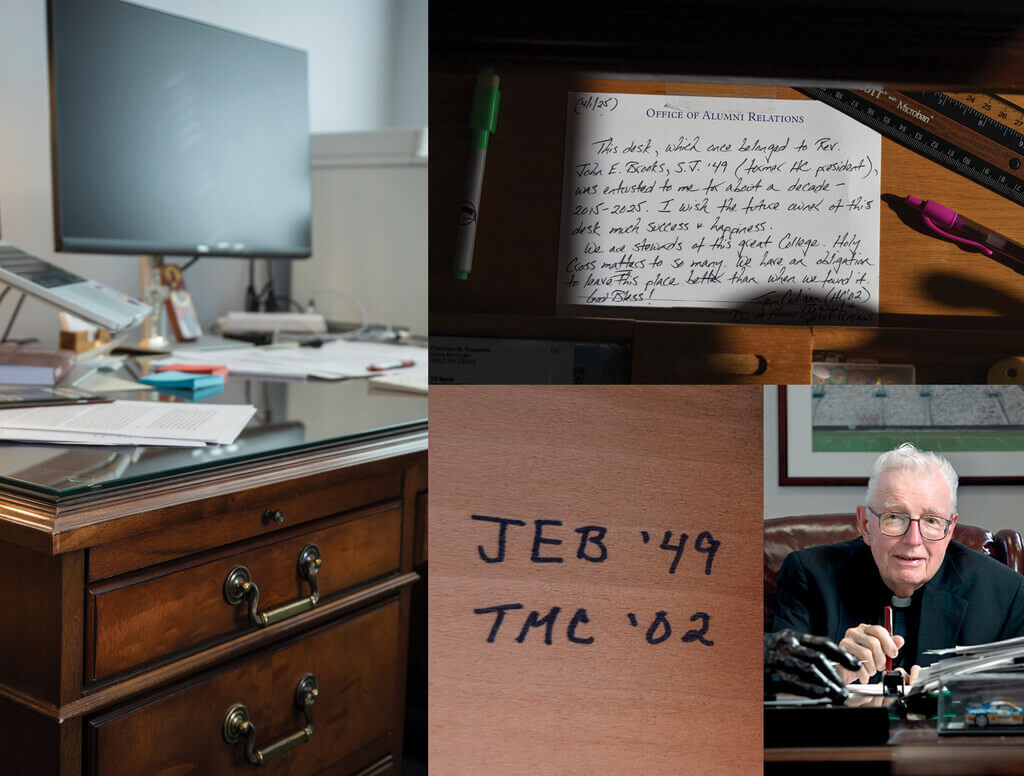
During the desk visit, Fr. Maczkiewicz discovered a note inside a drawer that Cadigan wrote on an 11th-hour whim while waiting in a mostly empty office for the official word that it was time to move. “I just had this fear that it was going to, like, end up in a back storage closet and be forgotten,” Cadigan says. This note was his prayer that the desk would end up in a good place.
Image
Collage of desk photos
Clockwise from left: Fr. Brooks’ desk in Fr. Maczkiewicz’s office; the note Cadigan left with the desk; Fr. Brooks at his desk; the former users’ initials.

It reads: “This desk, which once belonged to Rev. John E. Brooks, S.J., ’49 (former HC president), was entrusted to me for about a decade — 2015-2025. I wish the future owner of this desk much success and happiness. We are stewards of this great College. Holy Cross matters to so many. We have an obligation to leave this place better than we found it. God bless!”

SUSTAINABILITY AND HISTORY 

Other items associated with past College Jesuit leadership have also found their way to Fr. Maczkiewicz’s new office. The desk lamp belonged to Rev. Michael C. McFarland, S.J., Hon. ’12, the College’s 31st president, who passed it to Rev. William R. Campbell, S.J., ’87, former vice president for mission, who gave it to Rev. Timothy O’Brien, S.J., ’06, associate vice president for mission and Fr. Maczkiewicz’s predecessor.

Image
Desk surface with lamp and computer
The desk lamp that originated with Fr. McFarland.
Image
Chair with Fordham seal
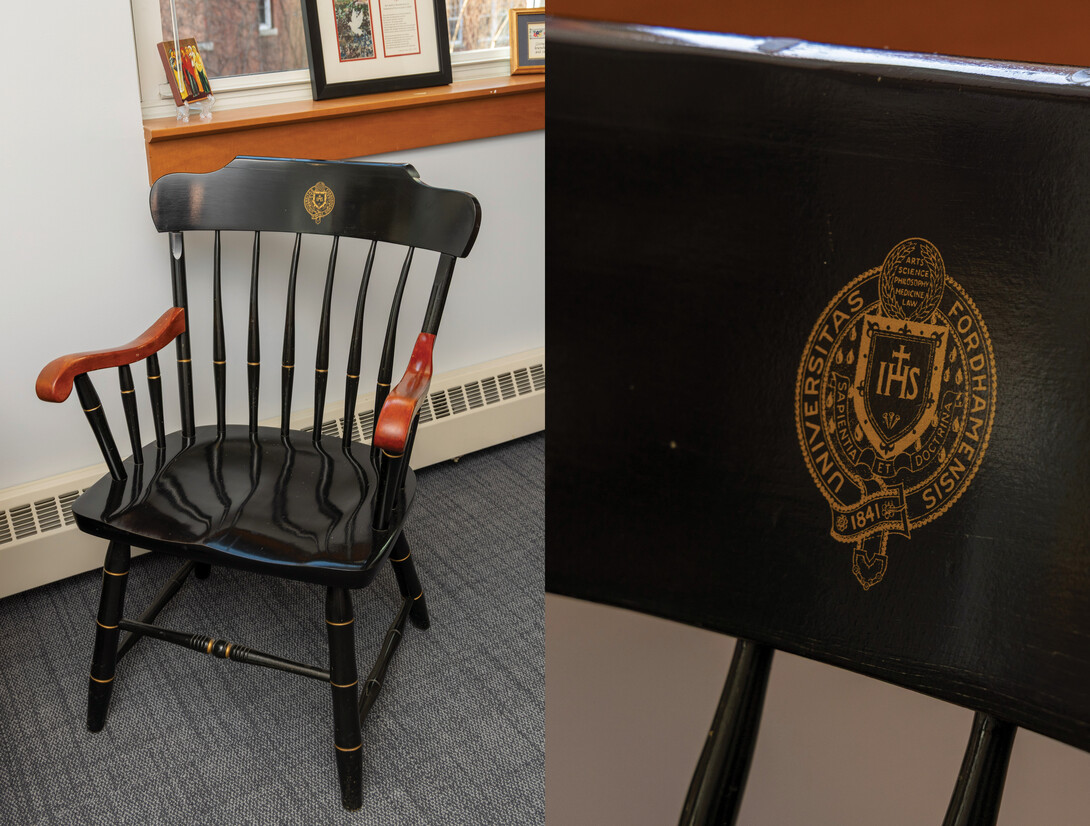
Fr. Reedy’s Fordham chair.

A chair, a gift from Fordham University, belonged to Rev. Gerard C. Reedy, S.J., Holy Cross’ 30th president. The watercolor on the wall was painted by Sarah (Valente) White ’16 and depicts one of the College’s Ignatian pilgrimages. It was gifted to Rev. Paul F. Harman, S.J., Hon. ’24, Holy Cross’ inaugural vice president for mission, who, in turn, gifted it to Fr. Maczkiewicz. Fr. Maczkiewicz wasn’t on the pilgrimage depicted in the painting, but has a close relationship with Fr. Harman and has since become the chaplain of the Office of Mission Engagement’s annual faculty and staff pilgrimage. 

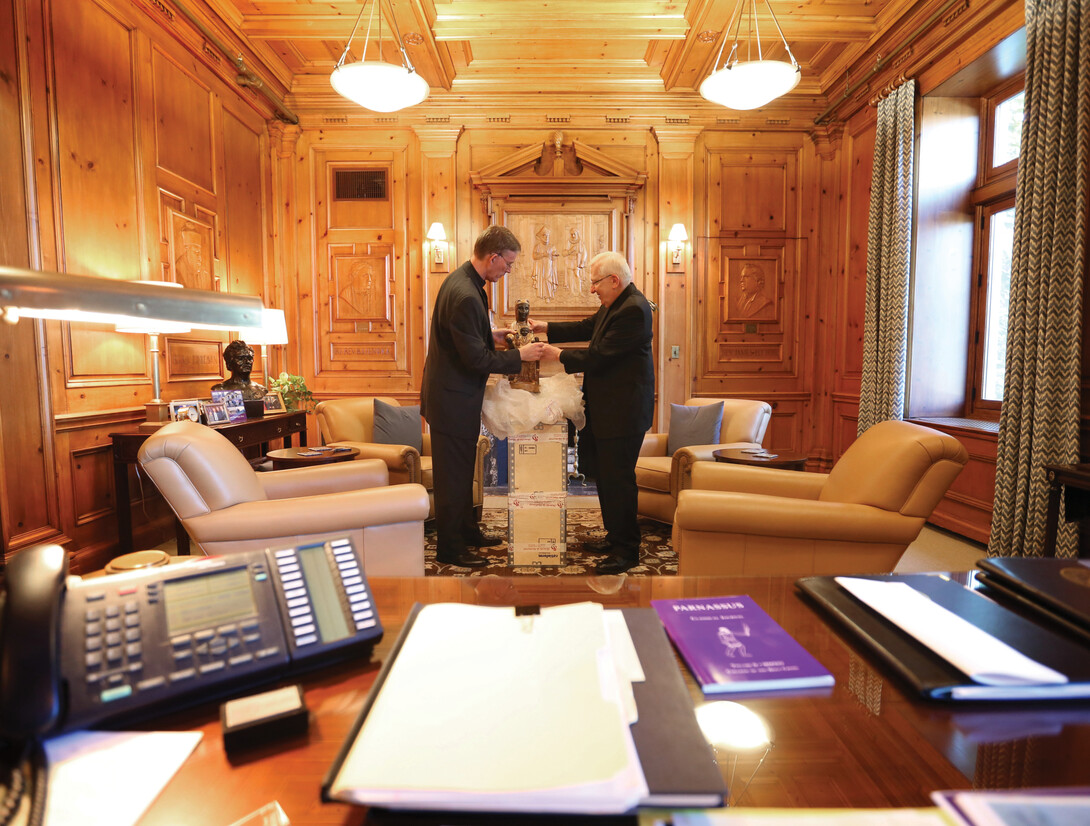
Two armchairs, originally part of a set of four, sat in the office of Rev. Philip L. Boroughs, S.J., Hon. ’22, the College’s 32nd president. And when new occupants of Fenwick 1 moved into their offices, they found a large crucifix in a closet that they believe belonged to Rev. Joseph Fahey, S.J., dean of the College for the better part of the 1970s; they brought it to Fr. Maczkiewicz’s office to find a new home.

Image
Seating area in Fr. Mac's office
A watercolor depicting sites from the College’s annual Ignatian pilgrimage hangs above chairs repurposed from the president’s office.
Image
Fr. Boroughs and Fr. Harman
Fr. Boroughs and Fr. Harman in the former’s Fenwick Hall office, flanked by the chairs that now sit in Smith Hall.

Ricciardi says it’s common practice at the College to be frugal and sustainable, reusing equipment and decor: “Everything gets put in recirculation … We want things to go to where they’re most needed and where they can do the most good. There’s no sense in something sitting preserved in time when it could be put to use.”

And the artifacts in Fr. Maczkiewicz’s office aren’t the only pieces of Jesuit history hidden in plain sight across the College. Furniture from the Jesuit residences, first in Loyola and then Ciampi Hall, now furnish the College’s off-campus faculty apartments; pews from the Jesuit chapels line hallways across campus, providing extra seating; and chairs and crucifixes now found in Fenwick classrooms once lived in Jesuit rooms on the same Fenwick floors.

GUARDIANS, NOT OWNERS 

These individual pieces have their own stories, but together, they paint one much bigger. On a practical level, Fr. Maczkiewicz views the pieces as “a furtherance of my vow of poverty,” in which Jesuits are called to live simply and not become attached to material goods or anything that detracts from loving and serving God. When he returned to Holy Cross in 2024 for this most recent assignment as associate vice president for mission and ministry, Fr. Maczkiewicz notes he inherited the office and the bedroom of the Jesuit who came before him: Fr. O’Brien. 

“It’s very strange in any other world, but that’s how it works for us,” Fr. Maczkiewicz says. 

He could be reassigned tomorrow, he explains, gesturing around his office, and would take nothing from the office with him: “None of this really belongs to me, you know? But I’m happy to be the guardian of it.” 

But more than anything, it’s a story of the people who have come before to shape Holy Cross. It’s a way to pay witness to their service and devotion, a way to keep their memories and Jesuit traditions alive. 

“It’s just a piece of furniture – it collects dust like everything else. But it’s a physical reminder of what the campus was, what it is today and maybe what it can be in the future,” Cadigan says. “At the end of the day, it’s the people that make this place, but a lot of it also is tied to memory. And memory can kind of be wrapped into a physical object, as well.” 

“Fr. McFarland and Fr. Brooks would be the first ones to tell you that it’s not as much the thing itself as it is the memory of the person,” agrees Ricciardi, who recalls as a student worker sitting at Fr. Brooks’ desk to install a software update on his computer, and who deeply admires what he learned from Fr. McFarland as a student. “It falls on those of us that have been lucky to have been influenced, to have known and to have learned from them to keep that tradition going.”

At the end of the day, it’s the people that make this place.

Tom Cadigan '02

Though Fr. Maczkiewicz didn’t know all of the Jesuits who used these items before him, he speaks about them as if they were old friends. Perhaps it’s a natural feeling within the Jesuit order, or perhaps these items connect him more closely to their stories. Either way, he views the items as a reminder to continue the work of the Jesuits who have come before.

“We try to use the things that we have that are given to us, leave them for someone else to use them, but we don’t hold on to anything too tightly,” Fr. Maczkiewicz says. “In some ways, that is part of the story about the tradition that gets handed on. Even though I didn’t go here, I feel part of a tradition. A lot of that has to do with my Jesuit identity. There’s a lot of guys who were here before, and God willing, there’ll be men here after I’m gone. 

“I don’t know if it’ll be a Jesuit who takes this stuff. But it’s a question about how do people stand in relationship to it, which I think is very Ignatian, actually,” he continues. “We stand in relationship to these things in the way that we stand in the world. So it’s the desk I’m using today. I’m happy to use it. And I’ll let it go when I go.”