One Spring Semester, Two Full-Time Jobs

Kaitlyn Flanagan '26
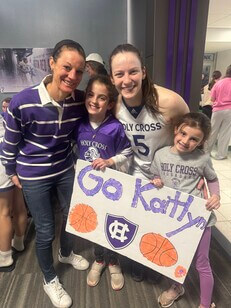
Kaitlyn Flanagan '26 in her classroom at Claremont Academy in Worcester.

How Crusaders guard Kaitlyn Flanagan ’26 juggled student teaching and a Division I NCAA basketball schedule.

Kaitlyn Flanagan ’26 woke up every day at 6 a.m. A senior point guard for Holy Cross’ women’s basketball team, she was preparing for a long day ahead – on her feet, thinking fast and strategic, holding herself and others accountable. 

But she wasn't headed to the basketball court. Not yet.

Instead, she went to Claremont Academy in Worcester, where she taught English to 10th graders, monitored bathroom duty and lesson planned until 2:08 p.m., when school was dismissed. Only then did she trade in her teacher clothes for basketball sneakers, and finally headed back to campus, to the Luth Athletic Complex for practice. 

Flanagan, who has been playing basketball since first grade, is a two-time team captain and four-year starter for Holy Cross. Over the past four years, she helped the team win three Patriot League championships, played in the NCAA Tournament three times, and competed against the likes of WNBA all-stars Caitlin Clark and Paige Bueckers.

But basketball is only half her story.

From the court to the classroom

Flanagan arrived at Holy Cross unsure of her future major, eventually choosing English in her sophomore year. She then attended a career fair for student-athletes, where she learned about the College’s Teacher Education Program (TEP), through which students earn their teaching licensure upon graduation.

Flanagan, whose father is a high school teacher, was intrigued enough to meet with program director Mary Beth Cashman ’05 to learn more. Yet she was also concerned about the feasibility of completing the program while simultaneously playing Division I basketball. Most classes and seminars are held in the evenings, because TEP professors are also practicing high school teachers during the day; these would conflict with Flanagan’s practice and game schedule. In addition, the program would require hundreds of hours of observations and student teaching — a full load to add during a basketball season.

‘There's no way that I can do this.’ That was my first reaction,” Flanagan recalled. “I care so deeply about basketball, about my team, my coaches, that I didn't want there to be something else, a huge responsibility taking away what I've been able to give. I want to give 100% here. But I also knew I'd want to be able to give 100% there, which is tough to do.”

But Cashman, a softball student-athlete during her Holy Cross years, wasn’t going to let the schedule stand in the way of Flanagan accomplishing her goals.

“I never want the Teacher Education Program to hold any student back from any opportunity at Holy Cross,” Cashman said. “The professors at Holy Cross are amazing. As long as you're upfront with them and you communicate clearly what your schedules are, they're willing to work with you. They want to see you succeed on the court or on the field or wherever. And so they're going to do whatever they can to make that happen. The same goes for the coaches. I think they are clearly at Holy Cross because they believe in student athletes. They believe in academics.”

“They understood how much the basketball side not only meant to me, but how committed I am to it,” Flanagan said about TEP faculty and staff. “Their understanding made me feel a lot more comfortable being able to go through this process, because I knew that they had my back as long as I was giving them my full effort and attention.”

With the support of Cashman, TEP professors and women’s basketball head coach Candice Green, Flanagan was accepted to the program for her junior and senior years. The program culminates with 300 hours of student teaching, which meant that during the height of her 2025-2026 senior basketball season, Flanagan would be teaching her own classroom for the very first time.

Which intimidates Flanagan more: taking the court against a Caitlin Clark-led Iowa team, or a classroom full of 10th graders?

“The classroom, 100%,” Flanagan laughs, without hesitation.

“Yes, that was daunting, playing in Iowa. But I'm doing something that, like, I know how to do. I’ve been doing it since first grade. It's something that I feel confident in myself, at this point in my life, that okay, I'm playing basketball,” she continued. “I've never taught before. And so I'm in the classroom now, and this is entirely new to me.”

Image
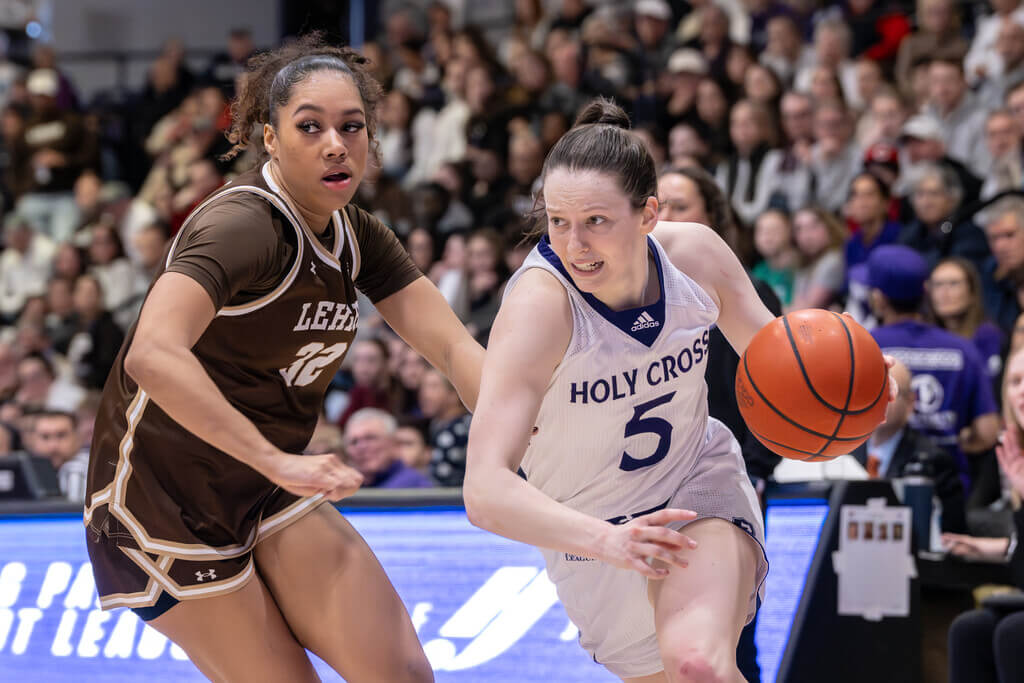
Kaitlyn Flanagan dribbling a basketball against opponent
Flanagan in action against Lehigh. Photo by Mark Seliger/Holy Cross.

Load management

Being a Division I student-athlete or a student teacher individually is enough to be considered a full-time job. But combined? It makes for one busy schedule. 

Yet Flanagan never missed a practice, a game, or a day of student teaching outside of basketball-related absences (and, even then, she made up missing hours before and after TEP’s official student teaching timeframe). Managing the load required a lot of planning and flexibility on the court and in the classroom. Sometimes this required individual study or one-on-one meetings with a professor when class time and game time conflicted. Once, it meant taking a class at Assumption College, an experience Flanagan valued for the new perspective it offered. And, this past season, she even got an assist from her classmates, who agreed to a later start time for one course so Flanagan could make practice and class. 

“We ended up moving it back after the season,” she said. “But definitely shout out to my classmates for dealing with that, for putting up with my schedule.”

“While she was in Michigan, [the class] joked, well, we basically got her here,” Cashman said of the basketball team’s trip to Ann Arbor to face No. 2 Michigan in the 2026 NCAA Tournament. “Her success is their success, and we had a lot of fun cheering her on. I'm just so impressed with them, too – everybody just kind of recognizing that success is collective here.”

On the student-teaching side, Flanagan worked with her supervising teacher to ensure she could meet her team commitments without impacting her students’ learning experience. She would leave Claremont around noon for home games in order to have enough time for shootaround and warm-ups. For mid-week away games, when the team drives or flies back to campus immediately after a game, Flanagan would only get about three to four hours of sleep before waking up for a day of student teaching: “A little caffeine, you know, a little support from both people at school and on my team, and I was able to push through it.” 

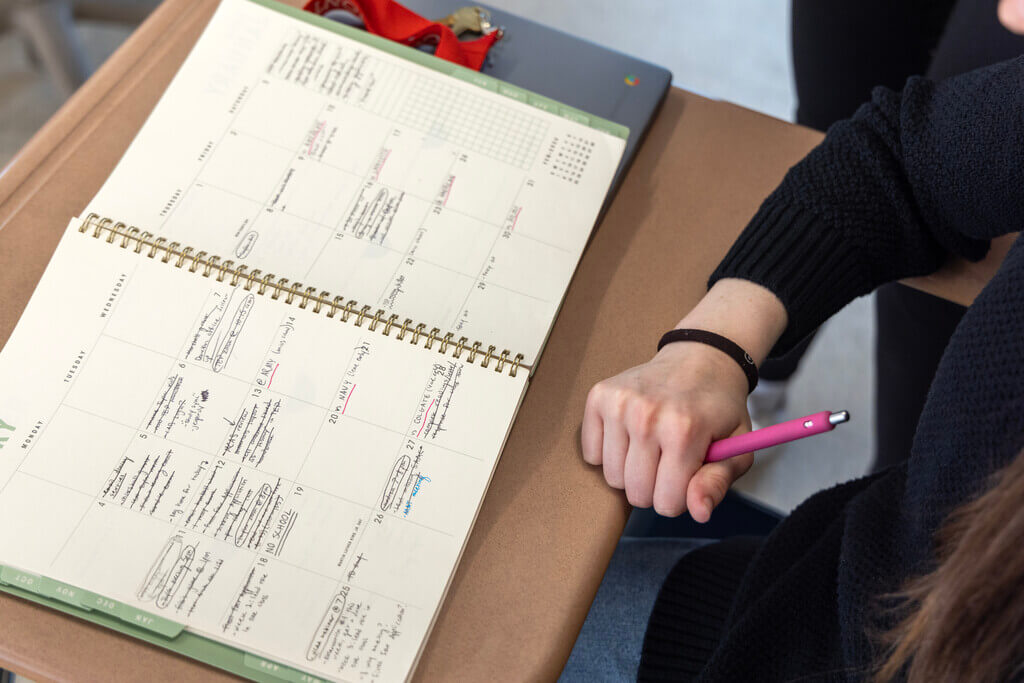
A glimpse at Flanagan’s planner reveals just how packed that schedule was. But you’d never know it just by talking to her. It was simply what she did.

“Her humility is just remarkable,” Cashman reflected. “It's hard in this day and age, with social media and a lot of attention on athletes and student athletes, to actually be genuinely humble. I think that is incredible. And then her mindset, her organization, her communication skills – she's wise beyond her years in the realm of managing things.”

Image
Planner open on a desk
Flanagan's secret to time management: her planner.

“This is the kid that worked for six, seven hours, then comes in and gets treatment on her body, then goes into practice. And you would never know that this was her whole day — of just constantly having to be on,” women’s basketball head coach Green said. “She just doesn't need all that extra praise and stuff like that. She’s just somebody that's, like, ‘No, it's what I have to do. It’s what I've chosen to do. And at the end of the day, this is going to pay dividends.’ She's so process driven. She's like, ‘Oh, yeah, it's hard now. But it'll be easier later.’”

“Staying in the present moment helped me the most, trying not to think too far ahead and stress myself out,” Flanagan explained. “Being in a teaching environment, it's very easy, actually, for me to stay present, because I have to be. I'm interacting with my kids. ‘Are they understanding? Are they doing this?’ So that helped a lot in keeping me present during the school day and not stressing too much about what came after. And then same thing with basketball. While you're on the court, you have to be present. You have to be locked in on what's going on. And so, honestly, it was hard for me to not be present. And if I wasn't present, then I'm not doing what I need to be doing in either of those realms.”

Finding her teammates

Flanagan also credits the relationships she built at Holy Cross with shaping her college experience and her success on and off the court.

“It's just such a community here that I didn't necessarily expect,” she said of her teammates. “We just have a lot of love for each other. You need that to be successful, obviously, on the court, but it just helps so much when we have people who are far from home and you're not used to this new environment and you're adjusting. Having a place where I know everybody on my team has my back and genuinely cares about me as a person – way before they care about me as a basketball player and what I can do on the court – that makes me so much more comfortable.”

Image
Kaitlyn Flanagan on the basketball court with her teammates
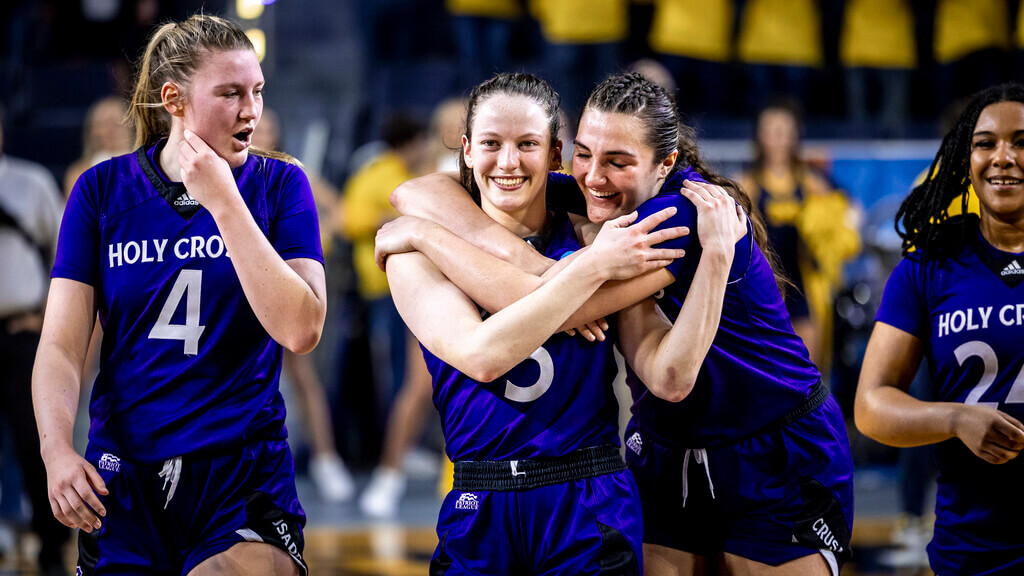
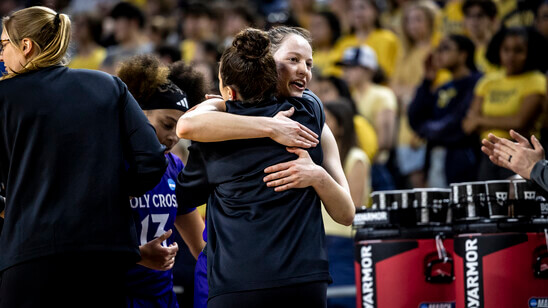
Celebrating with her teammates in Michigan. Photo by Rob Branning/Holy Cross.

And her community extends far beyond the court. Outside of basketball, Flanagan found that participating in service gave her deeper ties to the College and the greater Worcester area. Through a Community-Based Learning course, Flanagan was introduced to Abby’s House, a nonprofit organization that provides shelter, advocacy and support services for women with or without children. She actively volunteered at the nonprofit for two years, and for all four years brought her teammates to support Abby’s House’s annual 5K race — cheering, making posters, and handing out water — forming a relationship with the nonprofit that has plans to continue after Flanagan graduates.  

“All these service opportunities have been so awesome because I never expected to come here to Worcester, Massachusetts, which I didn't really know much about, and to feel so involved in the community at school, but also the outer community,” she said. “To be able to do that with my teammates and my coaches who are all so invested as well in making a difference has been so amazing. It’s made my experience that much more fulfilling outside of teaching and basketball.”

And, of course, there’s the community she found within the classroom itself. 

“The biggest thing that got me through some of the more challenging days – whether you're tired or dealing with the emotional ebbs and flows of a college basketball season – was the energy that the kids brought. Being able to build a relationship with them has been the most fulfilling thing,” Flanagan said. “They would bring so much joy and energy into the day, even when I was running on low sleep, low energy. They bring that energy, and I had no choice but to match it – and was happy to match it.”

A team sport mentality

Over the past four years, Flanagan has earned an impressive number of accolades. She is only the third player in program history with 1,000+ points and 500+ assists. She has the most starts in program history and fifth-most rebounds in Patriot League history. She has been named 2026 Patriot League Tournament Most Valuable Player and received the 2026 female Crusader of the Year award.

But Flanagan said her individual accomplishments aren’t what matter to her, but rather, what the team achieves.

“I am someone that just wants to win at the end of the day,” she said, citing Patriot League championship wins at home as her proudest team moments. “It takes a lot to get there as a team. You come out on top, but people don't always see what you go through together. I'm just so proud of each and every person on each of those teams that contributed to those wins. Everybody wants to end their season on the top, and to be able to do that three times has been a huge highlight for me.”

Flanagan has also taken her team sport mentality and applied it to her teaching style. On the court, she builds close relationships with her teammates and coaches.

“People flock to her,” Green said. “She has a relationship with every member of our team. Everybody looks up to her. She's got a magnetic personality, but also you can tell she really cares about you as a person.”

Never have I, never will I, be an individual sport person. I just love the team aspect.

Kaitlyn Flanagan '26

In the classroom, forming similar relationships with her students helped with classroom management and meeting students where they are. Flanagan was even able to collaborate with history teachers on the curriculum surrounding a novel she was teaching. “Never have I, never will I, be an individual sport person. I just love the team aspect. And so being able to do that in the teaching world was really cool for me.”

The classroom also helped shape how Flanagan shows up on the court, teaching her to be more confident, more vocal and command more space, she said. And the ability to combine her two biggest passions – basketball and teaching – has not only defined her college experience, but her growth as a person, she said.

“I think that it was such a huge challenge for me. And I am definitely a firm believer that the only way to grow and improve is to be challenged and to fail and to struggle. That's all we do in basketball, right?” she explained. “Having that be mirrored in my life is something that doesn't always happen. I'm really happy that I was able to apply that to something else that I've now been able to find out I'm also very passionate about.”

Flanagan is still weighing her options about what’s next – a teaching job, coaching or pursuing opportunities to continue playing. (Green, for her part, loves to joke that she’ll fire anyone on her staff if it means Flanagan will stay.) Whether she chooses the classroom or the court, Flanagan said she’ll be taking the lessons she learned – and taught – with her.

“I hope she’s doing something where she's leading people and molding young minds, whether that's teaching or coaching,” Green said. “We talk a lot at this level about leadership and the people that can, you know, tell the hard truths. She's one of those kids that people really gravitate to. So I just hope one day she's using those skills and making lives better, because she made a lot of lives that are here [better]. She made a lot of people feel seen, made a lot of people feel loved and made a lot of people feel important here.”