The first snowflakes of the season are falling outside O’Neil Hall on a grey Tuesday morning in November, and inside, Associate Professor Michelle Mondoux has been reviewing and practicing sample problems with her cell biology students for nearly an hour. She’s getting ready to switch gears to new material, but first, pauses to recap what they’ve done.
“This is beautiful and complicated,” she declares, “and we’ve done a lot of work.”
Mondoux is talking about membrane proteins, but, really, she’s talking about life.
Ask Mondoux about her work, and you’ll learn a lot about educating today’s students and how worms reproduce. But inside every scientific teaching is a metaphor for being human, an observation she’s made in the lab or the classroom and tries to apply to life. These are lessons she’s tried to impart in her classes, which she says she’s still learning herself. They are also lessons that have stuck with her colleagues and former students. Ann Sheehy, professor of biology, calls these “Michelle-isms.” Mondoux calls them “things I tell my students that also apply to me,” as she explained in a 2023 lecture to her peers and the greater College community. But whatever you call them, they’re lessons that Mondoux has spent her career learning and unlearning, rethinking the way she teaches — sometimes failing, sometimes succeeding — all in the name of one unchanging priority: her students.
“THE MOST INTERESTING THING”
Mondoux has been a member of the Holy Cross faculty for more than 16 years, and her passion for teaching science is evident every day, like that of a curious child. It’s a love that started early, with mail-order science kits and a mother who taught first grade. In sixth grade, a college professor visited her class for career day and Mondoux learned that such a job existed. She knew then that the combination of teaching and research was her ultimate goal. And she acknowledges how unusual that realization is.
“My husband jokes that I shouldn’t tell students this, because I think my path was way too clear,” Mondoux says. “It’s not how most people’s careers go.”
A high school biology teacher introduced Mondoux to genetics, cell biology and DNA, and she fell in love; she even found the same chromosomes poster that adorned her high school classroom and hung it in her Smith College dorm room. That passion later carried her into lab work at Dana-Farber Cancer Institute in Boston, to a Ph.D. program at Princeton University and, then, a post-doc at the National Institutes of Health (NIH). Throughout it all, she thoughtfully, persistently pursued the goal she set for herself at 11: to teach at a liberal arts college.
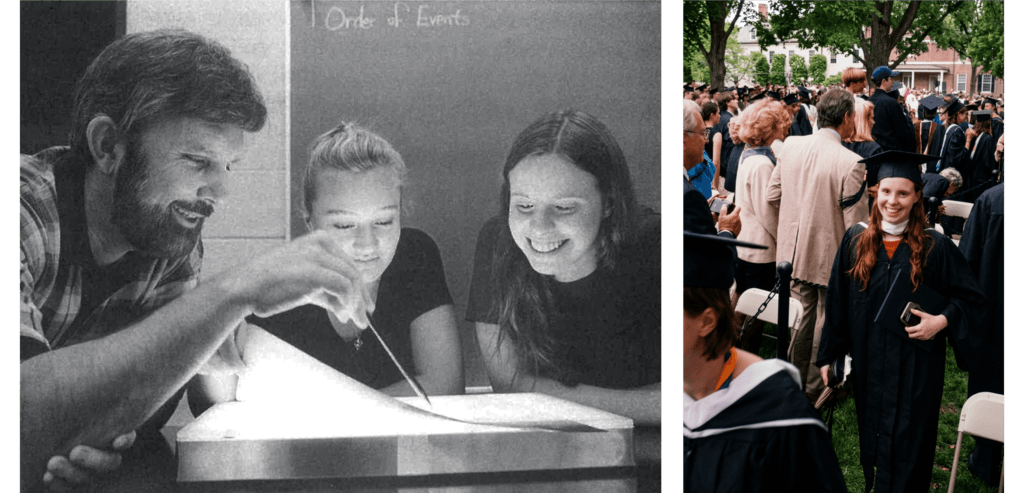
“She was interested, from the very beginning, in being at a small liberal arts college with an emphasis on teaching,” says Virginia Zakian, Mondoux’s Ph.D. adviser and professor emerita of molecular biology at Princeton. “It’s so unusual to come in knowing what you want and then to really seek out opportunities for yourself. She was an activist for herself and for other people. She took responsibility for her future.”
“I led with my future goal and the needs of the [liberal arts] environment,” Mondoux explains. “I’m a liberal arts student at heart. I have always had a broad range of interests, and I knew whatever scientific problem I ended up working on, I would find it the most interesting.” At the NIH, Mondoux found her research focus: C. elegans, a microscopic worm used as a model organism for research due to its genetic and cellular similarities with humans. It also has the added benefit of being ideal for use in an undergraduate research setting because of accelerated reproduction timelines and lifespans. Combined, these factors enabled Mondoux to set up a lab at Holy Cross that studies the impact of high-glucose diets on fertility – and added another passion to her list.
“DEDICATE CLASS TIME TO WHAT’S IMPORTANT”
What gets Mondoux out of bed in the morning? The answer is immediate.
“The worms and the students,” she says with a grin.
A few years into Mondoux’s career at Holy Cross, biology department faculty decided to rethink how Introduction to Cell and Molecular Biology, a core class for bio majors, was taught. At the time, withdrawal rates were approaching 15% to 20% by the end of the course, according to Sheehy. The traditional lecture-based approach to teaching science was no longer working.
Mondoux, Sheehy and a group of colleagues began team-teaching the intro course and overhauling the curriculum. Like the scientists they are, they approached the challenge like an experiment, testing countless new techniques to see what worked and what didn’t, and painstakingly kept track of the results.
“Everybody in the biology department that has a lab is an experimentalist at heart; that’s probably who their identity was first. Before anything else, before they were a teacher, they were a curious person who wanted to go in and say, ‘What happens if…?’” Sheehy says. “At her heart, Michelle was an experimentalist, and was willing to try and keep track of which things were working.”
Many of these changes aimed at centering the student as the learner, not the professor as the teacher. This developed from a growing realization, one that came to a head in 2020 when professors had to pivot to virtual classrooms: Students were not all starting from the same place when they came to Intro Bio. They enrolled with varying levels of prior knowledge in math and science, different access to technology and dissimilar life circumstances that impacted how they learned.
“We worked really hard in that class for every student to have the opportunity for success, no matter who they are and no matter where they’re coming from,” Mondoux explains. “And that requires us to really think critically about who we are and where we’re coming from.”
For Mondoux, that meant establishing a guiding principle from which all decisions are made: to be a “facilitator of student learning.” Her first priority is each student as a person, her second is that they’re learning. Every decision comes back to one core question: “What is better for student learning?”
And most of the time, the answer is not “more science.” Mondoux places a major emphasis on writing and communication skills, to help students better learn the material, and to help them succeed after college. She starts each class having students greet each other and weaves in time for them to ask questions or work through a problem together, building an environment of trust and respect. She offers different ways for students to participate and find their confidence. Another guiding principle, or “Michelle-ism,” is dedicating class time to what’s important. This means that there are no guessing games for students, no secrets to success, no leaving students to figure out a concept for themselves. She’ll change her lesson plans on the fly if students need more time with the material.
On paper, the results are clear: The biology major has nearly doubled in enrollment, and most Intro Bio students remain in the sciences in one way or another, according to Sheehy. But, more importantly, the results are felt in the classroom. Mondoux says if you compare her syllabi over the years, not much has changed, but the classroom environment has been transformed.
“It can be difficult to quantify and label the things we do in the classroom that facilitate student learning,” Mondoux explains. “But I think that the environment of the classroom and the approach to assignments and the approach to how I think about, ‘What am I doing here? What am I trying to help students achieve?’ — that is pretty radically transformed. It’s hard to see on paper, but it’s easy to feel in the classroom.”
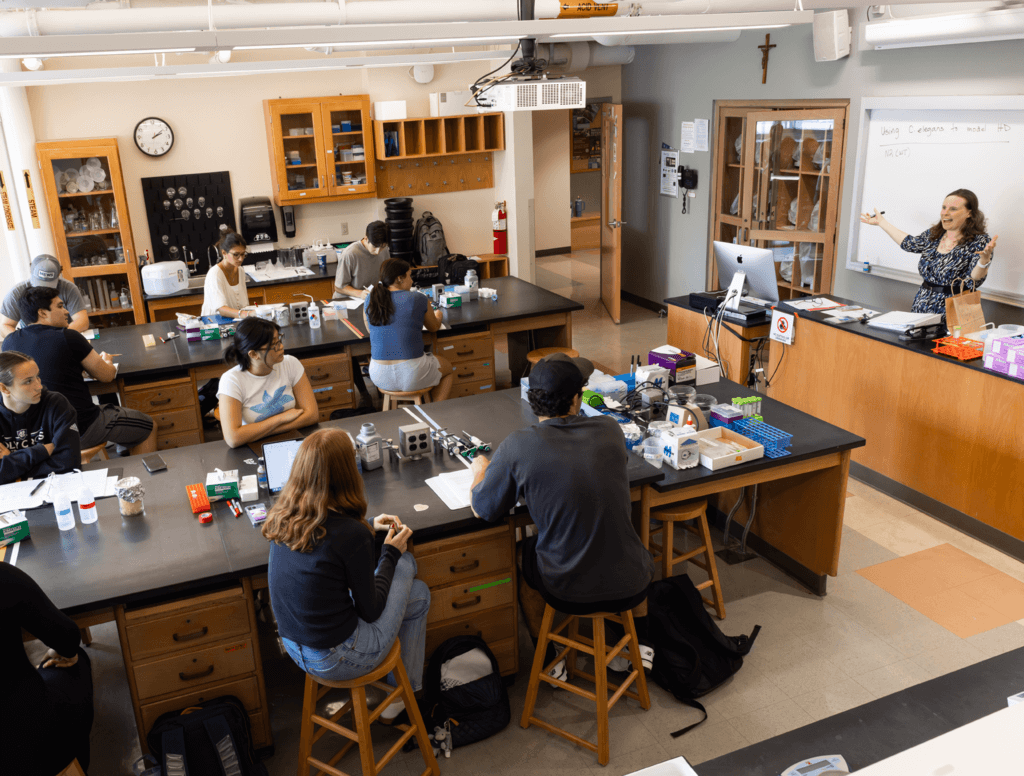
Back to that classroom on a cold November morning, and you can see all these elements in play. Mondoux spent the majority of the class working out additional problem sets to illustrate how proteins are inserted into cell membranes because the students needed it; she could tell they hadn’t grasped the concept. By the end of class, nearly all participated, nodding heads and audible “ohs” signal their understanding. The chalkboard is covered in examples.
“The classroom is really her environment,” Sheehy says. “She uses the board so effectively. And if you walk in right before she erases the boards after one of her classes, they’re full. She’s moving around and keeping people invested in the material.”
This teaching strategy has produced a trickle-down effect far beyond her classes. Zachary Nicholson ’23, now a Ph.D. candidate in the School of Medicine and Public Health at the University of Wisconsin-Madison, recalls a time when, as a senior, he gave a presentation in one of Sheehy’s classes. He had to present a figure on the screen and explain it without any supporting materials. Channeling Mondoux, he turned his presentation into a “chalk talk,” drawing on the board to break down concepts just the way she taught him.
“I finished and I don’t think I got any questions,” Nicholson remembers. “The only thing Professor Sheehy said was, ‘Well, I know you were in the Mondoux lab.’”
“YOU HAVE TO FEEL EMPOWERED TO BE WRONG”
Whether in the classroom or in the lab, Mondoux is teaching more than just biology. She’s also imparting lessons and skills that can make her students better scientists, better communicators and better human beings.
And according to Mondoux, one of the most important lessons in science — and in life — is failure.
“We are wrong all the time as scientists,” she says. “If we acknowledge that feeling empowered to be wrong is essential to success as a scientist, which I would strongly argue for, then my job has to be to create an environment where everyone feels empowered to be wrong.”
This includes not knowing the right answer to a question or having a reasonable hypothesis turn out wrong. But Mondoux emphasizes that no matter what, students need to first feel like they belong in the biology classroom and the scientific community in order to feel empowered to be wrong. If they feel like they do not belong, she explains, then they may feel that they risk losing their seat at the table if they are wrong.
“I want students to feel comfortable in my classroom — that if they offer an answer to a question and they weren’t right, it’s OK. But where it’s really important to be empowered is when you’re taking your best available knowledge and your best thinking, your best skills, and you have an idea that then does influence the science,” Mondoux says. “Because if you don’t feel empowered to be wrong in that scenario, how are we ever going to have new ideas, new thinking, move forward in any capacity?”
Katie Guilbo, M.D., ’19 was a Mondoux student in her first year at Holy Cross and later joined her lab. “Going into undergrad, I was just very shy and very quiet. I didn’t like to participate,” remembers Dr. Guilbo, now a pediatric resident at University Hospitals Rainbow Babies and Children’s in Cleveland. “I was always afraid of being wrong. She encouraged me to throw ideas out there and participate, and she made her classroom a safe space to be wrong. Even now, as a doctor, not every patient case is super straightforward. Being able to collaborate with other members of the team and throw ideas out there, it’s OK to be wrong.”