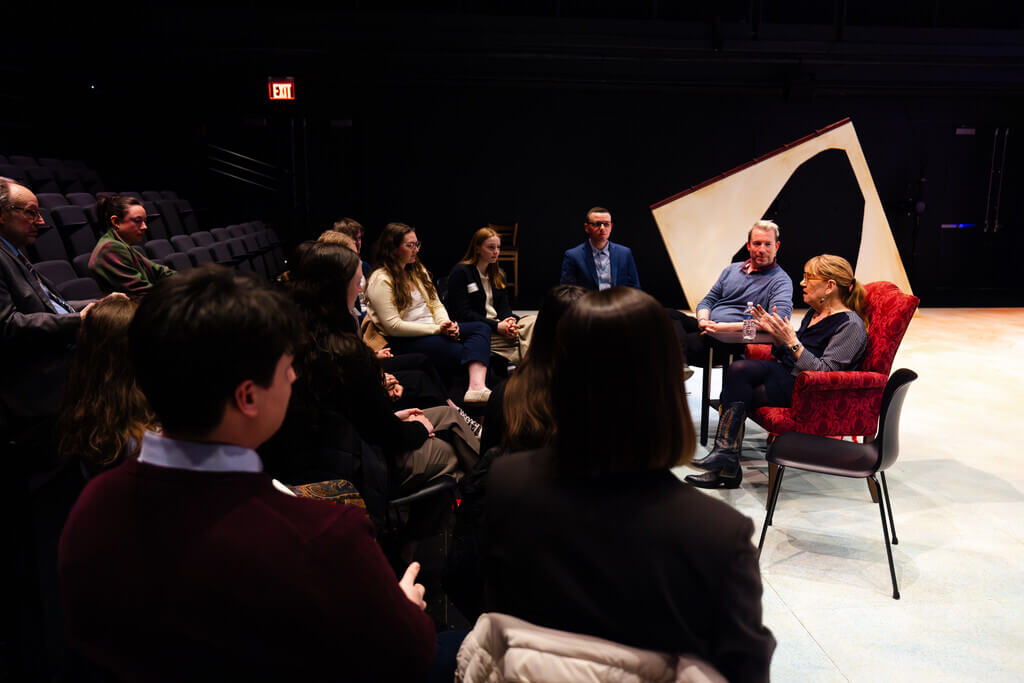
On April 21, 2026, Holy Cross hosted the 58th annual Hanify-Howland Memorial Lecture featuring literary titan Margaret Atwood in a conversation with students Evan Garcia ’26 and Keara Papa ’26 and moderated by Primetime Emmy Award-winner Ann Dowd ’78.
The conversation was held in Hogan Ballroom. This abridged transcript has been lightly edited for clarity.
President Rougeau: Welcome to our 58th Annual Hanify-Howland Memorial Lecture. It is just so wonderful to see so many people here with us tonight. There's definitely an excitement in the air. And we're here tonight because of the generosity of some very special families. The Hanify-Howland Memorial Lecture was created by Weston Howland, who endowed this lecture in memory of his friend and prominent Massachusetts jurist and active Holy Cross alumnus, the Honorable Edward F. Hanify, class of 1904. It is thus a very special honor to have with us John and Barbara Hanify, and Tony and Sue Howland, along with many members of both the Hanify and Howland families.
We also would not be here tonight without the leadership of our student committee. Each academic year, students from across the college make up the Hanify-Howland Memorial Lecture Committee. As a group, they meet and collaborate with the Hanify and Howland families to select and host the speaker — someone distinguished in the realm of public service, and their collaboration enhances the entire campus experience.
The caliber of speakers they have invited to campus over the years embodies our Jesuit liberal arts ideal of introducing new thoughts and perspectives to campus. The student committee has invited journalists, ambassadors, jurists, social psychologists, astrophysicists and governors to give the annual lecture, participate in small group seminars and lead discussions on topics that challenge us and allow us to expand our minds.
Personally, it is one of my favorite nights on campus. And so with that, I will turn it over to our committee co-chairs, both from the class of 2026, Keara Papa and Evan Garcia.
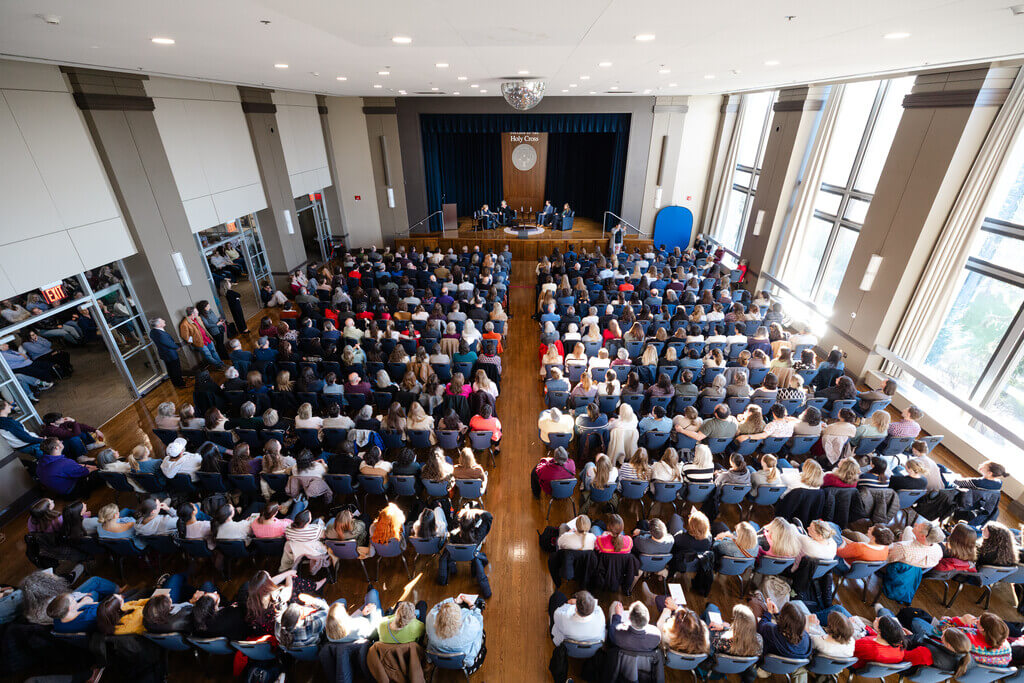
Garcia: Thank you, President Rougeau. Tonight, we are honored to welcome Margaret Atwood to the College of the Holy Cross. Margaret Atwood is the author of more than 50 books: fiction, poetry, and critical essays, a body of work which has been published in more than 40 languages and in more than 45 countries.
Her 1985 classic “The Handmaid's Tale” was adapted into a 15-time Emmy Award-winning TV series, and its record-breaking sequel, “The Testaments,” won the 2019 Booker Prize. Her other works include the Booker Prize-winner, “The Blind Assassin,” and the Giller Prize winner “Alias Grace,” as well as “Oryx and Crake,” “The Robber Bride,” “Cat's Eye,” and her memoir, “Book of Lives: A Memoir of Sorts.”
She has received the German Peace Prize, a Guggenheim Fellowship, the Franz Kafka International Literary Prize, and the PEN Center USA Lifetime Achievement Award, among many others.
Papa: We are also honored to welcome Ann Dowd, class of 1978, and parent of Emily Arancio, class of 2020. Ann is an Emmy Award-winning actress whose work across film, television and theater is defined by emotional precision, moral complexity and quiet power. Her breakthrough film performance came in “Compliance,” which earned her a National Board of Review Award for Best Supporting Actress and a Critics Choice nomination.
She went on to deliver a widely celebrated performance in “Mass,” for which she received numerous critics' awards and a BAFTA nomination, with critics praising the performance as both devastating and deeply humane. Across her career, she has brought that same depth to a wide range of acclaimed film, television and stage projects. She is perhaps best known for her Emmy-winning role as Aunt Lydia on “The Handmaid's Tale.”
Without further ado, please join us in welcoming Margaret Atwood and Ann Dowd to the stage.
Dowd: Thank you so very much. I remember being 29 years old when I read “The Handmaid's Tale,” and I absolutely loved it. And I was curious about a character named Aunt Lydia. Jump ahead 32 years. I was riding my bike in North Carolina because I was working on a show there, and I got a call from my manager and agent saying, ‘You have been offered the role of Aunt Lydia in “The Handmaid's Tale.” Offered, mind you. Not an audition. Offered. I nearly fell off my bike, and I remember just leaving the bike and going and sitting on a park bench and reading it from start to finish. I could not get over my good fortune. Jump ahead 10 years, if you would. I have had the profound privilege of playing a character that I love and respect for seven seasons of television. Margaret Atwood has changed my life and that is the truth.
I remember the first time meeting Margaret. She was going to come to the set and be in a scene with us, playing an aunt, and all the Canadians are standing by the door, ready to applaud — all of them standing, crew and cast.
The Americans are huddled in the corner and scared to death. That would be me thinking, What if she doesn't like Lydia and she's standing right next to me? What am I going to do? Well, she was absolutely fantastic. There was one thing that was a little tricky for her, if I may say, and that is, she was supposed to slap Lizzie Moss's face because her character wasn't doing what she was supposed to do. So Margaret's version of a slap is this.
[Dowd makes a gentle wave with her hand.]
And I remember we had to do the scene four times. Finally, Lizzie said, ‘Just whack me, will ya?’ She didn't really say that. What did she say?
Atwood: “Give me a whack.”
Dowd: Yeah, “Give me a whack.” And I want to say one last thing, if I may. We know the brilliance of this woman. I want you to know that she's an extraordinarily kind, generous and beautiful human being. And I could not be more grateful. Thank you.
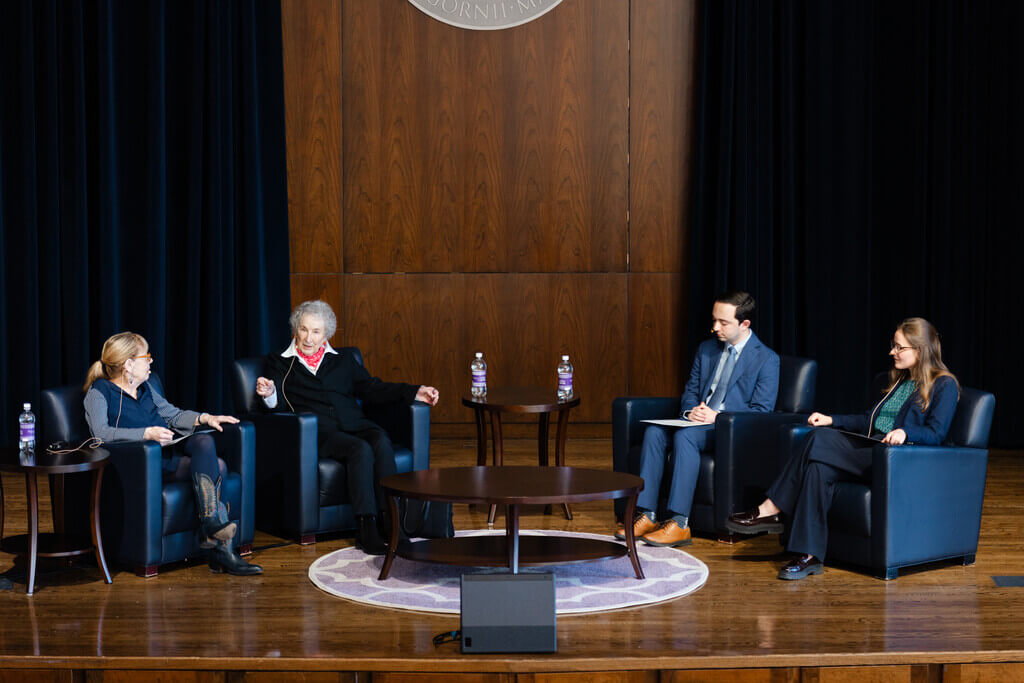
Atwood: So here's this kind, wonderful, nice person, and she comes over to London, because we're launching “The Testaments” in 2019. And, she is going to come on stage and be Aunt Lydia. We are broadcasting this to, I think, 120 theaters worldwide at the time. So Ann comes on, and she's, you know, this nice person. And then something happens. Something magical happens; I think it's called acting. She turns into Aunt Lydia before our very eyes. So thank you for being there.
Dowd: It was my entire pleasure. That's for sure.
Atwood: The broadcast actually worked. They’d never done this before. They were very nervous. We were at The National Theatre in England. They were backstage going, “What if it doesn’t work?”
Dowd: Did you hear them say that?
Atwood: Oh, yeah. And we've just been in another scene together in “The Testaments,” but we can't tell you what it is.
Dowd: She's wonderful in that, too, I can tell you.
Atwood: Well, I seem to be typecast as a mean, scowling old lady. I don’t think there are very many other roles for people of my age.
Dowd: She's a perfect aunt. I'm telling you. I have some questions here: I'm going to ask one of them now, which is, I'd like to go back to the beginning, if I may. Could you tell us about your background, your education and early experiences that led you to a career in writing?
Atwood: Well, search me. My family were not writers. My father was a scientist. He was an entomologist, a forest entomologist. And that meant that we spent about three-quarters of the year in my early childhood up in the northern woods of Quebec.
I refer you to a map: Go up the Ottawa River. Keep going up the Ottawa River. Go up the Ottawa River. Keep going up the Ottawa River. When they first went up there in 1937, there was no road. There was a little narrow gauge railroad, which would serve as the logging industry in those days, which then — this was a long time ago. It was done with horses. It was done in the winter, and it was done tree by tree, so that when you cut down a tree, they would skin one side of it.
They would skid it onto the ice with the horse. They would make a boom by connecting a lot of logs into a circle with the other logs inside. And so when the ice melted, they would tugboat that boom full of logs to a river, that they would shoot the logs down to the Ottawa River, and then they would go all the way to the side also.
And if you're wondering where the masts of the ships came from during England's blockade of France during the Napoleonic Wars, that's where they came from. Imagine that. Yes, we won it for England.
So it was pretty remote. And I didn't spend a full year in school until I was 12. It's not that I didn't go to school. I went in the winter. So the spring, summer and fall, we were up there, and my dad got a job teaching forest entomology, and that period up north got shorter.
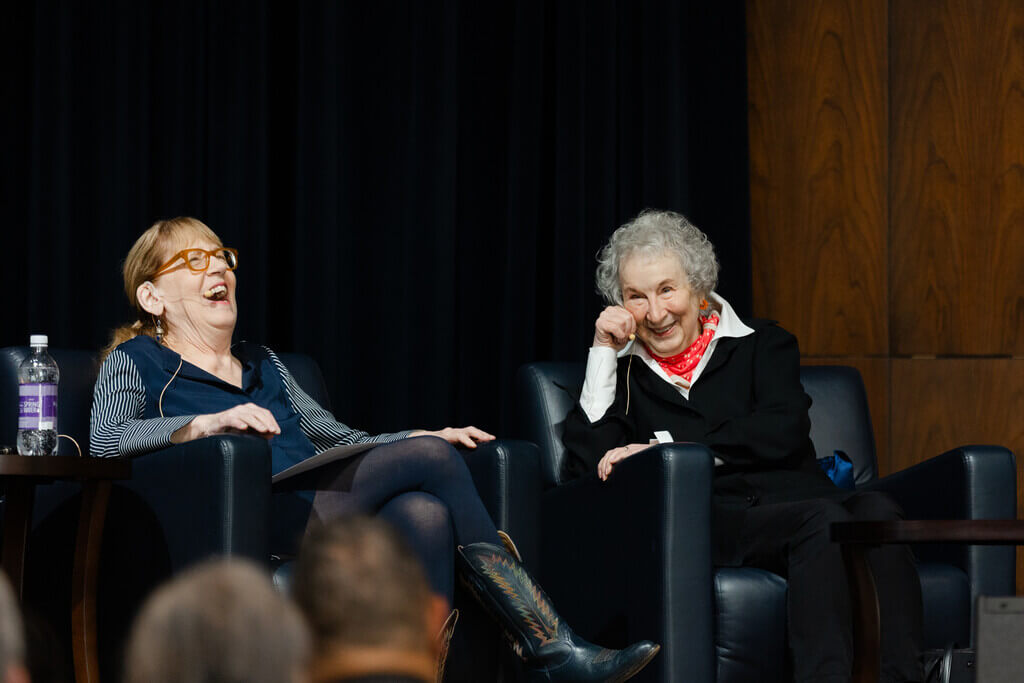
But if you want to get lost in the woods, do it with me. So what was there to do out there? There was no school. There were no shops. There was no town. There were no people, except visiting scientists. There was no television because there wasn't any television. No theater. There were no movies. But there were books. So I grew up reading, and I grew up reading everything. Nobody ever told me not to read a book. Some of these books were scientific books. Some of them were murder mysteries. My dad was very fond of murder mysteries. Some of them were science fiction. He thought science fiction was hilarious.
And some of them were novels. Some of them were children’s books. My life was ruined by George Orwell's “Animal Farm,” which I read as a child, thinking it was going to be like “Winnie the Pooh.” The death of the horse just ruined me. I had no idea it was a political allegory. I thought it was about real animals.
So that's the background. I had an older brother, and he eventually became a neuroscientist. But at that time, he was a prolific writer. And he wrote little books. He sewed them up the sides; one said, on the inside cover, by the same author. And, they were about a planet, which was populated with talking rabbits and their enemies, the frogs. And so I have to say, all of this was happening during World War II. So, so war was big. And these books, he drew a lot of the pictures, and he traded for my red, yellow, orange and black-colored pencils, so he could make more explosions and, oh, my God, in return was the pink, silver and the gold for which I could make princess dresses.
So that's how it was. We had a sort of Brontë-like, imaginary world. I was his second choice when there weren’t boys to play with. I was sort of it. What sort of games did we play? I'm sorry to say, not dolls. They were wars. We lined all of these stuffed animals up and we threw them at each other and some we threw over cliffs. It was one of the many things that we did that our parents weren't supposed to know about. So that's it. That's the beginning of my imaginary world. I was supposed to be a botanist, but that didn’t happen.
Garcia: In “Book of Lives,” you mentioned the tension between at least two beings: the one who lives and the one who writes. What would you consider to be the most formative moments, influences and relationships in your life? And do these influences differ based on whether you're wearing your writer hat or your living hat?
Atwood: That's a pretty complicated question. My most formative moment as a writer or as a rather frivolous person? So I was much given to staging amateur theatrics of a silly kind. So I can tell you about that. But actually, I don't think that had much to do with my writing career. I would say my formative, I was 16.
When you're 16, you have to believe that everything you've written is brilliant. If you don't believe that you're going to stop, right? So, I was writing some pretty bad poems, some of which I put into my memoir just to show you how bad they would be at the beginning. I think it's very encouraging for people to know how bad you can be at the beginning.
And I would say the second one was when I first got published in something other than a college magazine. So the thing about the college magazine, when I was at that age, was that almost nobody was interested in the arts. So we wrote a lot of it ourselves, some of it under assumed names. Well, we need to put something in the magazines, you know, make something up. Yeah, so that was fun.
And, I think those will do for now. Now, the other formative moment was when I told my mom, who had no interest in this writing thing at all. I said, “I just got published!” And I had just got accepted for publication in this magazine called the “Canadian Forum.” And she said, " What's that?” Most people in the world don't care about this; they actually don’t, but there was a small group of people who did. And, apart from movies and television, which are seen by a lot of people, I think live theater is somewhat similar. Hate to break it to you.
Papa: Thank you, Margaret. You were the first president of PEN Canada, the freedom of expression organization, and have spoken out against censorship, book bans and controlled information ecosystems. What do you view as the biggest threat to the freedom of expression today? And where should we draw the line on freedom of expression or speech in a democratic society, if at all?
Atwood: OK, that’s another complicated question. So, what the fathers of the United States of America meant when they said freedom of speech was that you ought to be able to express political opinions without getting hanged or shot. Remember, they lived in the 18th Century, so they had seen about 300 years of European warfare, and they had seen a number of absolutist monarchies in which people were not only shot or hanged, but disemboweled and other awful things, for expressing views that whoever was in power didn't like. Okay, so that's what they meant originally by freedom of speech. They didn't mean that anybody could say anything they liked without consequences. That's not what they intended, to me. So why did we start PEN Canada? Why did PEN begin in the first place? It began as a kind of tea party in the early part of the 20th century, in which writers would get together and discuss literary things, whatever those may have been. I think they just drank a lot.
But they were people like George Bernard Shaw — that generation. But then along came the ’30s, the rise of Nazi Germany, and the persecution of writers, which, I have to say, the persecution of writers has always been a thing, but it became particularly intense under Stalinist Russia and under Nazi Germany. And at that point, PEN International turned into a rescue mission, getting people out of Nazi Germany.
Skip forward in time to Canada in the ’70s. And that was a time when Canadian writers had to create their own institutions because they didn't exist. So we created the Writers Union because nobody had an agent, and nobody knew what was supposed to be in the contract. So we did that then, and we created the Writers Trust to support writers financially.
Come to the ’80s. I was asked by some people in Canada to start a chapter of PEN outside of Montreal. There had been this movement in Montreal that had been bilingual because it was the time of separatist thought. And Francophones wanted to have their own, and there weren't enough Anglophones left in Montreal to carry on. So could I take over? I was in England at the time. I didn't realize they didn't have any money and they didn't have any members. I thought I was something that already existed. Not so. So I had to create it and we did that. I'm here to tell you, people, once upon a time, there was no internet.
There were things called letters, things called stamps. They did something called the daily mail. And the other thing you did was you made phone calls. So we put together PEN Canada with stamps, phone calls and traveling, usually on buses, to talk other writers into doing this because we felt, after we built the national institutions that we needed, that we now should turn our attention to the plight of writers in other parts of the world. It was still the Cold War. There were still a lot of writers who were under duress or in prison. I said, if I take this over, it's not going to be a tea party; it's going to be devoted to the writers and present branch of PEN. Some countries had a very good record of writers in prison and didn't have any writers in prison because they’d shot them all.
So there was that, and it was a time when you could bring public pressure to bear on governments, but only if they cared what people thought about them. Once the government ceases to care what other people think about it, you have no leverage as writers. Anyway, that's what we did.
And, what was the next part? What do I think of freedom of speech today?
I think one of the biggest threats to freedom of speech today is people with massive amounts of money threatening lawsuits against magazines and newspapers. And we've seen this play before, and that is, the taking over of media. But they didn't used to do it that way. They used to just shoot people up, arrest them, put them in prison, close down their thing, or kill them.
One of my [interests] at the moment is the French Revolution, and it started out all in favor of free speech, freedom of expression, all in favor of free speech. This is usually the case before people get power: they’re all for freedom of speech. They get power and then things change. So as soon as the Revolution succeeded, they started smashing up printing presses.
And you will have noticed a similar kind of thing happening in this country. Freedom of expression is great as long as it's not being used against you. And if you've got power and it is being used against you, you try to squash it. We haven't got to the shooting, hanging and disemboweling stage — yet. So thank you for not being at that stage. Otherwise, we wouldn't be having this conversation, and you would not be in this room.
Dowd: For actors, it always begins with the writing.
Atwood: That was a pretty swift [segue].
[Audience laughter]
Dowd: I thought we'd move off that rather quickly. Yeah. How do you begin to hear your characters' voices?
Atwood: How do I begin to hear them? You know, nobody ever knows the answer to that. They usually make something up. Let's see what I can make up.
Dowd: You can pass it, if you like.
Atwood: Well, they just kind of come to me and then sort of turn. I never went to creative writing school because there weren't any. I don't have any theories. I have no theories. The French have theories. Yeah, I don't know. It's just, you know, it's what you do. Yes. And I think once that's what you do, you're not thinking about how you do it.
So, if you're a downhill skier, you're not stopping in the middle of your skiing and thinking, " How am I doing this? You're thinking about how to get to the bottom in the most graceful way without falling down. When you're writing, you're not thinking, How am I doing this? You're thinking, What's going to be on the next page? Where is this heading? I had some idea about this, but it's changed. I have some idea about how this was going to end, but it's going to end this other, different way. And, I had this beginning, I thought it was going to be the beginning, but it's not going to be the beginning anymore. It's going to be under Chapter 20.
So things move around. You know this yourself. It's like workshop. Try it this way, it doesn't work. There's another way that it might work better. And you try that, but, no, that isn't it, either. If it goes on long enough, you think, This whole thing isn't working and you throw it out. Or because I was brought up by Depression-era parents, put in a drawer. It might be useful later for something else.
Garcia: “The Handmaid's Tale” and your other works are based on your remarkable research skills. And you have said that every event in the novel has occurred somewhere else in history. Can you share a little bit more about the research process that goes into your writing, both for “The Handmaid's Tale” and your other works?
Atwood: Write first. Research later. Otherwise, you can get really bogged down. But as for my remarkable research skills, it's really just what you have in your great-grandmother's attic. You know, people put stuff up there, you don't know what's there, but you know, something might be, so when I need something, it's usually in the attic somewhere. And if it isn't in the attic, there's a clue to where else it might be. I have to say, the internet has made it easier to check. But you can't always trust Wikipedia. It's pretty good. You know, people are cross-checking them all the time, and I'm one of the 3% of people who donate to it.
And if you use it, you should, too, because they're fairly dependable. I'd say fairly. So there’s that. But once upon a time, there were these things called books, and just because it was in a book didn't mean it was always true, either. You know, there's always a sort of fuzzy area, which you're not entirely sure whether that's really the story or not.
Papa: You said in an interview with the Australian Broadcasting Corporation that Ann's performance enriched your understanding of Aunt Lydia, making her a more well-rounded character. Are there times in which you revisit your work and find meanings or messages you didn't plan for? Or would you make any additions or changes based on events that happened after publication?