
For Professor Amber Hupp, some memories carry a scent.
The smell of roses, for instance, recalls summer days spent with her cousins, running wild in the rose garden of her Aunt Jan, her mother’s eldest sister.
Hupp, an analytical scientist and a professor of chemistry, grew up in Michigan. The colors and the fragrances of that garden — and Hupp’s love for the flower — are bound up in her reminiscences of a beloved aunt. Aunt Jan passed away when Hupp was in graduate school.
“She was always a huge supporter of mine, always wanting to see me succeed. I was one of the first on that side of my family to go off to college and get a four-year degree, and she was always rooting for me in that regard,” Hupp says. “Her garden was so beautiful. Now that I'm an adult, I realize that she must’ve cared for her roses as much as she cared for her nieces, nephews and grandchildren.”
Last year, while on sabbatical, Hupp, whose research up to 2024 concentrated on biodiesel, a renewable fuel, began a self-directed study of fragrance molecules. She devoured books such as “The Secret of Scent” and “The Museum of Scent: Exploring the Curious and Wonderful World of Fragrance” by Mandy Aftel, whose California museum Hupp visited. And she attended several workshops, including Sensory Directed Analysis Training at Gerstel, a laboratory in Maryland. Sensory-directed analysis uses the human nose for olfactory detection along with traditional gas chromatography, a process of separating elements of a fragrant sample into its component parts to identify and quantify them.
A rose’s rich scent is surprisingly simple, chemically speaking, Hupp says. Mix the right amounts of citronellol, phenyl ethyl alcohol, geraniol and a dash of beta ionone, and you’re technically there. Perfumers, though, assiduously guard their formulas — and for good reason. Perfume is big business. Perfumes, such as Shumukh by Nabeel and Morreale Paris Le Monde Sur Mesure, command more than $1 million per bejeweled bottle. Perfumer JP Morreale justifies the price, in part, to having captured memory in a bottle.
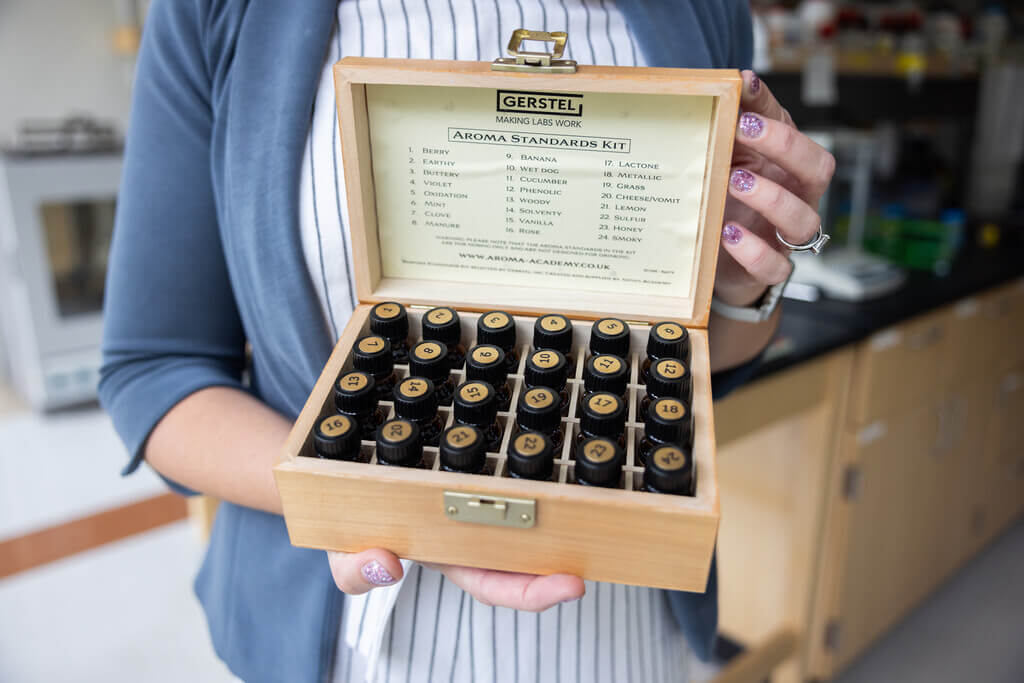
Hupp reaches for a small wooden box she keeps in her lab. This is her Gerstel Aroma Standards Kit. Inside are 24 glass vials containing different scents: berry, buttery and violet share space with wet dog, sulfur and cheese/vomit. The kit brings to mind Harry Potter’s Bertie Bott’s Every-Flavour Beans, where mistaking speckled coloring can mean the difference between a mouthful of marshmallow or rotten egg. Gerstel numbers each vial and provides a key on the underside of the box’s lid, thus eliminating unsavory olfactory exposures. Hupp uses the kit to train her nose for active recall of common aroma categories.
At the Institute of Art and Olfaction in Los Angeles, Hupp underwent intensive training on genres of finer fragrances, smelling synthetic fragrance molecules and learning how they combine to achieve the scents we encounter in nature — or at a department store fragrance counter.
The transportive power of fragrance
“My favorite days were the flower days,” Hupp wrote in a blog post for LCGC International, a media outlet for analytical scientists. “For hours, we smelled beautifully orchestrated chemical combinations that recreate the exact nuance of flowers fresh from the garden. Passing around the blotters, my brain first picked up on the rose scent . . . A flash of my aunt’s colorful pink and red rose bushes in her bright green yard popped into my head.”
What this new line of inquiry means for Holy Cross students is that they, too, will now have the opportunity to study fragrance and, perhaps, pursue careers in a multi-billion-dollar perfume market. Hupp is already commanding attention for her research into what she calls those “beautifully orchestrated chemical combinations.” The American Chemical Society will feature her in its publication, “Rising Stars in Measurement Science” and her article, “Determination of Rose Alcohol Composition in Extracts and Flowers via Headspace Solid-Phase Microextraction and GC-MS,” will be included in the society’s 2026 “Rising Stars” edition.
While accolades are great, for Hupp, this new avenue of study is also a welcome homecoming:
“It’s still amazing to me that with the right combination of fragrant molecules, we can be transported to a time we thought lost, with memories of certain moments in time rushing right back.”


