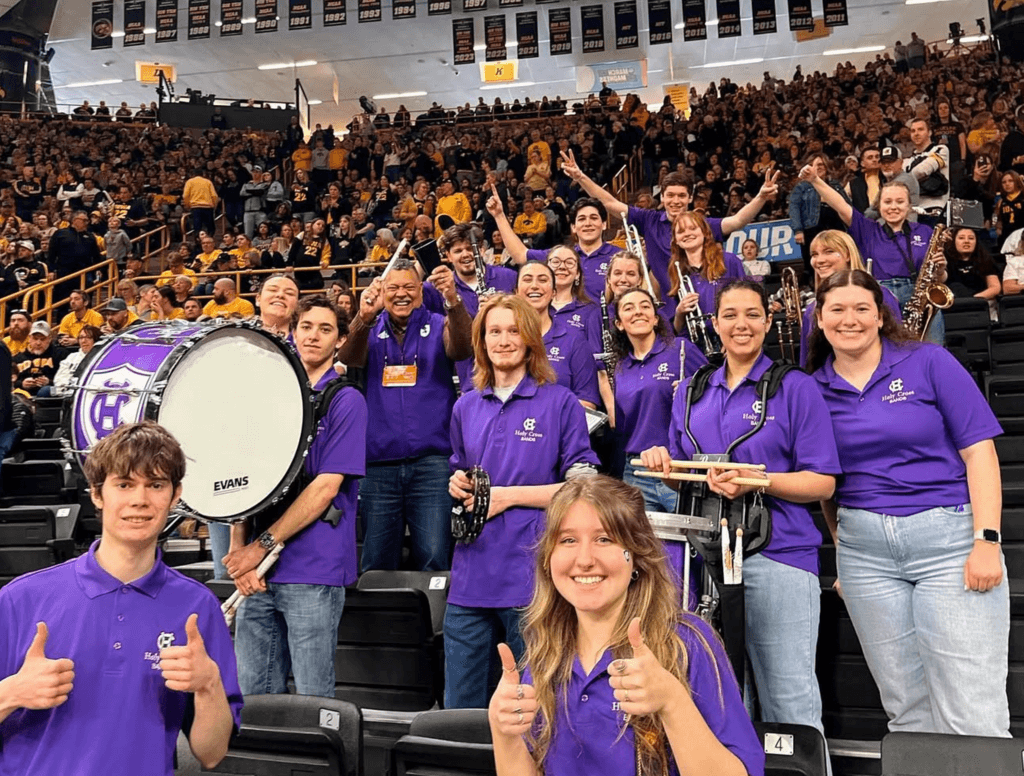
For a Good Time, Call...

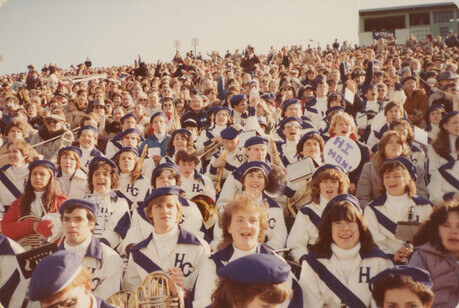
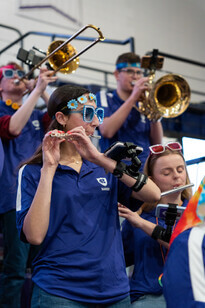
Band members cheering

How Holy Cross’ Goodtime Marching Band and Bettertime Pep Band deliver much more than music.

It’s 8 p.m. on Sunday, March 15, and nearly the entire Holy Cross Bettertime Pep Band is gathered in the Figge Hall dorm room of co-president Elaine Kelly ’26, who is hosting a watch party for the women’s basketball NCAA Tournament selection show. Earlier that day, the Crusaders won the Patriot League Tournament, earning them an automatic trip to the NCAA Tournament. Those gathered had two questions: Who would the team play in the first round of the national tourney, and would the band get to go, too? Answer #1 was swift: Holy Cross was named a No. 15 seed and would be headed to Ann Arbor to face No. 2 Michigan.

Answer #2 took a little longer. 

The next 14 hours were an “excruciating” wait, according to pep band drum major AJ Mann ’26. Finally, just after 10 a.m. Monday, an email came through: Send us the hotel room assignments. The band was headed to Michigan.

A whirlwind four days in Ann Arbor followed. The band spent them exploring the University of Michigan’s campus and the city, bonding as a group, and holed up for hours in a windowless hotel ballroom, rearranging and practicing music — all in preparation to step into the Crisler Center during a national television broadcast and onto the biggest stage in college basketball. 

A similar trip two years earlier was considered a once-in-a-lifetime opportunity. Now, the band was on its second trip in three seasons to the NCAA Tournament. 

It shows just how far the band has come since 1845.

180 YEARS OF HISTORY 

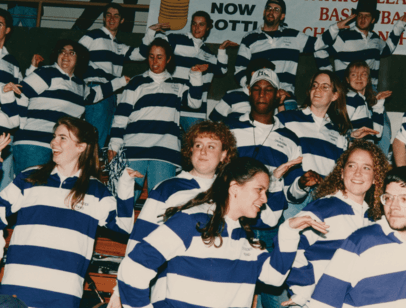
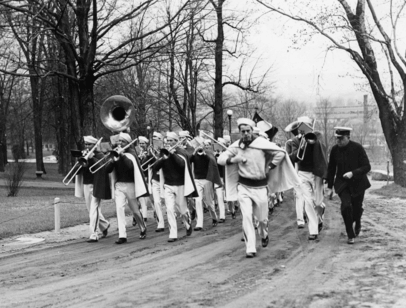
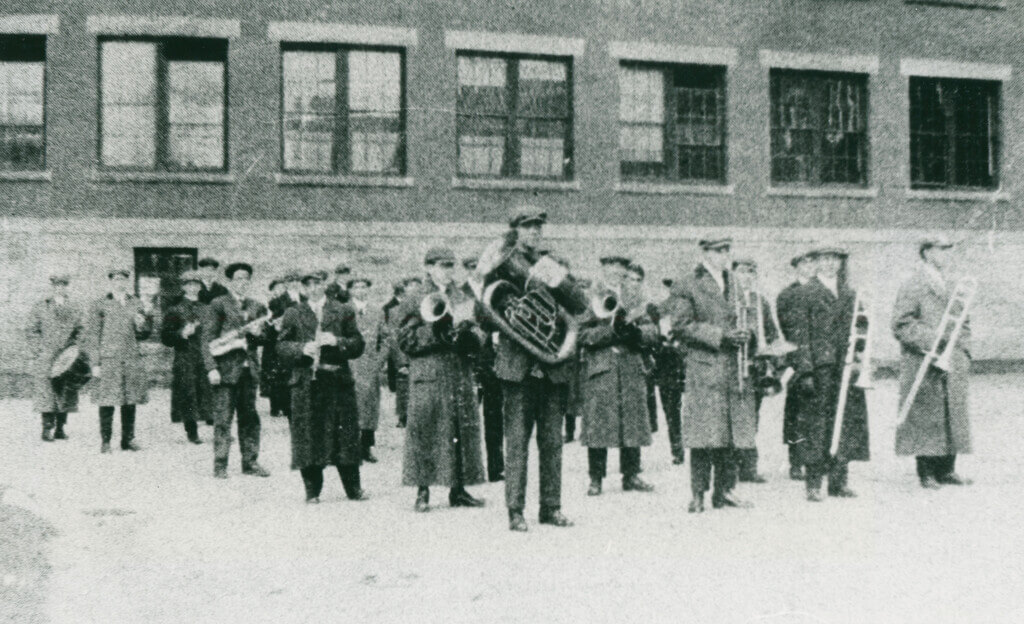
Holy Cross’ Goodtime Marching Band is acknowledged as one of the oldest college bands in the country. (The band uses this moniker during football season; its basketball and hockey counterpart, the Bettertime Pep Band, is essentially the same band – minus the marching. One band, two semesters, three sports.) According to “The Spires of Fenwick,” a history of Holy Cross published in 1966, the band was founded in 1845 — just two years after the College — and directed by local musician Samuel R. Leland. Passing mentions appear in the diaries of Samuel Lilly, a Jesuit scholastic who taught at Holy Cross from 1845-1849, and Bishop James A. Healy, the valedictorian of the class of 1849 and residence hall namesake. Both diarists describe the band rehearsing, “waking the boys up” to songs like “Adeste Fidelis” on Christmas and “Hail Columbia” on the Fourth of July, and appearing at College events such as commencement. Otherwise, not much else is written about the band’s history until 1911, when it debuted at its first football game on Nov. 10 against Worcester Polytechnic Institute. An article in The Purple describes a pep rally held in Fenwick Hall the night before the game: “To the efforts of our cheerleaders and our band great praise must be given for the cheering which, on that day at least, was unequalled.”

Image
Archival photo of band members
The marching band's first game-day appearance at the Holy Cross vs. Worcester Tech game on Nov. 10, 1911.

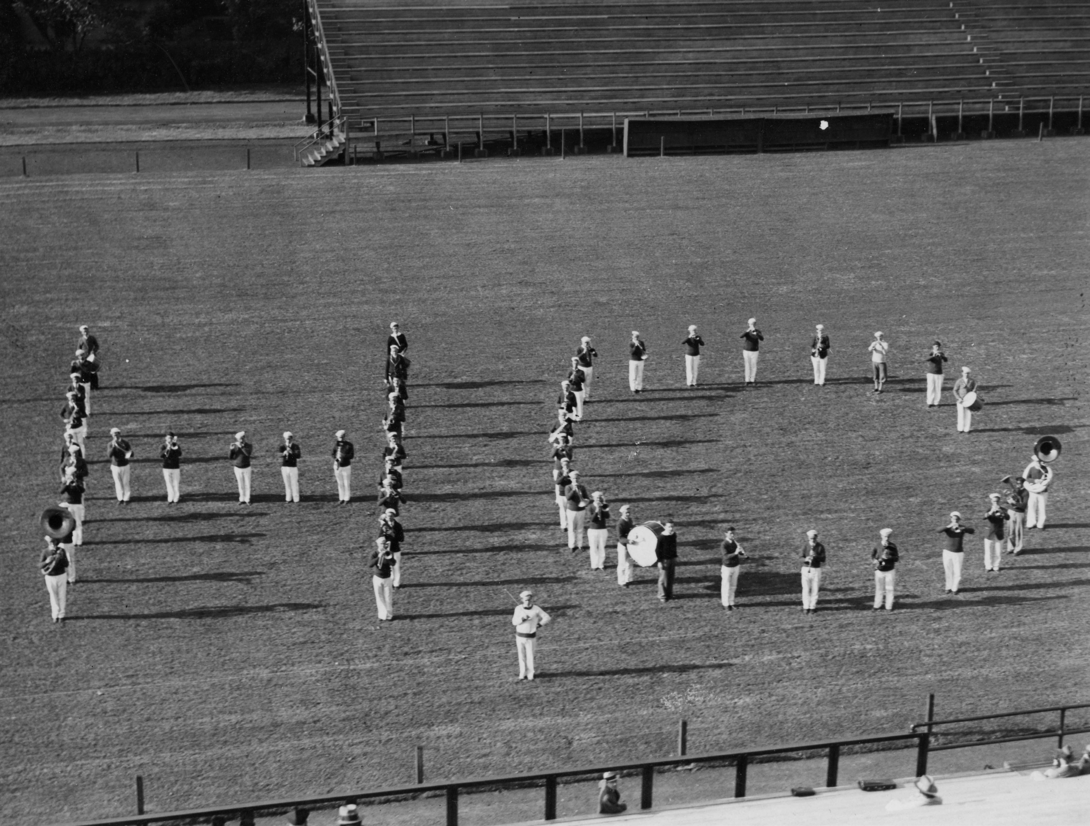
Band records in College Archives and Distinctive Collections start in earnest in 1927, documenting its travel to away games against teams such as Fordham University, held at New York City’s Polo Grounds, correspondence between the band director and new and returning members, and budget requests.

Image
Marching band forming an "HC" on the field
Practicing the “HC” formation in 1928.
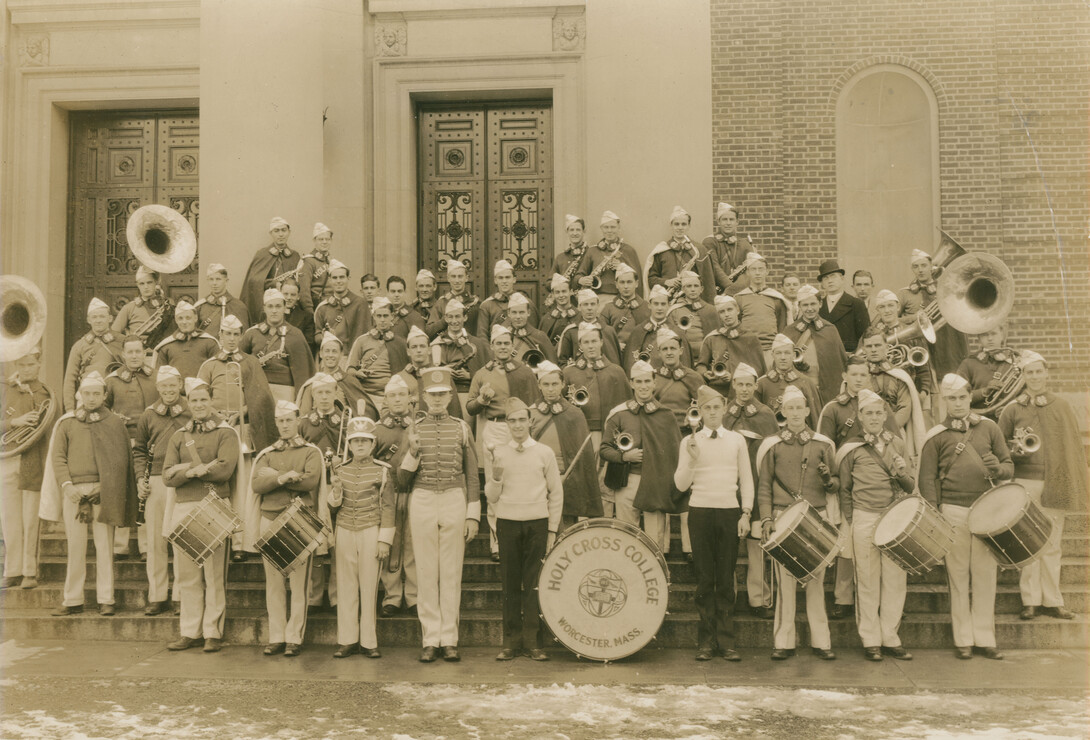
Image
Archival photo of band on steps of Dinand Library
On the steps of Dinand Library in 1935. Daniel Deedy ’35 (above, center) and his brother William ’39 both served as drum majors. Dan Deedy ’80, William's son, recalls family stories about his dad strutting onto Fitton Field in front of 25,000 people.

Throughout the decades — centuries, even — the Holy Cross bands have seen challenges, from annual changes in size and instrumental makeup (every May seniors graduate, every August new members join), to serious (drastic budget cuts of the 1970s or participation lows where there were not enough members to march). Members have always had to adapt, rearrange and reinvent, working with what they had — but through it all, the music never stopped.

Performed for the College’s Sesquicentennial in 1993. According to the October 13, 1925 issue of the Tomahawk, “The College Quick Step” is the oldest Holy Cross marching song in College history, written by the band’s director just six years after the founding of the College.

In the fall of 2022, another change arrived. After the departure of the band director, the College’s Office of Student Involvement (OSI) created the Holy Cross Spirit Programs, which comprise the bands and the College’s cheer team. This restructuring provided the group with the opportunity to closely collaborate with cheer on game-day performances. Also, the band would now be entirely student-led.

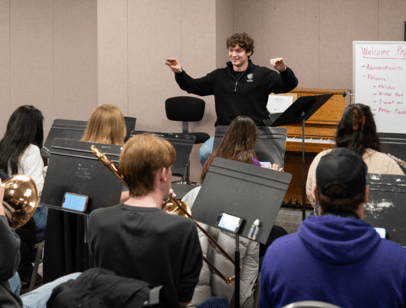
“Something really unique about our band is that they’re student-driven,” explains Mackenzie Drew, assistant director of student involvement for spirit programs. Drew handles many of the group’s logistics, such as scheduling, managing game days and ordering equipment. But the rest, from running rehearsals to choosing music and everything in between, is the responsibility of the band’s student leadership. “They’re really doing the physical music instruction, which is awesome, and [shows] how highly talented they are,” she says.

Alanya Telerski ’24 served as drum major during this transition. While the change was challenging, she says it also injected new energy and leadership into the group. The band consisted of approximately 20 members, and she says this small size actually worked to their advantage. 

“It was, like, ‘OK, this is the situation we have. We all love music. What can we do?’” Telerski recalls. “I feel like that’s sort of the spirit of the band. Even though it’s small, it’s mighty and it has a lot of history. The small sort of scrappiness is what makes this really special.”

“We’re the oldest student organization, and it feels really cool to bring the energy and consistently pound it home another year,” says Mann, who plays trombone when he’s not conducting the pep band. “We’ve survived so many trials and membership issues, but we’ve persisted because we’re so tight with each other. And I am so sure that with the younger classes we have, they’re going to do the exact same thing next year.”

MANY LIVES, LASTING TRADITIONS 

Though the group has continued to change throughout the years, even more has stayed the same. Of course, there’s the music: The band still plays Holy Cross standards, including the fight song, “Chu Chu Rah Rah,” the alma mater and Holy Cross originals, “Hoiah” and “Mamie Reilly.” And, the traditions, the bond between band members, and the fun have remained.

“It’s really just an unmatched community,” says band co-president Zoe Gopoian ’27. “It’s a group of passionate, hardworking people that care about the music, care about the art that marching band is. Everyone brings something different to the table, and I’ve just met the best people through band.” 

Telerski agrees: “It’s all based off students with talent who want to just do something good, and they want to encourage students to have fun on campus and embrace the spirit. In such an academically challenging environment, that can be hard to find.” 

That sense of community starts even before a student has joined. With the support of Drew, band members handle all recruiting – reaching out to accepted students who have expressed an interest in music or who play an instrument. Members aim to build personal connections over shared interests, share what it’s like to be in the band and assuage anxieties or dispel preconceived notions. Because members move onto campus to attend band camp well before the College’s official Move-In Day, upperclass students help first years move in, create a scavenger hunt to help them learn the lay of campus, and organize plenty of shared meals and activities to help them meet new people.

“My freshman year for band camp, I remember being terrified in my little hotel room the night before,” says Riley Listengart ’28, trumpet player and band librarian. “I was freaking out, and I got a text from Zoe [Gopoian]. She was like, ‘I’m just reaching out because I’m in the band.’ She told me a little bit about herself and said she’d love to hear a bit about me, and that if I needed any help moving boxes or anything, she’d be there. She’s like, ‘We have a whole band to send over.’”

I knew on the first day that I had met my people already.

Zoe Gopoian '27

Yet, this is nothing new. As far back as the 1920s, band recruitment was accomplished through letters and personal outreach. In 1968, the band introduced a “big brother” program, in which a returning band member was paired with one or two incoming students to help them adjust to college life. This close-knit spirit is all designed to help students find their place and their people.

“There’s a special community that arises from it. I’ve met a lot of people who go to Holy Cross who never really had that connection right off the bat, and it was very, very difficult for them,” Mann says. “I’m very lucky because I never had that issue.” 

“I knew on the first day that I had met my people already,” says Gopoian, who has photos of the band hanging in her room in London, where she is studying abroad. “There was such a welcoming vibe on the first day. It’s family.”

Ask band members and they’ll tell prospective students there’s a place for them even if they don’t play an instrument. Jim Dyer ’95 was recruited as a sophomore by his friend and classmate, tuba player Mike Pollastri ’95. Dyer didn’t play the tuba — or any other instrument. 

“My attempt at the tuba was a little bit challenging,” Dyer recalls. “Most things for a tuba are built around the note of B-flat, and for whatever reason, I could not do anything to make a B-flat. The percussion section was right in front of where the tuba would stand, and my friends that played the bass drum would say, ‘All you do is play F.’ It was very good-natured teasing – this tuba player can’t do the one thing that a tuba player needs to do.”

But it didn’t faze the band: “My friends around me knew that the instrument wasn’t clicking, and it was all OK,” Dyer says. 

Eventually, with the encouragement of the band director, Dyer switched to cymbals for the remainder of his time at Holy Cross. He appreciates the fact that the director recognized how much Dyer valued his friends and his experience in the band, and found a way for him to continue as part of it. 

“Honestly, if I had never decided to make a switch, they would have known that I was just really not good at playing the tuba,” he says. “Everyone would have been OK with that. 

“It was definitely an opportunity for me to be involved and part of something that was bigger than me, that challenged me – to be involved with something that I wasn’t necessarily good at, but that I was welcome to contribute and participate,” he continues.

Dyer is not alone in his experience. Recruitment materials throughout the decades advertise that prior experience is not necessary. Even experienced musicians have learned new instruments. 

“There are people in band who don’t play or didn’t know how to read music or how to play anything before band,” says Gopoian, who joined as a flute player and learned the piccolo in order to provide a bigger sound. “If you want to be in band, we will find a way for you to be in band.” 

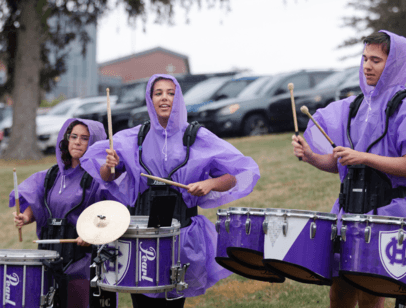
“All of us lift each other up,” adds Mann, who, as pep band drum major, had to teach himself how to lead rehearsals and conduct. “To do that in rehearsal, then go to a large-scale stadium, like Fitton Field or the Hart Center, and play music, that’s a pretty special feeling. We’ve played in pouring rain before where we all pick up a drum because we can’t bring our wind instruments outside. We are learning music together, and you get really close to the people that you’re working with.”

The bonds formed between band members last long after graduation. Many say they met their best friends in the band, and some, their future spouse. Band alumni often attend games, sitting by the band to chat, cheer and share the experience with their families. Sometimes they even play – and they still remember how to play the fight song. 

“It’s a testament to the kind of people that are in band, that they still keep coming back,” Gopoian says.

Image
Band alumni lined up on football field
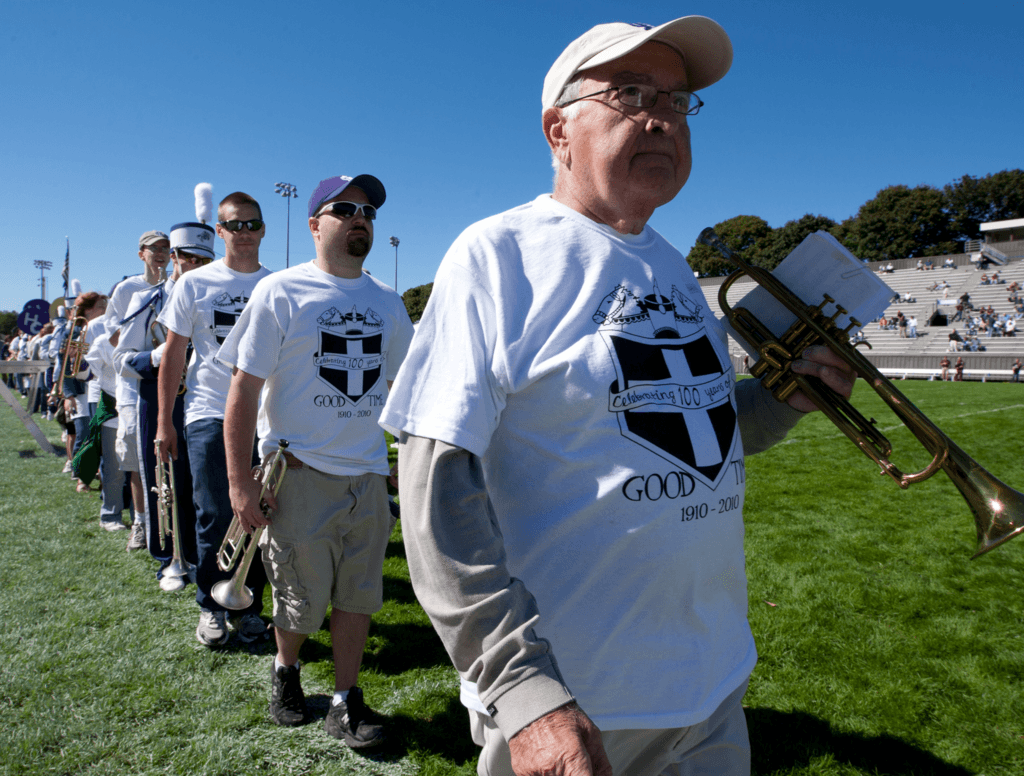
Former members prepare to take the field with students in 2010 at the band’s 100th anniversary of performing at football games.

“Looking back, the thing that I value most from it was the opportunity to be involved in growing my own sense of belonging within the Holy Cross community,” Dyer reflects. “Between the ages of 17 and 21-22, you sometimes feel a little bit at sea. You wonder where your place is, where you belong. [Joining the band] felt like it was going to enhance things for me in terms of welcoming and belonging.” 

“It’s just a sense of community and support for each other, and shared love for Holy Cross, that you only really get to experience when you’re in the band,” Telerski says. “It’s, like, I’ve never loved my school more, and the experience that school has given me, and so that shared experience brings you through life and maintains a lot of really great relationships. It’s just a good group of people to turn to.”

FROM BAND CAMP TO GAME DAY 

Five days before a first-year class moves in, you’ll find the Goodtime Marching Band on Fitton Field under the sweltering August sun. Members are learning how to read their marching drills and create formations for this season’s halftime show. Some have never marched before. After a few hours, they’ll head back inside, pick up their instruments and practice music. That’s followed by group dinner in Kimball and plenty of team-building activities later that night. 

Welcome to band camp. 

These 10 days serve as their main opportunity to teach themselves music and drills for the upcoming football season. Drills are choreographed by an outside consultant, and occasionally musicians are brought in to teach workshops. Otherwise, it’s up to the students – and their drum major. 

Ella Murray ’27 has served as drum major since her sophomore year (after a full year of leading both marching and pep bands, she conducted the marching band in fall 2025 and Mann took over for pep band in the spring). Thanks to her experience as a member of a large high school marching band, Murray knew that despite the band’s size, it had a lot of potential.

“Everybody there is really focused on spirit and is doing it for the right reasons,” she says. “It’s just a matter of ‘What can we do every day to make our performance better, our opportunities better, our numbers better?’ And learning that I could be part of the process of making it better.”

Image
Student conducts band members outside on the Hoval
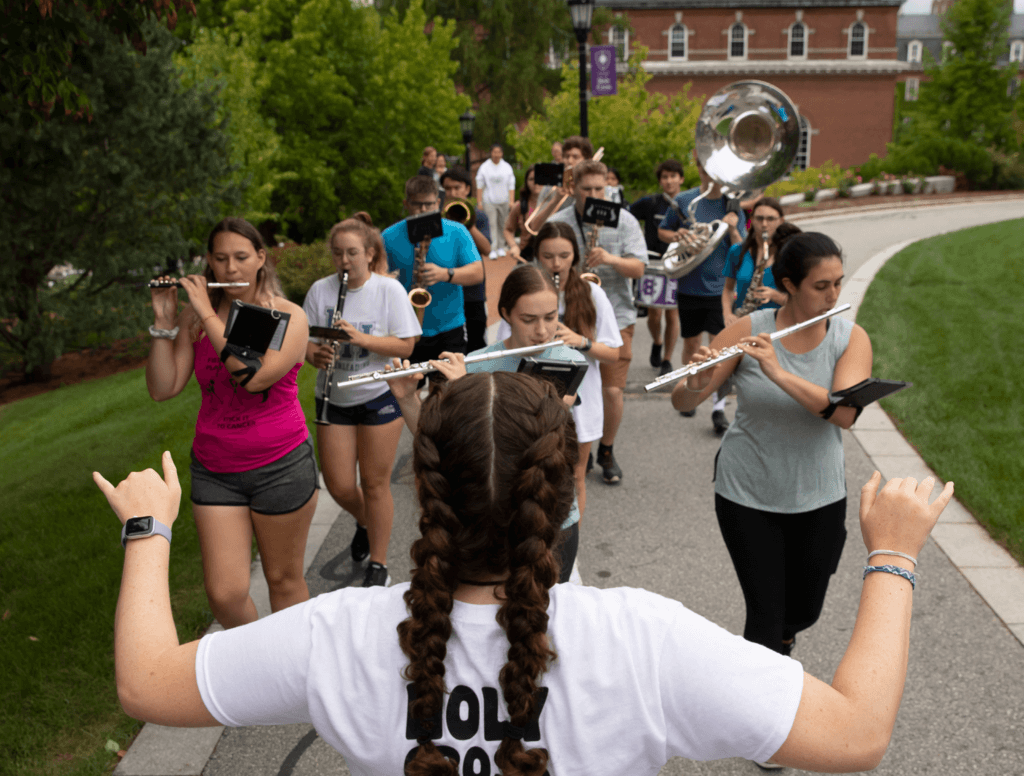
The marching band spends 10 days before fall semester classes begin teaching themselves music and drills for the upcoming football season.

As drum major, Murray is responsible for teaching drills throughout band camp and leading rehearsals and performances. Learning how to play and march at the same time is a complex and tiring skill, but Murray is proud of how the band commits to it: “Everyone shows up with a positive attitude. I’m always so grateful with our group dynamic, especially when we’re learning new things and having challenges.” 

At the end of band camp, the time comes to combine the marching and the music, and perform for the first time. 

“It is really fulfilling when it all gets together,” Listengart says of the first time she played with the band at the end of camp. “Everyone sounded amazing together. Everyone has their own place. Everyone was always so encouraging, even whenever you messed up, they encouraged you to keep trying. It just felt like home.”

Football Game Day Schedule

8 a.m. Breakfast at Kimball 

8:45 a.m. Arrive at band room in Hogan to pick up uniforms 

9 a.m. Rehearsal 

10 a.m. Pack up the van with instrument cases, spirit supplies, etc. 

10:50 a.m. Uniform check 

11 a.m. Leave Hogan for campus walkthrough, playing music all the way down to Fitton Field 

11:30 a.m. Arrive at Fitton 

11:40 a.m. Set up for Crosswalk, when band and cheer lead the football team through the fans into the stadium

11:53 a.m. Crosswalk 

12:15 p.m. Unload van; lunch 

12:50 p.m. Engage with fans 

1:30 p.m. Meet back at spirit section 

1:46 p.m. Pregame performance 

2:02 p.m. Kickoff 

Mid-game Halftime performance 

~5 p.m. Postgame performance 

5:30 p.m. Clean up and breakdown

Band camp is the precursor to a packed calendar. During football season, marching band practices twice a week to prepare for five home games. On game days, they’re some of the first people to the field and some of the last to leave. Drum major Murray is on a headset the entire game, listening to the broadcast booth and tracking the action to determine what and when to play. During hockey and basketball seasons, pep band practices one hour a week for 15 men’s and women’s home games combined, not counting playoffs. Without marching, the workload for those games is a little lighter, but the energy – compacted into a much shorter window of time – is even higher. Then there are the non-sporting performances, such as performing on Easy Street for Move-In Day, Homecoming, pep rallies, pop-ups at Crossroads and other campus events. For all of these, the band creates its set lists, performances and, sometimes, original songs. “Bone Cadence,” a favorite of the current band, originated when Mann started improvising the trombone over a percussion beat. Now, it’s a staple at every performance, and members improvise the music every time it’s performed.

This level of commitment goes largely unnoticed. Combined with cheer, the band is one of the only student organizations that spans almost an entire academic year, from band camp in August to performances well into March or April, depending on basketball and hockey playoffs, explains Brenda Hounsell Sullivan, assistant dean and director of student involvement. In October, marching band and pep band overlap as football season ends and hockey season begins. Supporters and members say their early mornings and late nights go unseen by anyone outside the band world. And their small size means they often don’t get the same kinds of support as larger bands at other schools; Drew says many members turned down band scholarships elsewhere to attend Holy Cross. But they all do it because they love the College – and they love band.

“Nobody’s there because they have to be,” says Kelly, a piccolo player. “Everyone’s there because they want to be involved in this. We all join because we love music so much.”

And starting with the 2025-2026 academic year, members have another reason to be excited: An anonymous donor established band scholarships for the next four years, for which students can receive $500 for participating in each marching band and pep band season (up to $1,000 toward their financial aid). Hounsell Sullivan hopes that this scholarship will help attract more members, as well as support additional camaraderie and community-building opportunities.

“WE’RE NOT IN THE HART ANYMORE” 

As the band looks to the future, some of those opportunities include the chance to travel with the athletic teams they support. In its early days, the band traveled to most away games for football, as far away as New York and Detroit, and as close as Fenway Park. They played monumental games against Harvard University and Boston College, fostering rivalries not just between the football teams, but between the bands. Extreme budget cuts in 1971 meant the band had to stay home for away games. In 1991, Holy Cross football headed across the pond to take on Fordham in Limerick, Ireland, at the Wild Geese Classic. The band, determined not to be left behind, fundraised their own trip, staying in hostels and performing in parades and concerts in addition to the game.

In November 2025, the football team – and the band – made their long-awaited return to Fenway Park for the first time in nearly 70 years. As fans made their way to the ballpark to watch the season finale against Patriot League opponent Georgetown, the band lined up in the cold along Lansdowne Street and improvised a welcome pep rally. 

“It was once in a lifetime to march on Fenway,” says Listengart of performing on the field during halftime. “My favorite part was seeing the crowd get energized. The [Red Sox] mascot would come up to us to hang out or conduct. The best part was seeing the environment and how people would react to it.”

Image
Young woman goes to hug team mascot
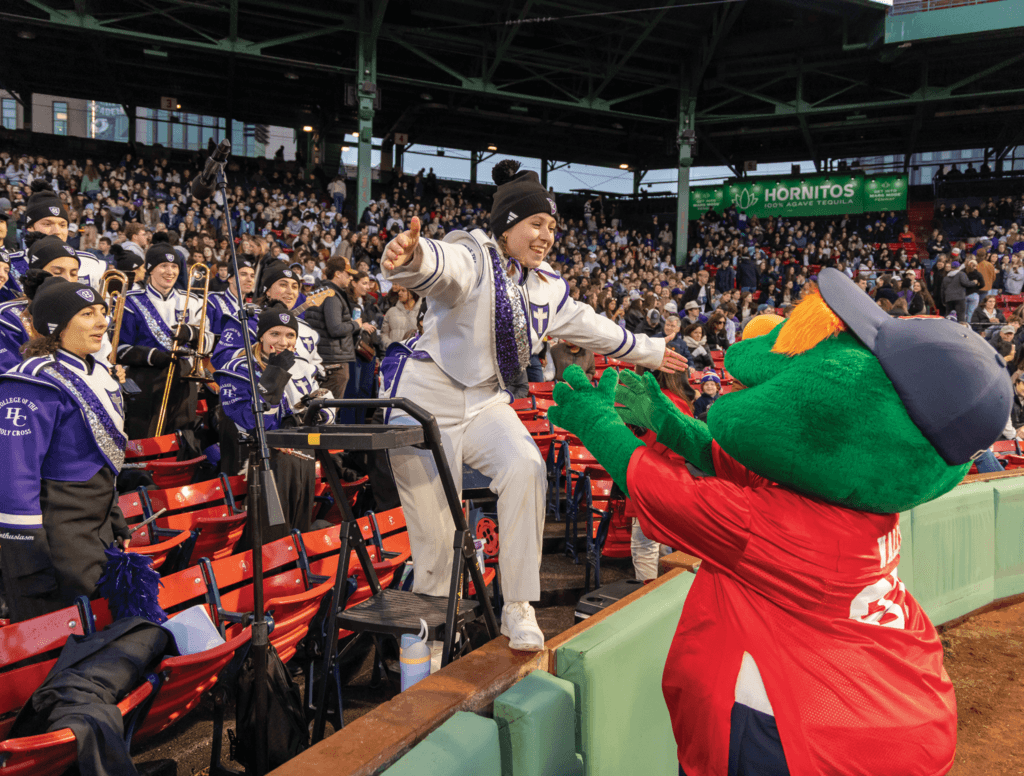
Drum major Ella Murray ’27 goes in for a hug with Wally the Green Monster at Fenway Park in November 2025.

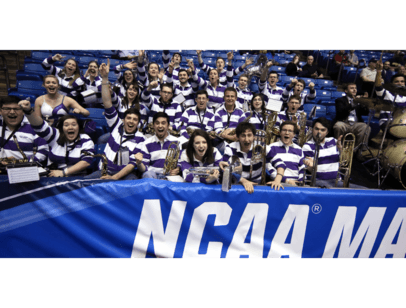
And, of course, there’s the women’s basketball team’s 2024 and 2026 appearances in the NCAA Tournament. Though Holy Cross basketball has made the tournament in the past – 15 times for the women’s team and 13 times for the men – it had been almost a decade since the band’s last trip. When women’s basketball punched a ticket to the tournament in 2024, ultimately taking on No. 1 seed Iowa and its superstar guard, Caitlin Clark, it was just after the band moved under OSI and spirit programs. To be invited along was a huge accomplishment for the now student-led group. 

“It was, like, if they’re gonna take us, we obviously have to show that we’re gonna bring the spirit,” says Telerski, then drum major. “We took it as a really important challenge as a group: How can we work together to build a setlist that we think best represents our talents, best represents the school and supports the women who are playing?” 

With barely 36 hours notice, the band and cheer flew to Iowa City. For five days, they hunkered down in the hotel ballroom to work on their routines — and also in the University of Iowa’s library to work on homework from the classes they were missing. When the band stepped into 15,000-seat Carver-Hawkeye Arena and a nationally televised game, they were a tiny dot of purple in a sea of Iowa yellow. 

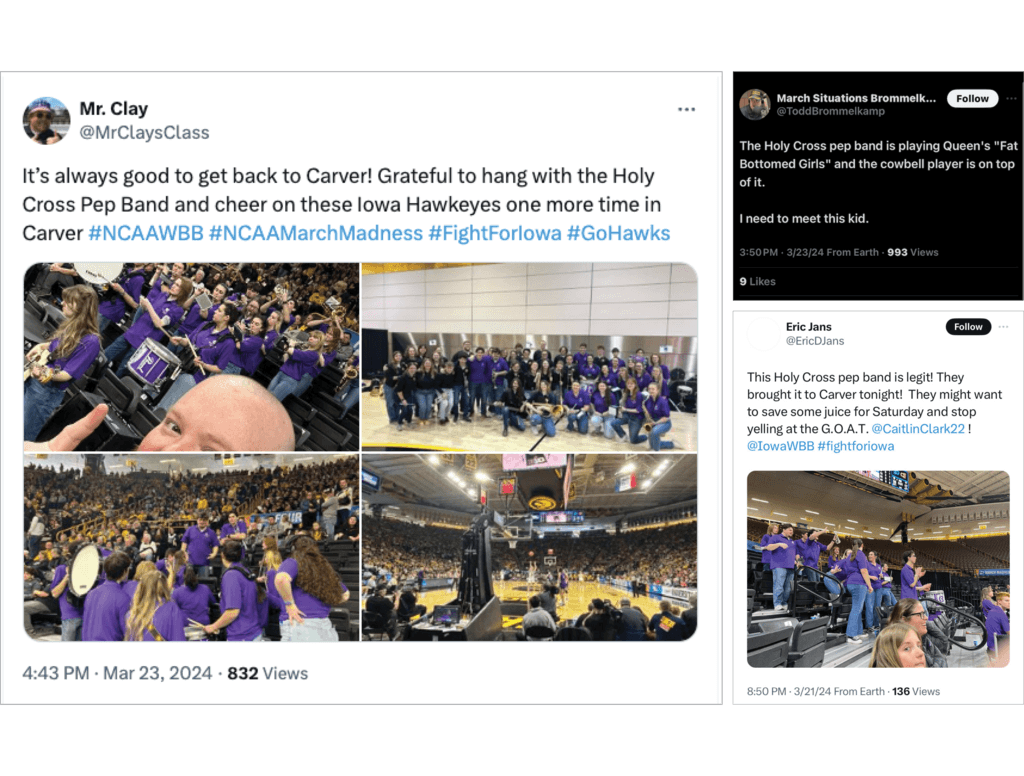
But that didn’t stop them. The 20-person band played as loud as they possibly could; members who were there note they were louder than Iowa’s pep band. Even Iowa fans were tweeting about how well Holy Cross’ band performed (and requesting “more cowbell”).

Image
Collage of tweets from Iowa fans
Even Iowa fans were impressed by the Bettertime Pep Band's spirit during the 2024 NCAA Women's Basketball Tournament.

“It was the biggest place we’ve probably played at, and we’re surrounded by Iowa fans, there’s people yelling at us, and it’s just crazy,” Gopoian recalls. “But it was still the most incredible experience. We sat there, we played our music, we had as much of a loud sound as we could, and people were really liking us, which was pretty fun. But, even if they didn’t, we were still having the time of our lives.” 

“If we show up loud, and if we show up big, no one’s gonna realize how small we are. We have to show the world that Holy Cross is small but mighty,” Telerski remembers thinking. “The women lost the game against Iowa, but everyone was so proud of them. They were so proud of themselves that they were able to show up in that way on a national stage. In a similar way, we were very proud of ourselves for showing up, bringing the energy, [and doing] whatever we can to represent this team and this school.”

Image
Pep band and President Rougeau in the stands Iowa
President Vincent D. Rougeau joined the Bettertime Pep Band for a photo at the 2024 NCAA Women’s Basketball Tournament in a sold-out Carver-Hawkeye arena.

Fast forward to March 2026, and the band was off to Michigan — another NCAA Tournament appearance and another large (14,000-seat) arena. A new city, a new team, a new set of challenges. With multiple members of the junior class studying abroad for the semester, only four members of the spring 2026 pep band had been to Iowa. But it provided a chance for new memories and a new story to tell. 

“The nature of our trip could have been so intimidating and so scary,” says Kelly, a sophomore when she played at the Iowa game. “But we all made it such a point to be together and present this united front the whole week. We all ended up closer than we’ve been this whole year.” 

“Even in a larger environment than the Hart, it just shows how talented they are as musicians, but also their community of working together,” Drew reflects. “The giant arena did not faze them at all.” 

“There’s something really cool about playing the songs of Holy Cross in the Michigan stadium,” Mann adds. “It’s like, ‘This is us now. Look at us.’”

BRINGING THE JOY 

Whether it’s a sold-out arena in Iowa, a sunny day at home on Fitton Field, or Move-In Day on a rainy Easy Street, there’s always one thing you can expect: the Goodtime Marching Band and the Bettertime Pep Band will live up to their name. 

A 1993 program for the band concert held to celebrate the College’s sesquicentennial defines the “good time” moniker: “The general attitude which distinguishes this fine organization here at Holy Cross.” 

Previously known under iterations such as the Purple Band and the Crusader Marching Band, the Goodtime Marching Band introduced a tradition in the 1970s of adding a new descriptor onto the name each year, typically an inside joke or reference decided by that year’s graduating class. Its current complete name features more than 50 additional descriptors. The Bettertime Pep Band, meanwhile, was known simply as the Pep Band until 2022, when the band decided to officially rebrand to reflect their spirit.

And that’s exactly what they bring to game day. 

“The band brings an element of life. There’s something different, having a live band there to react to whatever’s happening. I think that really brings life to the student section,” Gopoian says. “It’s electric, being on the field as somebody who’s not an athlete.”

“The band and spirit team played a vital role in shaping the gym atmosphere throughout our home playoff run and into March Madness,” says women’s basketball head coach Candice Green. “Their dedication and commitment to the overall game experience and support for our team did not go unnoticed. Their behind-the-scenes preparation and consistent output helped create an environment that elevated the excitement and energy of each game.” 

“We’re always cheering. We’re always happy, whether we’re winning or losing. We keep a fairly positive attitude. We have a great time,” Listengart adds. “And we cheer for our team, of course.”

At the core of what they do is joy.

Mackenzie Drew, assistant director of student involvement for spirit programs

“The role we play as part of the game day atmosphere and in support of the teams is really fun,” Murray says. “But we’re not just there for the sports team. I look at our show as something in itself. We’re also there to perform, and that’s why we try to do our best musically. We’re a value in and of ourselves.” 

“These are kids who truly love music, who love the arts, who love to showcase their talents,” says Dan Deedy ’80, a football season ticket holder whose father and uncle led the band as drum majors in the 1930s. “The showcase on the field or the basketball court, that’s why everyone buys tickets. But the other showcase is the band. For me, it’s theater in motion; it’s poetry in motion.”

Win or lose, the band is always playing, always performing. And it’s their love for the music and for each other that keeps them going. 

“The point of having the spirit programs, and especially the band, is to make everyone feel like they’re important here and they’re valued and that they’re part of the community,” Kelly says.

“At the core of what they do is joy. While it may seem really daunting to go spend eight hours on Fitton Field to do a football game, they are playing popular music for the fans to dance to; they have little kids that stand in the front and dance to their songs,” Drew explains. “They’re just joyful. School spirit is joyful – and that’s what they do.”

BAND ALWAYS WINS 

When the buzzer sounded in Michigan, only the winning team’s band was allowed to play. But the Bettertime Pep Band wasn’t going to let that stop them. Instead, members put down their instruments, put their arms around each other and started to sing the alma mater. Before the game, Mann made sure all members knew the words in the event of a loss, even though they’d typically be playing their instruments (or the fight song, played after a win). 

“The Michigan band was playing while we were singing it, but then it cut out and you could hear us all of a sudden,” Mann says. “It was really cool.”

Kelly admits to crying in that moment, but it wasn’t because the team lost. Rather, it was the culmination of four years of band and the knowledge that it was her last game as a member. 

“It was a full circle moment. We lost, but we’re all still in it together,” the senior says. “For that to be the way we close it out was really special.”

Losses on the scoreboard may matter in the sports world, but not to the band. What matters most, they say, is that they’re doing their best and having fun in the process. 

“Holy Cross spirit and our love for our school and our pride for our school, which is what we stand for – that will never die,” Mann says. 

“Regardless of what happened with the team, we still got to go as this teeny tiny marching band and play in this big arena,” Kelly adds. “And we sounded so strong and we sounded so good. That’s a win.” 

After all, band always wins.