'That’s What I’m Proud Of, Living in Worcester'

People standing in an old mill building
Dan Ricciardi '06 takes Professor Mary Conley, Natalie Denon '28, Kate Santini 27 and others on a tour of the Whittall Mills site.

How four students built a new relationship with Worcester after spending the summer researching the city.

For most college students, “summer vacation” conjures up images of endless sunshine, catching up with hometown friends, maybe a beach or two. Less so concrete city streets, empty mill buildings and dusty archives.

But for four members of the College’s Weiss Summer Research Program, it meant exactly that.

English majors Alyssa Daly ’28 and Dan Rentel ’27 and history majors Natalie Denon ’28 and Kate Santini ’27 spent their summer assisting professors with research projects centered around Worcester. These projects were also an opportunity to dive into the rich history and culture the city has to offer.

Working alongside Susan Elizabeth Sweeney, distinguished professor of arts and humanities, Daly and Rentel organized, digitized and catalogued materials for the Worcester Poetry Archive, as well as supported Sweeney’s work guest editing an issue of the Worcester Review, a poetry journal in Worcester.
Image
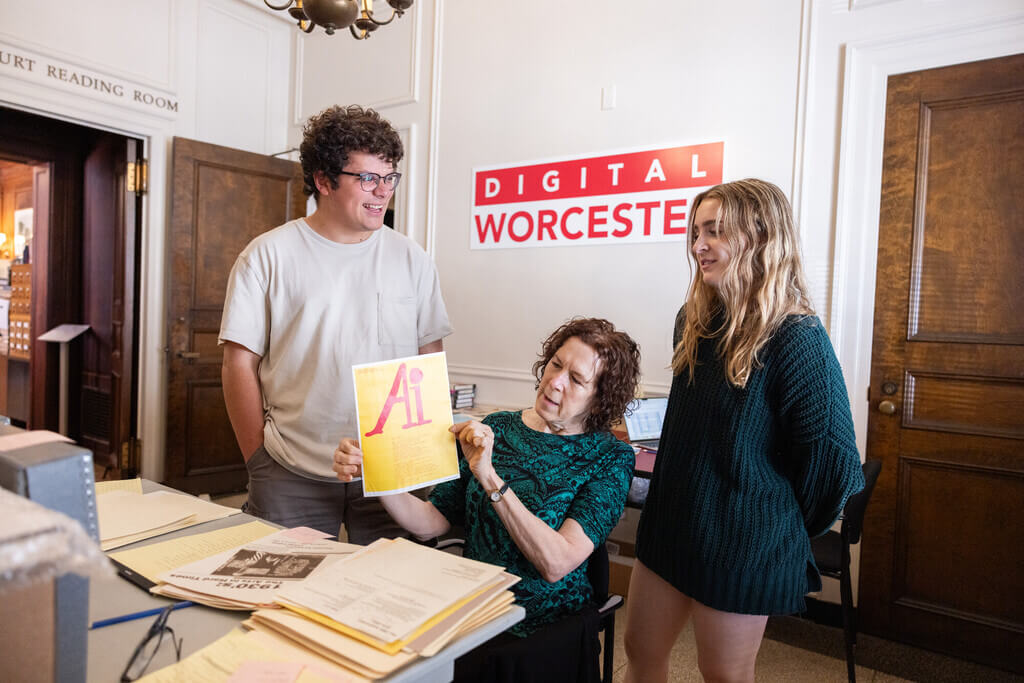
Two students and a professor looking at archival materials
Dan Rentel ’27, Professor Susan Elizabeth Sweeney and Alyssa Daly ’28 reviewing materials for the Worcester Poetry Archive in the Museum of Worcester.


“Worcester has an abnormally large number of really great poets,” explained Rentel, citing historic figures Elizabeth Bishop and Stanley Kunitz, and contemporary poets such as John Hodgen, as examples. “That's left a legacy, and there are a lot of poetry groups in Worcester.” 

Most of the pair’s work was completed downtown at the Museum of Worcester, home to the poetry archive, but they also attended poetry groups and open mic nights to immerse themselves in this notable part of Worcester culture, as well as talk directly to some of the poets whose work they were archiving.
Image
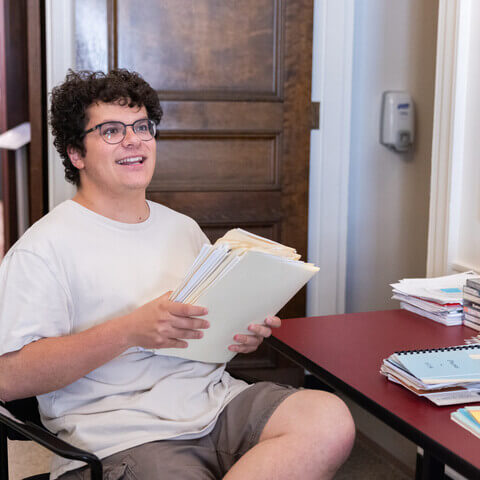
Dan Rentel
"I'd never really been around Worcester before, so it was almost an intensive on Worcester history," said Rentel.

“I was really interested in the sense of community that emerges. I think we live in a real isolated time and I'm interested in how people make and maintain connections in the modern age,” Rentel said. “I find it really easy to just stay in my room all day. This research helped me with this, but I want to get out of my room and have new experiences. I'd never really been around Worcester before, so it was almost an intensive on Worcester history.”

Meanwhile, Denon and Santini collaborated with Mary Conley, associate professor of history, and Stephanie Yuhl, W. Arthur Garrity, Sr. Professor in Human Nature, Ethics and Society, on research for a course Conley and Yuhl are teaching this fall on the history of South Worcester. The group collected information and created a digital archive on Whittall Mills, a historic site that was home to a prominent carpet factory from 1880 to 1956, in order to examine immigration and industrialization during that period.

“I would say [Conley and Yuhl are] using the mill as an example of broader historical trends going on at the time, especially with industrialization, the rise of unions, things like that,” Santini explained. “We tried to segment our research into different categories that we can envision a class being taught about. For example, one of them was looking at labor tensions, and I found a lot of newspaper clippings and articles on a 1921 strike. So [we were] looking at the employer-employee relations and how that embodied the general trends of the time, and trying to zoom out a little bit and say, ‘OK, why is this significant in broader terms?’”

Their research took them into the world of church records and archives, census databases, old issues of the Telegram & Gazette, tours of old mill buildings, and conversations with neighbors to piece together what it was like to live and work during the Whittall Mills era as a factory employee, many of whom were English immigrants. Like Daly and Rentel, Denon and Santini were thrilled about how eager people were to help, whether it was community members in the neighborhoods they visited or staff at the Worcester Public Library or Museum of Worcester.

“They want to showcase their history because they're so proud of their city,” Denon said. “And that's what I'm proud of, to be living in Worcester. I will defend it till I die.”

Image
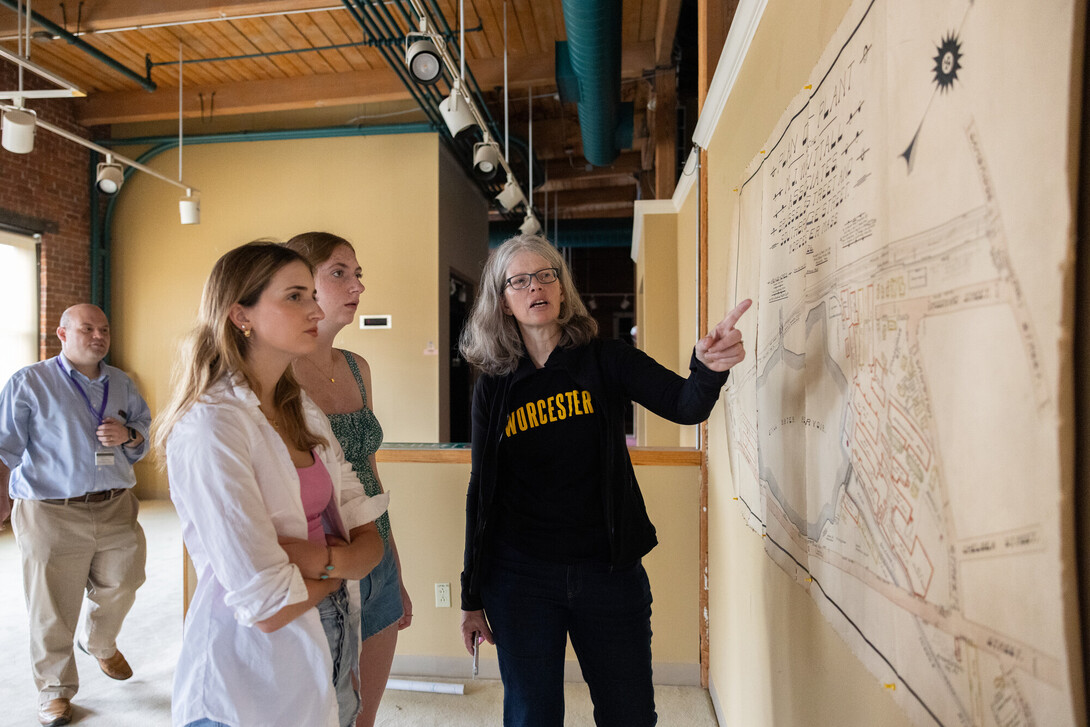
Professor pointing at a map with two students looking on
Kate Santini ’27, Natalie Denon ’28 and Professor Mary Conley look at plans for the Whittall Mills from 1926.
Image
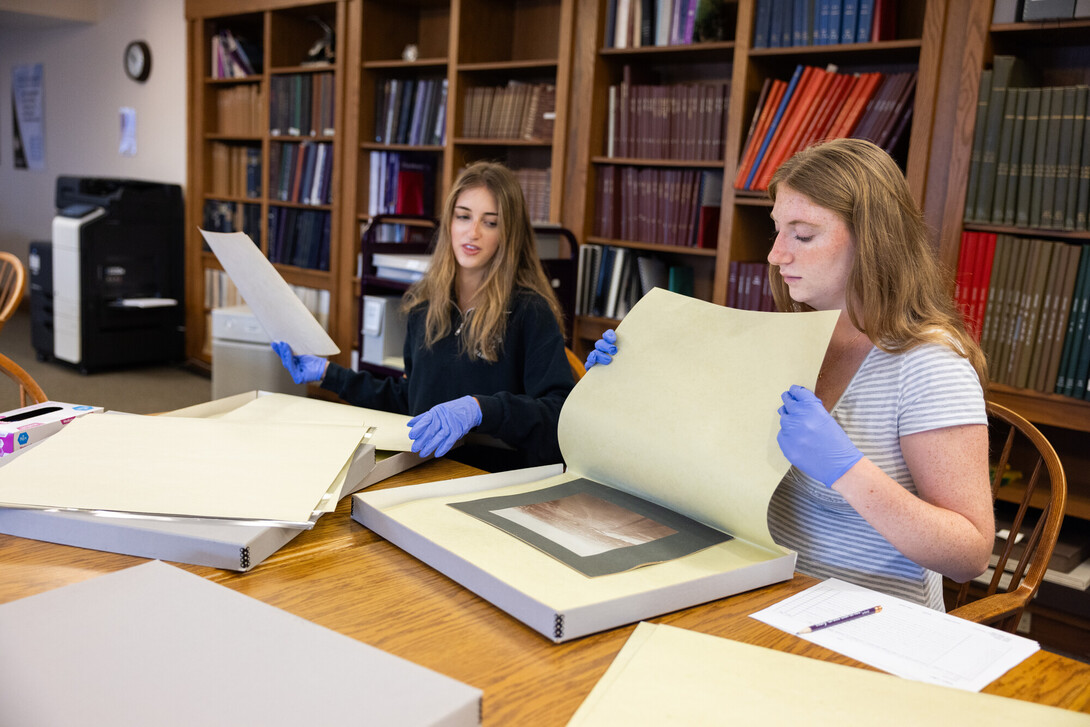
Two students looking at archival materials
Santini and Denon look through archival materials in College Archives and Distinctive Collections.

All four students said they also discovered a newfound appreciation for the city, which previously they had little opportunity to explore beyond coffee shop visits or scheduled volunteer work through service opportunities or a community-based learning course. 

“This project definitely got me a lot more immersed in Worcester,” Santini said. “Exploring these sites definitely had a lot of significance, because I wouldn't have thought to go there in other circumstances.”

“I did develop a lot of appreciation for it, and I really was moved by a lot of what I learned about Worcester history and the culture here,” Rentel agreed.

Even Daly, a Worcester native, realized there was so much more to her hometown than she knew.

“It was a really interesting thing, being able to learn more about my hometown and the institutions that exist here,” she said. “I became very aware of how unaware I'd once been. There was one poet who ran a Worcester youth poetry thing, like, a block away from my house, at the Worcester Youth Center when I was a kid, and I was like, I never knew about this. 

“I definitely feel more formally involved with the city and with its literary history,” Daly noted. “I plan on continuing to volunteer at the Worcester Poetry Archive. I just feel more committed to the place where I grew up, and I feel like I still have something to offer.”

The students also realized the abundance of resources and depths of research that New England’s second largest city has to offer.

“Everyone's drawn to Boston or New York, but a lot of that stuff has been done before. Not as much research has been done into Worcester,” Santini said. “You have more of an opportunity to make an impact when you're researching something more specific in a less-studied area. There's a lot of value to that because you feel like you're really contributing something to what's out there.”

“I've always loved Worcester, and I've always thought it offered so much. Doing this research over the summer, like, confirmed what I'd always believed, but never really been able to verbalize,” Daly said. “It gave me hard proof that Worcester is awesome.”